In this guide
- What goes into a steel water tank vs plastic cost comparison?
- How long does a water storage tank actually last?
- Does stainless steel rust near the Kerala coast?
- What does your water source change?
- What protects water quality, whatever tank you buy?
- Which water tank offers better value over 15 years?
- Who should not buy a stainless steel tank?
- What should you ask before you pay?
- Your 15-year water tank buying checklist
- Still have a question?
- Cite-as
- Frequently asked questions
Short answer:
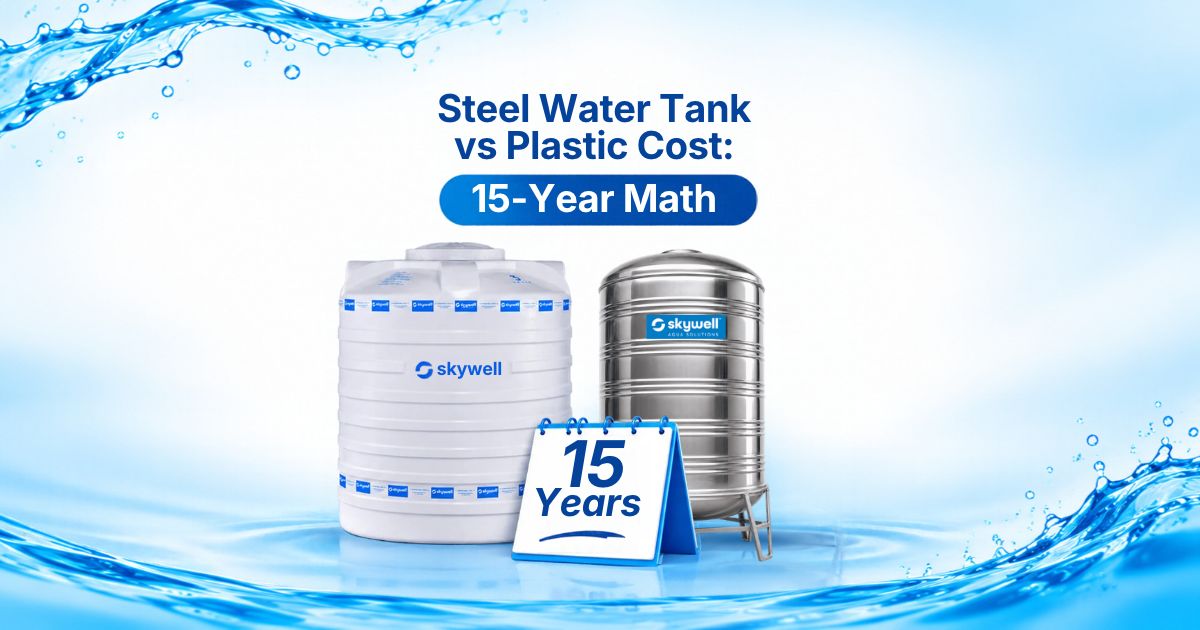
Steel water tank vs plastic cost depends on how long you plan to use the tank, its purchase and installation costs, maintenance requirements, and whether either option needs replacement during that period. Stainless steel can make financial sense over a longer ownership period, but a good plastic tank may be more economical when your budget or time horizon is limited.
Key takeaways
- Compare total ownership cost, not just the purchase price.
- Include installation, cleaning, repairs and possible replacement.
- SS-304 suits many inland applications, subject to local conditions.
- SS-316 is preferable in aggressive coastal environments.
- A 10-year warranty does not guarantee a 10-year service life.
Want to compare actual tank prices? Share your district and required capacity with Skywell on WhatsApp to request a written quotation.
What goes into a steel water tank vs plastic cost comparison?
A meaningful steel water tank vs plastic cost comparison includes every major expense throughout your expected ownership period. Purchase price is only the starting point.
Most buyers compare two prices at the counter. That takes thirty seconds and can influence a decision lasting many years.
A better approach is to prepare a simple ownership-cost sheet.
Five costs you should include
Use written quotations and realistic estimates rather than relying on old prices or assumptions.
| Cost line | What to record | Where to get the figure |
|---|---|---|
| Purchase | Actual tank price | Written supplier quotation |
| Installation | Installation and platform cost | Dealer or mason estimate |
| Cleaning | Annual cleaning expense | Your maintenance routine |
| Repairs | Fittings, valves and other repairs | Plumber estimate |
| Replacement | Number of replacements | Your expected ownership period |
Add these expenses together to calculate your estimated total ownership cost.
Then divide the total by the number of years you expect to use the tank.
Annual ownership cost = Total estimated cost ÷ Years of ownership
For example, if a household expects to own a property for 15 years, it should compare all expenses within that period rather than assuming both tanks will last equally long.
Do not automatically assign a replacement date to either material. Actual service life depends on construction quality, installation, maintenance and environmental exposure.
Why replacement costs matter
A lower-priced tank may become more expensive if it requires replacement during your ownership period.
Similarly, a higher-priced stainless steel tank does not automatically become economical simply because it is made from metal.
The deciding factor is the difference between the complete ownership costs.
Skywell prices are quotation-based. You can request a written figure for your required capacity and location before completing your comparison.
How long does a water storage tank actually last?
There is no universally reliable service-life figure for every stainless steel or plastic water tank. Material grade, manufacturing quality, exposure and maintenance all influence durability.
Homeowners often encounter advertised lifespans ranging from 10 years to 30 years or more.
These figures should be treated carefully. Manufacturer estimates are not equivalent to independently verified service-life studies under Kerala rooftop conditions.
What does the BIS standard say about plastic tanks?
IS 12701:1996 covers rotationally moulded polyethylene water storage tanks.
The standard specifies material and manufacturing requirements, including carbon-black content for outdoor tanks.
The standard specifies carbon-black content of 2.0–3.0% for relevant outdoor polyethylene tank material. It also restricts the use of external recycled waste material while permitting specified manufacturer-generated reworked material within its limits.
Source: IS 12701:1996, Bureau of Indian Standards.
This distinction matters when comparing ordinary plastic tanks with properly manufactured, UV-stabilised products.
Ask your supplier about the material composition and applicable product-standard compliance rather than relying only on colour or appearance.
What does outdoor exposure do to plastic?
Research indicates that prolonged outdoor exposure can change the mechanical properties of high-density polyethylene (HDPE).
A 2022 study, published in Materials, examined four years of outdoor weathering across several polymers. The researchers recorded a reduction in HDPE fracture strain from approximately 897% to 175%.
Source: Analysis of Mechanical Property Degradation of Outdoor Weather-Exposed Polymers, 2022, PMC8782030.
However, laboratory specimens are not complete water tanks.
These results demonstrate material changes under the study conditions. They do not establish that a household tank will fail after four years.
Kerala’s rooftop conditions also involve factors such as temperature variation, rainfall, installation conditions and exposure.
What determines stainless steel durability?
For stainless steel tanks, two important specifications are material grade and sheet thickness.
AISI 304 and AISI 316 are different stainless steel grades with different corrosion-resistance characteristics.
A supplier should identify the actual water-contact material on the quotation.
Do not compare two stainless steel tanks based on appearance alone. Ask about grade, thickness, fabrication quality and the treatment of welded areas.
Durability depends on specifications and conditions, not simply on whether a tank is called steel or plastic.
Does stainless steel rust near the Kerala coast?
Yes, stainless steel can develop surface staining or corrosion in marine environments. The risk depends on the grade, salt exposure, surface finish and maintenance.
This is particularly important for Kerala homeowners living close to the sea.
The Australian Stainless Steel Development Association recommends grade 316, or equivalent corrosion resistance, within approximately five kilometres of the surf. It also explains that grade 304 is more vulnerable in marine conditions.
Source: ASSDA, Technical FAQ 6, Preventing Coastal Corrosion (Tea Staining).
Why does grade selection matter?
SS-304 is widely used for general stainless steel applications.
However, coastal environments expose metal surfaces to airborne salt and moisture. These conditions can increase the risk of tea staining and more serious corrosion.
Tea staining is a brown surface discolouration caused by corrosion. ASSDA explains that it is generally cosmetic, although more serious corrosion can occur under aggressive conditions.
The distance from the sea is not the only consideration. Wind direction, shelter, humidity and whether rain regularly washes the surface also matter.
Which grade should you consider in Kerala?
| Location or exposure | Grade to consider | Important consideration |
|---|---|---|
| Inland Palakkad | SS-304 | Check actual exposure and specifications |
| Inland Thrissur | SS-304 | Consider local environmental conditions |
| Coastal Kollam | SS-316 | Higher marine corrosion resistance |
| Coastal Alappuzha | SS-316 | Salt exposure needs consideration |
| Coastal Kannur | SS-316 | Confirm grade in writing |
This is a practical starting point, not a universal geographic classification. Some inland locations can experience aggressive exposure, while sheltered coastal locations may have different conditions.
For a coastal installation, ask for SS-316 in writing rather than assuming the grade from the product description.
Considering a stainless steel tank for your home? Ask Skywell about SS-304 and SS-316 availability and obtain a quotation based on your installation location.
What does your water source change?
Your water source affects how much storage capacity you need, how frequently the tank refills and how you plan your overall water-storage system.
Kerala households do not depend on a single water source.
According to the Kerala State Planning Board’s Economic Review 2014, 62% of households depended on wells for drinking water, while 29.3% received tap water through the supply network.
Source: Kerala State Planning Board, Economic Review 2014.
These are historical figures, not current household statistics. They nevertheless illustrate why water-storage planning in Kerala must consider different supply arrangements.
Well water and borewell supply
If your home depends on a well or borewell, consider the refill rate before selecting tank capacity.
A slow-refilling source may require a larger storage buffer than a reliable piped connection.
During summer, some households may experience longer gaps between water availability. Your storage requirement should account for those periods.
Piped water supply
If your home receives municipal or Kerala Water Authority supply, consider the frequency and reliability of the connection.
A steady supply may allow a different storage arrangement from a household receiving water intermittently.
Underground storage is a separate requirement
Do not confuse an overhead water tank with an underground sump.
IS 12701:1996 addresses rotationally moulded polyethylene storage tanks and excludes underground applications.
Underground storage generally requires an appropriately designed RCC sump or another purpose-built system.
The correct storage solution depends on your property and construction requirements.
For more guidance on choosing capacity, read our article on what size water tank you need for your home in Kerala.
What protects water quality, whatever tank you buy?
Proper covering, cleaning, inspection and hygienic water handling matter regardless of whether you choose stainless steel or plastic.
The tank material alone does not determine the cleanliness of stored water.
The World Health Organization recommends suitable household water-storage practices, including covered containers and hygienic handling.
Source: WHO, Technical Fact Sheet on Household Water Practices, 2020.
WHO guidance on cleaning and disinfecting water-storage tanks also highlights the importance of safe access for inspection and cleaning.
Source: WHO, Technical Note TN-03, Cleaning and Disinfecting Water Storage Tanks and Tankers.
Practical maintenance measures
- Keep the tank securely covered.
- Inspect the lid and access opening regularly.
- Clean the tank according to your maintenance schedule.
- Check inlet, outlet and overflow connections.
- Inspect the installation platform for visible damage.
- Avoid unsuitable cleaning chemicals or abrasive materials.
Stainless steel and plastic tanks both require appropriate maintenance.
For more practical advice, read our guide to water tank maintenance in Kerala.
Which water tank offers better value over 15 years?
Neither material automatically wins every 15-year comparison. The better-value option depends on your actual quotations, expected maintenance and replacement requirements.
Consider these differences before deciding.
| Comparison factor | Stainless steel tank | Plastic tank |
|---|---|---|
| Initial purchase | Generally higher | Generally lower |
| Material | Stainless steel grade such as SS-304 or SS-316 | Polyethylene |
| Weight | Heavier construction | Generally lighter |
| Coastal exposure | Grade selection is important | Different material-related exposure considerations |
| Installation | Requires suitable structural support | Requires suitable support |
| Maintenance | Cleaning and inspection required | Cleaning and inspection required |
| Replacement cost | Depends on model and quotation | Depends on model and quotation |
| Warranty | Check manufacturing-defect coverage | Check manufacturing-defect coverage |
Consider the ownership period
A homeowner planning to remain in the same property for 15 years may evaluate a higher initial investment differently from someone planning to sell within three years.
However, do not assume that stainless steel will automatically outlast plastic in every installation.
The actual outcome depends on specifications and operating conditions.
Consider the warranty separately
Skywell offers a 10-year warranty on its stainless steel and plastic water tanks.
For stainless steel products, manufacturing-defect coverage and model-specific terms should be confirmed at quotation stage.
A warranty is a contractual commitment, not a prediction of the exact service life.
Always ask what is covered, what is excluded and what documentation is needed to make a claim.
For a broader material comparison, see stainless steel vs plastic water tanks in Kerala.
Who should not buy a stainless steel tank?
A stainless steel tank is not the right choice for every homeowner. There are situations where purchasing a good plastic tank is the more practical decision.
Four cases deserve particular attention.
1. You plan to move within a few years
If you expect to sell or rebuild your property soon, you may not benefit from a higher initial investment intended for long-term ownership.
Your actual ownership period should determine the calculation.
2. Your budget is fixed and limited
A good UV-stabilised plastic tank can be a sensible choice when affordability is the main consideration.
There is no reason to stretch your household budget simply to purchase stainless steel.
Skywell manufactures both stainless steel and plastic water tanks.
3. Your terrace needs structural work
Do not install a heavy water tank on a terrace without checking whether the supporting structure is suitable.
The platform and structural requirements should be assessed before installation.
A tank purchase should never take priority over structural safety.
4. You need underground water storage
An overhead stainless steel or plastic tank is not a substitute for a properly designed underground sump.
Discuss underground storage with a qualified construction professional.
Stainless steel is not automatically the right investment. The product must suit your actual requirements.
What should you ask before you pay?
Before purchasing a water tank, obtain written answers to four important questions.
- Which material grade will come into contact with the stored water? Is it specified on the quotation?
- Can the supplier provide a material test certificate identifying the stainless steel grade and relevant sheet details?
- What exactly does the warranty cover, and what are its exclusions and claim conditions?
- Who handles installation and after-sales service if a fitting or weld develops a problem?
These questions apply especially when comparing two quotations that appear similar in price.
What does Skywell offer?
Skywell Aqua Solutions manufactures stainless steel and plastic water tanks at its ISO 9001:2015 certified manufacturing plant in Kanjikode, Palakkad, Kerala.
The stainless steel range uses food-grade AISI 304 (SS-304), with SS-316 available on request.
Available stainless steel capacities include:
| Capacity | Available configuration |
|---|---|
| 500 L | Vertical and horizontal |
| 1,000 L | Vertical and horizontal |
| 1,500 L | Vertical and horizontal |
| 2,000 L | Vertical and horizontal |
| 3,000 L | Vertical and horizontal |
| 5,000 L | Vertical and horizontal |
Skywell also manufactures plastic water tanks using a food-grade 100% virgin polyethylene inner layer and three-layer UV-stabilised construction.
Plastic tank capacities range from 500 L to 10,000 L.
Both product ranges carry a 10-year warranty, subject to the applicable model-specific terms.
Manufacturing, product specifications and warranty coverage should be considered separately when evaluating a purchase.
Compare before committing. If you are unsure about the grade or capacity, contact Skywell for a water tank quotation.
Your 15-year water tank buying checklist
Take these five questions to your plumber, supplier or installation professional before placing an order.
- What is my actual water-storage requirement based on household use and supply reliability?
- Is the quoted tank suitable for my location, especially if my home is near the coast?
- Does the quotation clearly specify the material, capacity and installation requirements?
- What are the complete purchase, installation and expected maintenance costs?
- What does the written warranty cover, and who provides after-sales service?
Keep both quotations and compare them using the same capacity and ownership period.
This makes the decision more meaningful than comparing two different products using only their initial prices.
Skywell Aqua Solutions makes food-grade stainless steel and plastic water tanks in Palakkad, Kerala.
Not sure which tank suits your home? Message us on WhatsApp for free, honest advice.
Still have a question?
Share your district, required capacity and water source with Skywell. The team can help you understand the available options and request a quotation.
Cite-as
Cite as: skywell.in/steel-water-tank-vs-plastic-cost/
Frequently asked questions
Is a steel water tank worth the extra cost?
A steel water tank may be worth the extra cost if you plan to use it for a sufficiently long period and its specifications suit your location. Compare purchase, installation, cleaning, repairs and possible replacements over your expected ownership period. A good plastic tank may be more economical when your budget is limited or you plan to move soon.
How long do stainless steel water tanks last?
Stainless steel water tank service life depends on material grade, sheet thickness, fabrication quality, installation and environmental exposure. Published manufacturer estimates vary considerably and should not be treated as independently verified lifespans. Ask for the material grade, sheet specifications and warranty conditions before purchasing a stainless steel water tank.
Does SS-304 rust near the sea in Kerala?
SS-304 can develop tea staining or more serious corrosion under aggressive marine exposure. The Australian Stainless Steel Development Association recommends SS-316 or equivalent corrosion resistance within approximately five kilometres of the surf. Coastal homeowners in Kerala should consider local salt exposure and request the specified stainless steel grade in writing.
What is the difference between SS-304 and SS-316 water tanks?
SS-304 and SS-316 are stainless steel grades with different corrosion-resistance characteristics. SS-316 generally performs better in marine environments because of its higher alloying content, including molybdenum. SS-304 is commonly used for many inland applications. The appropriate grade depends on environmental exposure, fabrication and maintenance requirements.
What size stainless steel tank does a home need?
The correct stainless steel tank capacity depends on household water consumption, the number of occupants, bathrooms and the reliability of the water source. Skywell manufactures stainless steel tanks from 500 L to 5,000 L in vertical and horizontal configurations. A household relying on a slow-refilling well may need a different storage buffer from one receiving a reliable piped supply.
Can a plastic water tank be used underground?
IS 12701:1996 covers rotationally moulded polyethylene water-storage tanks and excludes underground applications. An underground sump generally requires an appropriately designed RCC structure or another purpose-built storage system. Homeowners planning underground storage should consult a qualified construction professional rather than installing an ordinary overhead plastic water tank below ground.
What does the 10-year Skywell water tank warranty cover?
Skywell offers a 10-year warranty on its stainless steel and plastic water tanks. The applicable coverage, exclusions and conditions depend on the product model and should be confirmed in writing at the quotation stage. Keep your purchase invoice and warranty documentation, and ask the supplier about the process for reporting manufacturing defects.
Can I get a water tank price on WhatsApp?
Yes. You can request a Skywell water tank quotation through WhatsApp. Share your district, required tank capacity and whether you need an overhead or other storage arrangement. Skywell can provide a quotation based on the product specifications and your requirements, allowing you to compare the purchase price with other ownership costs.