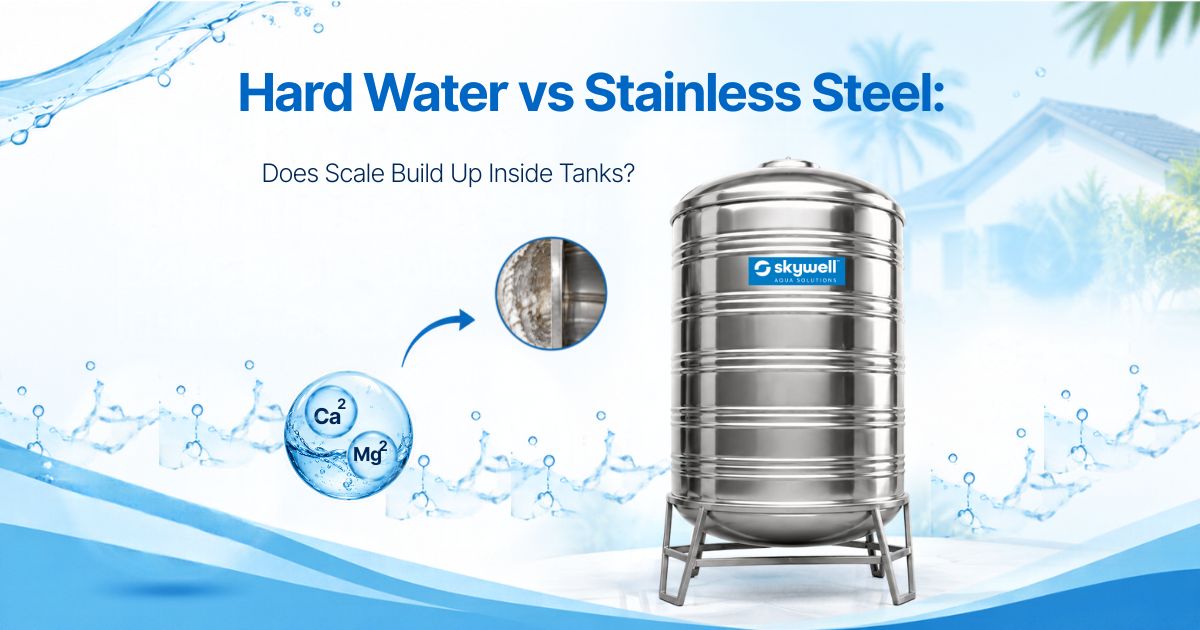
Short answer: A hard water stainless steel tank can develop mineral scale because stainless steel does not remove calcium or magnesium from stored water. Scale formation depends on water chemistry and conditions inside the tank. For a Kerala home, testing your actual water source is more useful than assuming every hard-water area behaves the same way.
In this guide
- Does hard water cause scale inside a stainless steel tank?
- How hard is your water?
- Why should Palakkad homeowners check their actual water?
- Does stainless steel make hard water softer?
- Is scale the same as rust?
- What should you check before choosing a stainless steel tank?
- Who should not buy a stainless steel tank?
- How should you maintain a stainless steel tank with hard water?
- What is the practical answer for a Kerala home?
- Still have a question?
- Frequently asked questions
Key takeaways
- Hard water can leave mineral deposits on stainless steel surfaces.
- SS-304 stores water but does not soften it.
- Kerala groundwater hardness varies between sampled locations.
- Scale and corrosion are different problems with different causes.
- A water test is more useful than judging hardness by district.
If your overhead tank is the last stop before water reaches your kitchen, the material matters, but the water entering it matters too.
A white crust around a tap, kettle or bathroom fitting is a familiar sign of mineral deposits. Similar deposits can form on a stainless steel surface when the water chemistry and conditions allow scaling.
That does not mean every stainless steel tank will develop heavy scale. It means you should not choose stainless steel on the assumption that its surface makes hard water harmless or completely scale-free.
A 2025 study examined calcium carbonate scaling on 304 stainless steel and found that surface finish influenced scale formation and adhesion. The experiment was performed under controlled industrial conditions, so it is evidence that scaling can occur on 304 stainless steel, not a measurement of what happens inside every Kerala household tank. Evaluation of the Surface Finish on 304 Stainless Steel as a Way to Mitigate Calcium Carbonate Scaling
The practical point is simple: hard water and stainless steel can coexist, but stainless steel is not a water-softening system.
If you are comparing materials, you can also read our guide to stainless steel versus plastic water tanks in Kerala before making the final choice.
Message Skywell on WhatsApp if you want to discuss your water source and tank application before ordering: https://wa.me/916238801881?text=Hi%20Skywell%2C%20I%20would%20like%20a%20quote%20for%20a%20water%20tank.
Does hard water cause scale inside a stainless steel tank?
Yes, hard water can contribute to mineral scale inside a stainless steel tank. Dissolved calcium and magnesium can contribute to deposits when the water chemistry and operating conditions favour mineral precipitation.
A stainless steel surface does not remove those dissolved minerals. The same basic chemistry that can leave deposits around taps, kettles and pipes can also affect surfaces inside a storage tank.
The 2025 304 stainless steel study found that surface finish affected calcium carbonate scaling and adhesion under controlled experimental conditions. Its industrial test conditions mean the findings should not be presented as a direct prediction for a cold household tank in Kerala. 2025 study on calcium carbonate scaling and 304 stainless steel
That distinction matters because a homeowner needs practical information, not a promise that a particular material can never develop deposits.
I would therefore avoid the claim that SS-304 means “no scale”. The more accurate statement is that SS-304 can be used for water storage while the hardness of the incoming water remains a separate consideration.
How hard is your water?
For drinking water, BIS IS 10500:2012 specifies total hardness of 200 mg/L as CaCO₃ as the acceptable limit and 600 mg/L as the permissible limit where an alternate source is unavailable. These are drinking-water quality specifications, not a guaranteed threshold for tank scale formation. IS 10500:2012 drinking-water standard text
Kerala groundwater data also shows why a district name should not be treated as a water-quality test.
The Central Ground Water Board’s 2023 Kerala assessment recorded 7 sampled locations in Palakkad and 3 sampled locations in Thrissur with total hardness above 200 mg/L. These are sampled locations, not percentages of households, wells or properties in those districts.
| What you are checking | Evidence or interpretation |
|---|---|
| BIS acceptable total hardness | 200 mg/L as CaCO₃ |
| BIS permissible limit where no alternate source exists | 600 mg/L as CaCO₃ |
| Palakkad sampled locations above 200 mg/L | 7 locations |
| Thrissur sampled locations above 200 mg/L | 3 locations |
| Does hardness guarantee tank scale? | No; water chemistry and conditions also matter |
These figures should be read as evidence from specified standards and sampled locations, not as a description of every Kerala household.
The practical step is to test the water entering your house if hardness is a concern. Kerala Water Authority says its laboratories test total hardness, calcium and magnesium among other water-quality parameters, and its current quality-control page states that public water samples are also tested after payment of the applicable testing fee.
Why should Palakkad homeowners check their actual water?
Palakkad is a useful example of why the district name alone cannot tell you how hard your household water is. Groundwater chemistry can vary substantially between locations.
The Central Ground Water Board’s 2024 Aquifer Management Plan for the Kanjikode Industrial Area, Palakkad District, Kerala, is specifically identified as a 2024 publication in the CGWB repository.
The draft cites a hardness range of 23.2 to 915.8 mg/L in the Kanjikode groundwater dataset. Because that figure comes from a particular groundwater assessment, it should not be interpreted as the hardness of every home in Kanjikode or Palakkad.
Your neighbour’s borewell water and your well water can therefore have different chemistry. A Kerala Water Authority connection is also a different source from a private borewell.
If you are building a house in Kanjikode, do not tell the plumber, “Palakkad water is hard, so choose this tank.” Ask for the source water to be tested instead.
For broader maintenance guidance, see our guide to water tank maintenance in Kerala.
Does stainless steel make hard water softer?
No. A stainless steel tank stores the water you put into it; it does not function as a water softener.
Skywell’s stainless steel range uses food-grade AISI 304 stainless steel and is available in capacities from 500 litres to 5,000 litres. Those are product specifications, not a claim that the tank removes calcium or magnesium from water. Skywell stainless steel water tanks
If your borewell or well water has high hardness, changing the storage tank does not remove the calcium and magnesium already dissolved in that water.
Water treatment is a separate question. Depending on the source and test results, you may need to investigate treatment independently from the storage decision.
Capacity comes first. Material comes after. Water treatment is a separate decision.
If you already know your water source and approximate tank capacity, you can review the different stainless steel tank options from Skywell before speaking with your plumber.
Is scale the same as rust?
No. Scale is a mineral deposit, while corrosion is deterioration involving the metal and its environment.
This distinction matters in Kerala because coastal exposure can introduce additional corrosion considerations. The British Stainless Steel Association states that 304 and 316 stainless steels are generally suitable for storing and handling cold or unheated drinking water when tanks are properly designed, fabricated and finished. It also identifies factors including chlorides, temperature, oxygen and stress in corrosion behaviour.
A separate 2023 laboratory study examined calcium carbonate deposits on 310S stainless steel under hot-water conditions. Because that experiment used 80°C water and 310S rather than a normal cold household tank using SS-304, it should not be treated as a direct model of an overhead tank in Kerala.
That limitation matters. Industrial or hot-water research can demonstrate that scaling or corrosion mechanisms are possible, but it does not establish how quickly a particular household tank will develop deposits.
Coastal exposure also does not automatically mean that a stainless steel tank will fail. Water chemistry, chloride exposure, design, fabrication and surface condition all influence corrosion behaviour.
What should you check before choosing a stainless steel tank?
Before ordering, check the water source, test results, stainless grade, installation access and surrounding conditions. These questions help separate the storage decision from the water-treatment decision.
- What is the water source: well, borewell, rainwater system or Kerala Water Authority supply?
- Has the source water been tested for total hardness?
- What stainless grade is actually being supplied?
- Can the tank be inspected, drained and flushed after installation?
- Is the installation exposed to coastal air or other chloride sources?
- Can your plumber access the inlet, outlet, overflow and drain connections after installation?
The coastal question deserves particular attention for homes in areas such as Kollam, Alappuzha, Kozhikode or Kannur. Coastal exposure does not automatically make SS-304 unsuitable, but chloride conditions and tank design should be considered rather than ignored.
Skywell’s stainless steel tanks are specified as food-grade AISI 304 stainless steel, with capacities from 500 litres to 5,000 litres. The product information also describes an accessible lid and drain valve for inspection, emptying and flushing. Skywell stainless steel tank specifications
The material should suit your use case. The capacity should suit your water requirement. The installation should allow practical inspection and maintenance.
Who should not buy a stainless steel tank?
Do not choose stainless steel solely because you believe hard water cannot leave deposits on it. Stainless steel is not a substitute for testing or treating hard source water.
A stainless steel tank may also be the wrong choice if your household has a tight budget and another suitable tank already meets your storage requirements. Likewise, unresolved structural, plumbing or access problems should be addressed before changing tank material.
Skywell states that its stainless steel tanks carry a 10-year warranty and are manufactured at its Kanjikode, Palakkad facility. Its published product information specifies food-grade AISI 304 stainless steel. Skywell About Us
Those product facts may be relevant if you specifically want food-grade AISI 304 construction and the associated product specifications. They do not mean stainless steel is automatically the right choice for every home.
The tank should fit the house, not the other way around.
How should you maintain a stainless steel tank with hard water?
Maintenance should be based on the actual condition of the tank, the water entering it and the manufacturer’s guidance rather than an arbitrary cleaning schedule.
Skywell recommends regular cleaning and inspection and describes an accessible lid and drain valve on its stainless steel tank design. Skywell stainless steel tank maintenance information
If you notice mineral deposits, do not automatically use an abrasive or chemical cleaner simply because the deposit is difficult to remove. Follow the manufacturer’s cleaning instructions and make sure the chosen method is appropriate for the stainless steel surface.
For a new house, discuss inspection access before the tank is installed on the terrace. The inlet, outlet, overflow and drain should remain practically accessible.
A tank that can be inspected and drained is easier to maintain than one that becomes difficult to reach after installation.
What is the practical answer for a Kerala home?
A hard water stainless steel tank can develop mineral scale, so “SS-304 means no scale” is not technically sound. Stainless steel stores the water; it does not remove the calcium and magnesium responsible for hardness.
The CGWB data shows that hardness varies between sampled groundwater locations in Kerala, while scientific research has documented calcium carbonate scaling on 304 stainless steel under controlled conditions.
There is also an important uncertainty: the amount and rate of scale that a particular household tank develops cannot be predicted from a district name alone. It depends on the actual water chemistry and operating conditions.
For a Kerala home, a sensible sequence is:
- Test the water source.
- Understand the required storage capacity.
- Compare tank materials against your actual requirements.
- Confirm the stainless grade supplied.
- Plan for inspection and maintenance.
- Investigate water treatment separately if hardness requires it.
That approach gives you a decision based on your home rather than a generic promise about stainless steel.
You can also browse Skywell’s water tank range if you are still comparing storage options.
Skywell Aqua Solutions makes food-grade stainless steel and plastic water tanks in Palakkad, Kerala.
Not sure which tank suits your home? Message us on WhatsApp for free, honest advice.
Still have a question?
Tell us your water source, approximate household requirement and location, and we can help you identify the questions to ask before choosing a tank.
WhatsApp Skywell: https://wa.me/916238801881?text=Hi%20Skywell%2C%20I%20would%20like%20a%20quote%20for%20a%20water%20tank.
Cite as: skywell.in/hard-water-stainless-steel-tank/
Frequently asked questions
Does hard water cause scale in a stainless steel tank?
Yes. Hard water contains dissolved minerals, particularly calcium and magnesium, and suitable water chemistry can result in mineral deposits on stainless steel surfaces. Research published in 2025 documented calcium carbonate scaling on 304 stainless steel under controlled industrial conditions. That evidence shows scaling is possible, but it does not predict the amount of scale in every household tank. 2025 study on calcium carbonate scaling and 304 stainless steel
Is stainless steel suitable for hard water?
Stainless steel can be suitable for storing cold drinking water, but hardness should not be treated as a reason to expect zero scale. The British Stainless Steel Association states that 304 and 316 stainless steels are generally suitable for storing and handling cold or unheated drinking water when tanks are properly designed, fabricated and finished.
Does an SS-304 water tank remove hard water?
No. An SS-304 water tank stores water but does not soften it. Calcium and magnesium already present in the source water remain in the water unless a separate treatment process removes or reduces them. If your borewell or well water is hard, test the source water and consider the appropriate treatment separately from the storage decision.
How hard is groundwater in Kerala?
Groundwater hardness varies considerably by location. The Central Ground Water Board’s 2023 Kerala assessment recorded sampled locations above 200 mg/L in several districts, including 7 locations in Palakkad and 3 in Thrissur. These figures describe sampled locations, not the percentage of households or wells in either district.
Can stainless steel rust in coastal Kerala?
Stainless steel is corrosion-resistant, but environmental conditions still matter. The British Stainless Steel Association identifies chloride concentration, temperature, oxygen, stress, design, fabrication and finish as relevant factors in stainless-steel corrosion behaviour. Coastal exposure therefore deserves attention, but it does not by itself establish that a particular SS-304 tank will corrode.
How do I know whether my household water is hard?
Test the water entering your house for total hardness, usually reported as mg/L as CaCO₃. Kerala Water Authority states that its laboratories test total hardness, calcium and magnesium among other water-quality parameters, and its current quality-control service also accepts public water samples for testing.
What is the acceptable hardness level for drinking water in India?
BIS IS 10500:2012 specifies total hardness of 200 mg/L as CaCO₃ as the acceptable limit and 600 mg/L as the permissible limit where an alternate source is unavailable. These are drinking-water specifications, not a direct prediction of whether a storage tank will develop scale. IS 10500:2012 standard text
Should I choose an SS-304 tank just because my water is hard?
No. Hardness alone is not a sufficient reason to choose SS-304, because stainless steel does not soften water and mineral scale can still form. Test your source water, determine the required capacity, consider the installation environment and compare materials against your actual requirements before ordering.