In this guide
- What is the difference between SS-304 and SS-316?
- Is SS-304 suitable for a household water tank?
- When does SS-316 make more sense?
- Does living near the Kerala coast mean you need SS-316?
- What if your house uses well or borewell water?
- What should you check besides the steel grade?
- How should you compare SS-304 and SS-316?
- What does this mean for a Skywell SS-304 tank?
- Who should not buy a stainless-steel water tank?
- What is the practical answer for Kerala homes?
- What should you ask your plumber or supplier?
- Still have a question?
- Frequently asked questions
Short answer:
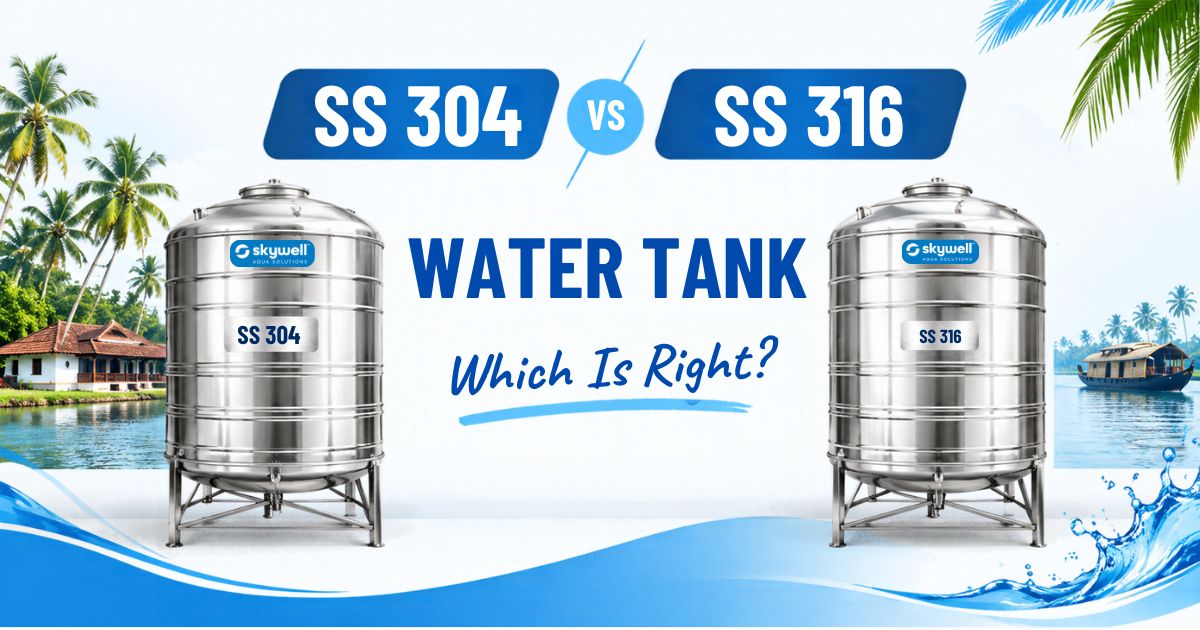
SS 304 vs SS 316 water tank selection depends mainly on chloride exposure, water source, location, fabrication and installation conditions. SS-304 suits many cold-water storage applications, while SS-316 provides greater resistance to chloride-related localized corrosion. A coastal Kerala location does not automatically require SS-316, and neither grade is corrosion-proof.
Key takeaways:
- SS-304 is suitable for many properly designed cold-water storage applications.
- SS-316 offers greater resistance to chloride-related localized corrosion.
- Coastal location alone does not automatically mean SS-316 is necessary.
- Water testing is more useful than choosing a grade from TDS alone.
- Fabrication, welds and crevices can affect stainless-steel tank performance.
If you already know your water source and required capacity, you can ask Skywell for the applicable stainless-steel specification before purchasing.
What is the difference between SS-304 and SS-316?
SS-304 and SS-316 are both austenitic stainless-steel grades, but SS-316 contains molybdenum and generally provides greater resistance to chloride-related localized corrosion. That difference is the main reason SS-316 is considered for more demanding environments.
The British Stainless Steel Association states that 304 and 316 types are generally suitable for storing and handling cold or unheated drinking water when tanks are properly designed, fabricated and finished.
Chlorides matter because stainless steel can experience localized corrosion, including pitting and crevice corrosion, when conditions become sufficiently aggressive. BSSA identifies chlorides, temperature, oxygen and tensile stress among factors that influence corrosion and stress-corrosion cracking.
For a Kerala homeowner, the practical question is therefore not simply which number is higher. It is which grade fits your water and installation conditions.
Is SS-304 suitable for a household water tank?
Yes, SS-304 is suitable for many household cold-water storage applications when the tank is correctly designed, fabricated and finished. The British Stainless Steel Association specifically identifies 304 and 316 types as generally suitable for cold or unheated drinking-water storage under appropriate conditions.
That matters because a higher grade number does not automatically make SS-304 unsuitable. Your water source, chloride exposure and tank construction still need to be considered.
Fabrication is particularly important. BSSA recommends designs with as few engineering crevices as possible and states that fully filled welded joints are preferable to overlapping seams or mechanically fastened joints.
So when comparing two stainless-steel tanks, ask for more than the material grade. Ask how the tank is fabricated.
See Skywell’s stainless steel water tank range
When does SS-316 make more sense?
SS-316 becomes more relevant when chloride exposure is more demanding because its composition provides greater resistance to chloride-related localized corrosion than SS-304.
Water UK guidance on stainless steel in the water industry gives indicative exposure guidance for 304 and 316 under specified conditions. The document lists 304 up to 200 mg/L chloride and 316 up to 1,000 mg/L for the stated environment. These figures are engineering guidance, not Kerala regulatory limits or automatic household buying thresholds.
The figures should therefore be treated carefully. Actual performance also depends on temperature, water chemistry, flow, oxygen, fabrication, joints and whether chlorides become concentrated in particular areas.
BSSA also notes that 316 is widely used in marine applications but remains susceptible to pitting and crevice corrosion in seawater. It should not be treated as corrosion-proof.
Higher grade does not mean unlimited corrosion resistance.
Does living near the Kerala coast mean you need SS-316?
No. A coastal address is a reason to consider chloride exposure, not an automatic SS-316 requirement.
Kerala’s groundwater chemistry varies by location. The Central Ground Water Board’s 2023 Kerala shallow-aquifer assessment examined 295 samples and reported one sample above 250 mg/L chloride, representing 0.34% of the sampled locations. The reported sample was at Chellanam in Ernakulam.
That result should not be treated as a measurement of every coastal household. A house near the sea may have different water chemistry from another house in the same district.
Your actual water source and recent water test are therefore more useful than simply choosing a material because your address is classified as coastal.
If your home is in a coastal area, tell the supplier where the water comes from and where the tank will be installed. That gives the material discussion useful context.
What if your house uses well or borewell water?
Well or borewell water does not automatically mean you need SS-316. The appropriate grade still depends on the actual water chemistry and installation conditions.
Kerala has extensive household dependence on wells. The Kerala State Planning Board’s 2024-25 Annual Plan cites the 2011 Census figure that 65% of Kerala households depended on wells for drinking water.
A groundwater report can contain several different measurements. TDS, hardness, chloride, electrical conductivity and pH do not mean the same thing.
A 2024 peer-reviewed study of groundwater in Alappuzha examined parameters including pH, electrical conductivity, TDS, hardness, sodium and chloride. Its results illustrate why groundwater quality should be assessed using multiple parameters rather than one number alone.
If you have a recent laboratory water report, use those results when discussing your tank specification. Do not choose SS-316 from TDS alone.
What should you check besides the steel grade?
A stainless-steel water tank is a fabricated product, so material grade is only one part of the specification. Water source, welding, joints, installation and documentation should also be checked.
| What to check | Why it matters |
|---|---|
| Stainless-steel grade | Confirms the specified material |
| Water source | Well, borewell and network supplies can have different chemistry |
| Chloride exposure | Relevant to localized corrosion resistance |
| Welding and joints | Poorly designed crevices can increase corrosion risk |
| Tank location | Terrace, loft and exposed locations create different conditions |
| Fittings and installation | The complete storage system matters, not only the tank shell |
| Warranty and documentation | Gives you a clear reference after installation |
The World Health Organization’s 2026 drinking-water guidance provides an international framework for managing drinking-water quality and emphasizes risk management from source through to consumer. It is international guidance, not a Kerala-specific tank certification.
For a homeowner, the useful questions are straightforward: What is the material? Where is it suitable? How is it fabricated? What conditions does the manufacturer recommend? What documentation and warranty are provided?
How should you compare SS-304 and SS-316?
The practical comparison is about corrosion resistance, application conditions and specification rather than simply choosing the higher number.
| Factor | SS-304 | SS-316 |
|---|---|---|
| General composition | Austenitic stainless steel | Austenitic stainless steel with molybdenum |
| Cold-water storage | Generally suitable under appropriate conditions | Generally suitable under appropriate conditions |
| Chloride-related resistance | Lower than SS-316 | Greater than SS-304 |
| Chloride exposure | Needs appropriate conditions | More suitable for more demanding chloride exposure |
| Coastal environment | Requires assessment | May be considered where chloride exposure is more demanding |
| Corrosion-proof | Yes | Yes |
| Fabrication importance | High | High |
| Household selection | Depends on actual conditions | Depends on actual conditions |
BSSA’s guidance supports the use of both 304 and 316 for cold or unheated drinking-water applications when tanks are properly designed, fabricated and finished.
The key distinction is chloride resistance, not a simple hierarchy in which one grade makes every other consideration irrelevant.
Capacity comes first. Material comes after.
Before selecting the grade, make sure the tank capacity itself matches your household requirement. If you are still deciding the size, see what size tank you need for your home.
What does this mean for a Skywell SS-304 tank?
Skywell Aqua Solutions manufactures food-grade AISI 304 stainless-steel water tanks at its ISO 9001:2015 certified manufacturing plant in Kanjikode, Palakkad, Kerala. Its stainless-steel range covers 500 L to 5,000 L capacities, with a 10-year warranty.
These are Skywell product specifications. They do not mean SS-304 is appropriate for every possible water chemistry or industrial environment.
For a normal household installation, the useful question is whether the Skywell SS-304 specification fits your water source, location and intended use.
If you are uncertain, provide the location, water source and required capacity when asking for the specification. That gives the manufacturer enough context to discuss the applicable product.
Message Skywell for a specification and quote
Who should not buy a stainless-steel water tank?
You should not choose a stainless-steel tank simply because it sounds more premium if another suitable water-storage material already meets your requirements and budget.
You should also avoid choosing SS-304 solely because someone says stainless steel will last forever. No stainless-steel grade is immune to every corrosion condition.
If your site has unusually aggressive water chemistry, severe chloride exposure or specialized industrial requirements, SS-304 may not be the appropriate specification. SS-316 may also be insufficient for extreme environments. BSSA notes that duplex and other more corrosion-resistant stainless steels can be considered for particularly aggressive applications.
This uncertainty matters. A household tank recommendation cannot replace a site-specific engineering assessment when the environment is unusually aggressive.
For an ordinary Kerala home, start with the water source, actual water chemistry and installation conditions. Then compare the suitable grades.
What is the practical answer for Kerala homes?
For many Kerala homes, SS-304 can be a suitable choice for cold-water storage when the tank is properly designed, fabricated and used under appropriate conditions. SS-316 becomes more relevant when chloride exposure is more demanding.
A coastal location alone does not establish that SS-316 is required. Likewise, an inland location does not automatically prove that SS-304 is suitable.
The material grade should be considered alongside the water source, chloride exposure, tank design, welds, fittings and installation environment.
| Situation | What to consider |
|---|---|
| KWA or treated network water | Check the applicable water chemistry and tank conditions |
| Well water | Consider actual test results, including chloride |
| Borewell water | Review water chemistry rather than TDS alone |
| Coastal home | Pay particular attention to chloride exposure |
| Normal inland household application | SS-304 may be suitable under appropriate conditions |
| More demanding chloride exposure | SS-316 may warrant consideration |
| Extreme or specialized environment | Obtain a site-specific material recommendation |
These are application guidelines, not automatic buying rules. The actual water chemistry and installation conditions can change the appropriate specification.
The material should suit your use case. The capacity should suit your water requirement.
What should you ask your plumber or supplier?
Take these questions with you before placing the order.
- What exact stainless-steel grade is specified for the tank?
- What is known about the chloride level and other relevant parameters in my water?
- How are the tank joints and welds designed and finished?
- Is this grade recommended for my water source and installation location?
- What warranty and material documentation will I receive?
These questions help you compare tanks on specification rather than on the grade number alone.
For broader tank maintenance considerations, see Skywell’s tank maintenance guide.
Skywell Aqua Solutions makes food-grade stainless steel and plastic water tanks in Palakkad, Kerala.
Not sure which tank suits your home? Message us on WhatsApp for free, honest advice.
Still have a question?
Tell Skywell your location, water source and required tank capacity, and ask which specification is appropriate for your installation.
Frequently asked questions
Is SS-304 suitable for drinking-water storage?
Yes. The British Stainless Steel Association states that 304 and 316 stainless-steel types are generally suitable for storing and handling cold or unheated drinking water when tanks are properly designed, fabricated and finished. Suitability still depends on water chemistry, fabrication, tank design and installation conditions.
Is SS-316 better than SS-304 for a water tank?
SS-316 provides greater resistance to chloride-related localized corrosion than SS-304, so it can be more appropriate where chloride exposure is more demanding. However, SS-316 is not universally required for household storage and is not corrosion-proof. Actual water chemistry, temperature, fabrication and installation conditions should determine the specification.
Does a coastal Kerala home automatically need an SS-316 water tank?
No. A coastal location is a reason to consider chloride exposure, not an automatic SS-316 requirement. Groundwater chemistry varies between locations, so the water source and actual test results are more useful than district or coastal classification alone. The tank’s fabrication and installation conditions should also be considered before selecting the stainless-steel grade.
Does high TDS mean I should choose SS-316?
No. TDS and chloride are different measurements, and chloride is particularly relevant when assessing localized corrosion risk in stainless steel. Groundwater studies commonly measure several parameters separately, including TDS, hardness, electrical conductivity and chloride. Use the actual water analysis rather than choosing SS-316 from TDS alone.
Can SS-316 rust or corrode?
Yes. SS-316 has greater resistance to chloride-related corrosion than SS-304, but it is not corrosion-proof. BSSA notes that 316 types remain susceptible to pitting and crevice corrosion in seawater. Water chemistry, temperature, flow, oxygen levels, joints and fabrication can affect performance.
What should I ask before buying an SS-304 water tank?
Ask for the exact stainless-steel grade, fabrication details, warranty terms and recommended application conditions. Tell the supplier whether your water comes from a well, borewell or network supply and whether the tank will be installed in a coastal or otherwise demanding environment. These details provide a more useful specification than simply asking which grade is better.
Is SS-304 or SS-316 always the right choice?
No. Both grades have appropriate applications, but unusually aggressive conditions may require a different material specification. BSSA notes that duplex and other more corrosion-resistant stainless steels can be considered for extreme applications. For a normal household tank, consider water chemistry, chloride exposure, fabrication and installation requirements before selecting the grade.