In this guide
- Key takeaways
- Why does water tank lifespan vary so much?
- How long does a stainless steel water tank last?
- How long does a plastic water tank last?
- How long does a concrete water tank last?
- What determines how long your water tank actually lasts?
- Which Kerala conditions can affect water tank lifespan?
- How should you read a water tank warranty?
- Who should not buy a stainless steel water tank?
- When should you inspect, repair or replace your water tank?
- Still have a question?
- Frequently asked questions
Short answer:
Water tank lifespan depends on its material, installation, water conditions and maintenance. Plastic, stainless steel and concrete tanks do not have one guaranteed service life established by Indian regulators. Manufacturer claims and warranty periods provide useful starting points, but your tank’s actual condition and written warranty matter more than a number quoted in a brochure.
Key takeaways
- No universal Indian regulatory service-life figure applies to all domestic water tanks.
- Plastic tanks need appropriate UV protection and a properly supported base.
- SS-304 offers corrosion resistance but can experience chloride-related pitting.
- Concrete tanks can remain serviceable when construction and maintenance are sound.
- A warranty is not a guarantee of the tank’s total working life.
Want help comparing tank materials? Skywell Aqua Solutions can help you understand the available options before you purchase.
Message Skywell on WhatsApp for practical advice.
Why does water tank lifespan vary so much?
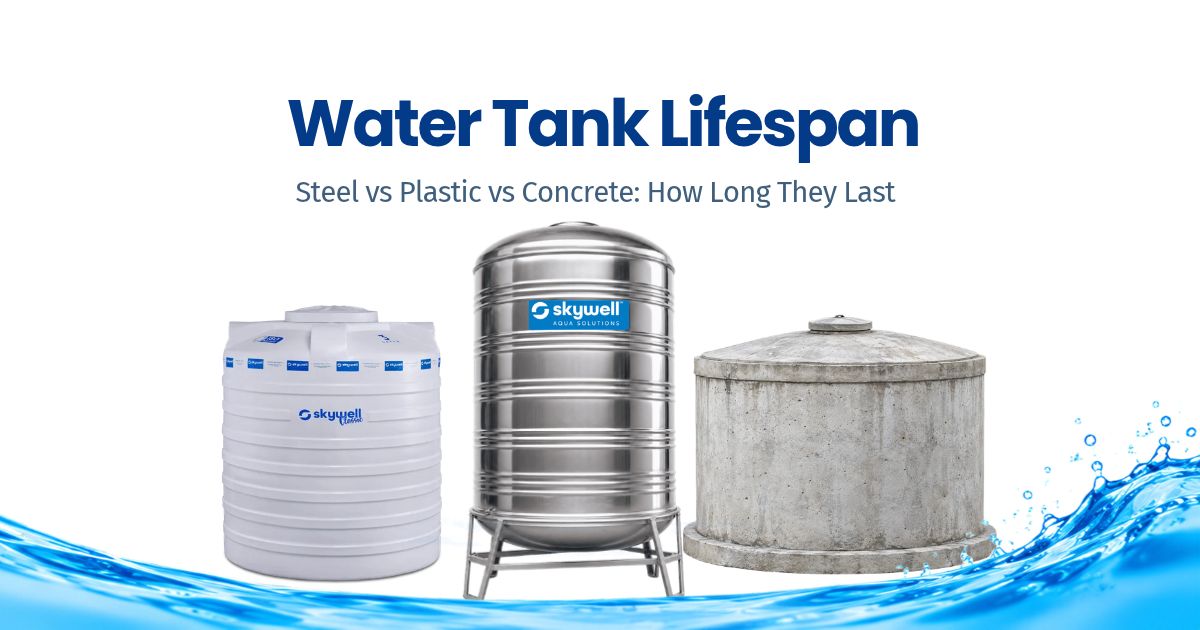
Water tank lifespan describes how long a tank remains structurally serviceable and suitable for its intended water-storage purpose. It is not necessarily the same as the manufacturer’s warranty period.
You may find websites quoting 10–15 years for plastic, 20 years or more for stainless steel, and 25–50 years for concrete. These figures should not be treated as independently verified service-life guarantees.
The distinction matters.
A manufacturer may describe an expected product life, while a warranty specifies the period and conditions under which the company accepts responsibility for covered defects.
The Bureau of Indian Standards (BIS), in IS 12701:1996, Rotational Moulded Polyethylene Water Storage Tanks — Specification, establishes requirements for materials, construction, dimensions and performance. It does not prescribe a universal number of years that every tank must last.
Source: Bureau of Indian Standards, IS 12701:1996.
The following table separates commonly quoted estimates from what you can actually verify.
| Tank material | Commonly quoted lifespan claims | What you should verify |
|---|---|---|
| Stainless steel SS-304 | 20 years or more | Material grade, corrosion exposure and written warranty |
| Rotomoulded plastic | 10–15 years | Applicable BIS specification, UV protection and warranty |
| RCC concrete | 25–50 years | Construction quality, waterproofing, cracks and maintenance |
These are indicative industry claims, not regulator-approved service-life figures. Your actual tank may need replacement earlier or remain serviceable longer.
The important distinction: a claimed lifespan is not a guaranteed lifespan.
How long does a stainless steel water tank last?
A stainless steel water tank can remain serviceable for many years when its material grade, fabrication, installation and operating environment are suitable. However, there is no universal Indian regulatory figure guaranteeing 20 years or more.
The grade makes a difference.
Food-grade AISI 304, commonly called SS-304, is widely used in food-processing and storage applications because of its corrosion-resistant properties.
Its chromium content helps form a protective surface layer. However, stainless steel is not completely immune to corrosion.
According to the Nickel Institute’s Guidelines for Corrosion Prevention, 304 stainless steel can experience pitting in marine environments, while 316 generally performs better in coastal architectural applications.
Source: Nickel Institute, Guidelines for Corrosion Prevention.
Is SS-304 suitable for Kerala homes?
For many inland Kerala homes, SS-304 is a practical option when the tank is properly manufactured and installed.
However, houses exposed to salt-rich coastal air need additional consideration. Locations around Kannur, Alappuzha, Kollam and other coastal areas may experience more demanding corrosion conditions.
SS-316 contains molybdenum, which improves resistance to chloride-related corrosion compared with SS-304.
That does not make SS-316 corrosion-proof. The actual exposure conditions, surface finish and maintenance still matter.
Skywell Aqua Solutions manufactures stainless steel water tanks using food-grade AISI 304 (SS-304), with a premium SS-316 product line also available.
The range includes vertical and horizontal capacities of 500, 1,000, 1,500, 2,000, 3,000 and 5,000 liters.
You can compare the available options on the Skywell stainless steel water tanks page.
Verdict: Stainless steel can be a long-term choice, but grade selection must match your location and installation conditions.
How long does a plastic water tank last?
A plastic water tank’s working life depends on polyethylene quality, UV stabilisation, manufacturing consistency, installation and maintenance. Common manufacturer lifespan claims should be treated as estimates rather than guaranteed outcomes.
Sunlight is one important consideration.
Polyethylene can degrade under prolonged ultraviolet exposure. UV stabilisers and suitable pigments help slow this degradation.
A peer-reviewed study published in Polymer Degradation and Stability in 2002, titled Effect of Carbon Black on UV Stability of LLDPE Films under Artificial Weathering Conditions, examined the role of carbon black in improving resistance to UV degradation.
Source: Polymer Degradation and Stability, 2002.
What should you check before buying?
Look beyond the tank’s colour and advertised lifespan.
Check these details:
- Whether the tank uses food-grade polyethylene.
- Whether its construction includes appropriate UV stabilisation.
- Whether the manufacturer provides material and product information.
- Whether the tank has the relevant BIS certification where applicable.
- Whether the written warranty explains coverage and exclusions.
BIS also publishes IS 10146:1982, Specification for Polyethylene for Its Safe Use in Contact with Foodstuffs, Pharmaceuticals and Drinking Water.
This is a separate material specification from IS 12701, which covers rotationally moulded polyethylene water storage tanks.
Source: Bureau of Indian Standards, IS 10146.
Are three-layer plastic tanks worth considering?
Three-layer construction can provide different functional layers, including a food-grade inner layer and an outer layer designed for UV protection.
Skywell plastic water tanks use a food-grade 100% virgin polyethylene inner layer and three-layer UV-stabilised construction.
The range covers capacities from 500 to 10,000 liters, including classic black and white, marble-finish insulated, capsule and loft or bed-type models.
Explore the Skywell plastic water tank range to compare available designs.
A well-selected plastic tank can be entirely suitable for a Kerala home. The important thing is to match its construction to the installation environment.
How long does a concrete water tank last?
A properly constructed and maintained reinforced cement concrete (RCC) tank can remain serviceable for decades. However, there is no single dependable service-life figure applicable to every domestic concrete tank.
Concrete performance depends on several factors:
- Cement and concrete quality.
- Reinforcement design and placement.
- Waterproofing and curing.
- Soil and groundwater conditions.
- Structural loading.
- Maintenance and timely crack repairs.
Unlike a manufactured plastic or stainless steel tank, a concrete sump is part of the building’s construction.
Its condition cannot be judged by age alone.
A small crack may require investigation and repair, while a much older structure may remain serviceable after appropriate maintenance.
The Central Public Health and Environmental Engineering Organisation (CPHEEO), under the Ministry of Housing and Urban Affairs, publishes guidance on water-supply infrastructure and its operation and maintenance.
Its 2024 Manual on Water Supply and Treatment Systems, Part B: Operation and Maintenance provides a useful reference for maintaining water-supply infrastructure.
Source: CPHEEO, Manual on Water Supply and Treatment Systems, Part B, March 2024.
If your existing concrete sump has no significant structural problems or persistent leakage, replacement may not be necessary.
Verdict: A healthy concrete sump deserves proper maintenance, not automatic replacement based on age.
What determines how long your water tank actually lasts?
Seven practical factors influence how long a water tank remains serviceable: installation, material quality, water source, cleaning, sunlight, surrounding conditions and workmanship.
Material is only one part of the decision.
1. Installation quality
Every tank needs an appropriate, stable and fully supported base according to its design.
An uneven base can create stress, deformation or damage. The correct support arrangement also depends on the tank’s shape, capacity and manufacturer’s installation instructions.
Do not assume that bricks or a small concrete platform will be adequate.
2. Water source
Water from wells, borewells and municipal supply can carry different amounts of sediment and dissolved minerals.
In some Kerala homes, iron deposits and laterite sediment accumulate inside storage systems.
These deposits may require more frequent inspection and cleaning.
3. Cleaning habits
A tank that is rarely inspected can accumulate sediment and deposits.
Cleaning should follow the condition of the tank, the water source and applicable local guidance. A fixed annual schedule may not suit every household.
4. Sunlight and weather exposure
Plastic tanks need suitable UV protection when installed outdoors.
Kerala’s long periods of strong sunlight and seasonal heavy rain make the installation location important.
5. Coastal exposure
Salt deposits carried by coastal air can increase corrosion risks for certain stainless steel grades.
The Nickel Institute’s corrosion guidance explains why grade selection and regular removal of surface contaminants matter in marine environments.
6. Workmanship
Poor welding, unsuitable fittings, damaged joints and incorrect installation can shorten the working life of an otherwise suitable tank.
Ask who is responsible for installation and what support is available if a problem develops.
7. Maintenance and inspection
A visible leak, damaged lid, loose fitting or structural crack should not be ignored.
Regular inspection helps identify developing problems before they become expensive repairs.
The material should suit your conditions. The installation should protect your investment.
Which Kerala conditions can affect water tank lifespan?
Kerala’s climate makes installation and material selection particularly important. Coastal salt exposure, terrace heat, heavy monsoon rainfall and variations in water supply can all influence tank maintenance requirements.
Consider your location rather than choosing solely by what is popular at the nearest dealer.
Coastal homes
If your home is close to the Arabian Sea, discuss stainless steel grade selection with your supplier.
SS-304 may not be appropriate for every highly exposed coastal environment. Ask whether SS-316 is more suitable and what maintenance is recommended.
Homes with borewells
Borewell water conditions differ from one location to another.
If your supply contains visible sediment or iron deposits, arrange inspections based on how quickly material accumulates.
Homes with intermittent municipal supply
Some households depend on storage because water arrives at irregular intervals.
A ground-level sump and overhead tank may work together to manage supply interruptions.
The storage arrangement should suit your household’s actual requirements rather than an assumed standard.
Homes exposed to strong terrace sunlight
A plastic tank installed on an exposed terrace experiences different conditions from one installed in a shaded location.
Ask about UV-stabilised construction and the manufacturer’s recommended installation arrangements.
There is some uncertainty in predicting the exact lifespan from climate alone. Two neighbouring houses can have very different tank conditions because of their installation and maintenance practices.
How should you read a water tank warranty?
A warranty tells you what the manufacturer agrees to cover during a specified period. It does not automatically guarantee that the tank will remain in perfect condition for that entire period or beyond.
Skywell Aqua Solutions provides a 10-year warranty on its stainless steel and plastic water tanks.
However, you should confirm the applicable model-specific warranty terms before purchasing.
Check these details in writing:
| Warranty detail | What you should ask |
|---|---|
| Warranty period | When does coverage begin? |
| Covered defects | Which manufacturing or material defects qualify? |
| Exclusions | Are installation damage and accidental damage excluded? |
| Claim procedure | Which documents must you provide? |
| Service support | Who handles inspection and warranty claims? |
Keep your invoice, warranty document and installation details together.
Do not rely on a salesperson’s verbal explanation when the written terms are available.
A 10-year warranty is a useful purchasing consideration, but it is not the same as a guaranteed 10-year total service life.
Who should not buy a stainless steel water tank?
A stainless steel tank is not automatically the right choice for every household. In some situations, a quality plastic tank is the more practical purchase.
That is worth saying clearly.
Consider choosing plastic instead if:
- Your budget cannot comfortably accommodate stainless steel.
- You are renting and may need to relocate the tank.
- Your house is likely to undergo major renovation or reconstruction soon.
- Access to your terrace makes handling heavier equipment difficult.
- Your existing storage arrangement does not justify the additional expense.
A good-quality plastic tank with food-grade construction and appropriate UV protection can serve your requirements perfectly well.
Similarly, if you already have a sound RCC sump, there is no reason to replace it simply because stainless steel is available.
I would not choose a tank simply because one material sounds more premium.
I would first consider capacity, installation conditions, water source, budget and the manufacturer’s written warranty.
For a long-term home where the owner wants a durable manufactured storage option, stainless steel may be worth considering.
For a budget-conscious household, a suitable plastic tank may be the more sensible decision.
Buy what your home needs, not what sounds impressive.
When should you inspect, repair or replace your water tank?
You should investigate a tank when it develops recurring leaks, structural damage, persistent deposits or other problems that ordinary maintenance does not resolve. Replacement should follow an assessment of the damage rather than age alone.
Look for these warning signs:
- A visible crack or bulging wall.
- Water leaking from seams or fittings.
- Repeated deposits that return soon after cleaning.
- A damaged lid or opening that cannot be secured properly.
- Persistent discolouration or unusual deposits associated with the tank.
- Corrosion or visible pitting on stainless steel surfaces.
Some problems can be repaired. Others indicate that replacement is the more practical option.
If you suspect structural damage to an RCC tank, ask a qualified professional to inspect it before continuing to use it.
Four questions to take to your plumber or supplier
Before ordering a replacement, ask these questions:
- Is my existing tank structurally damaged, or will proper cleaning or repair solve the problem?
- What tank capacity suits my household and water-supply pattern?
- Which material and grade are appropriate for my installation location?
- What exactly does the manufacturer’s written warranty cover, and who handles service?
These questions help you make a decision based on your actual requirements.
If you are comparing products, you can also browse the Skywell product range and discuss the available options with a dealer.
Skywell Aqua Solutions makes food-grade stainless steel and plastic water tanks in Palakkad, Kerala.
Not sure which tank suits your home? Message us on WhatsApp for free, honest advice.
Still have a question?
Your tank’s age alone cannot tell you whether it needs replacement. Share your tank type, approximate age and installation conditions with Skywell for practical guidance.
Cite as: skywell.in/water-tank-lifespan-guide/
Frequently asked questions
How long do plastic water tanks last?
Plastic water tank lifespan depends on polyethylene quality, UV stabilisation, installation and maintenance. Manufacturers commonly quote figures such as 10–15 years, but these are product claims rather than universal regulatory guarantees. Check the applicable BIS specification, material information, written warranty and installation requirements before purchasing.
How long does a stainless steel water tank last?
Stainless steel water tanks can remain serviceable for many years when the grade, fabrication and installation suit the environment. There is no universal Indian regulatory lifespan guarantee of 20 years or more. SS-304 and SS-316 have different corrosion-resistance properties, particularly in chloride-rich coastal environments.
How long does a concrete water tank last?
A properly constructed RCC water tank can remain serviceable for decades, but its lifespan depends on concrete quality, reinforcement, waterproofing, workmanship and maintenance. There is no single reliable service-life figure for every domestic concrete tank. Structural cracks and persistent seepage should be assessed by a qualified professional.
Does sunlight damage plastic water tanks?
Prolonged ultraviolet exposure can degrade polyethylene over time. UV stabilisers and suitable pigments help slow this degradation. A three-layer UV-stabilised plastic tank is worth considering for an exposed Kerala terrace. However, UV protection does not eliminate the need for correct installation, regular inspection and appropriate maintenance.
Does stainless steel rust in coastal Kerala?
Stainless steel can experience corrosion in coastal environments because salt deposits contain chlorides. SS-304 can be susceptible to pitting under aggressive marine exposure, while SS-316 generally offers better resistance. Neither grade is completely corrosion-proof in every condition. Discuss your location and maintenance requirements with the manufacturer before selecting a grade.
What does the ISI mark mean on a plastic water tank?
The ISI mark indicates conformity with the applicable BIS product specification when the product is covered by a valid BIS licence. IS 12701:1996 covers rotationally moulded polyethylene water storage tanks. It establishes product requirements, not a guaranteed number of service years. Check the manufacturer’s licence and applicable product scope.
Does a 10-year water tank warranty mean the tank lasts 10 years?
No. A 10-year warranty specifies a coverage period under the manufacturer’s stated terms. It does not establish the tank’s total service life or guarantee that every type of damage will be covered. Skywell provides a 10-year warranty on its stainless steel and plastic tanks, subject to the applicable model-specific terms.
When should I replace my water tank?
Consider replacement when your tank has significant cracks, persistent leaks, structural deformation, serious corrosion or damage that cannot be reliably repaired. Recurring deposits or discolouration should first be investigated and the tank inspected or cleaned as appropriate. A professional assessment can help determine whether repair or replacement is the better decision.