In this guide
- What do Indian standards actually require from a water tank?
- What is the difference between SS-304 and SS-316?
- How does your water source change the answer?
- Which tank is easier to maintain?
- Where should you install a water tank in a Kerala home?
- Which water tank should you choose for your budget?
- When should you NOT buy a stainless steel tank?
- What should you ask before buying a water tank?
- Still have a question?
- Frequently asked questions
short answer
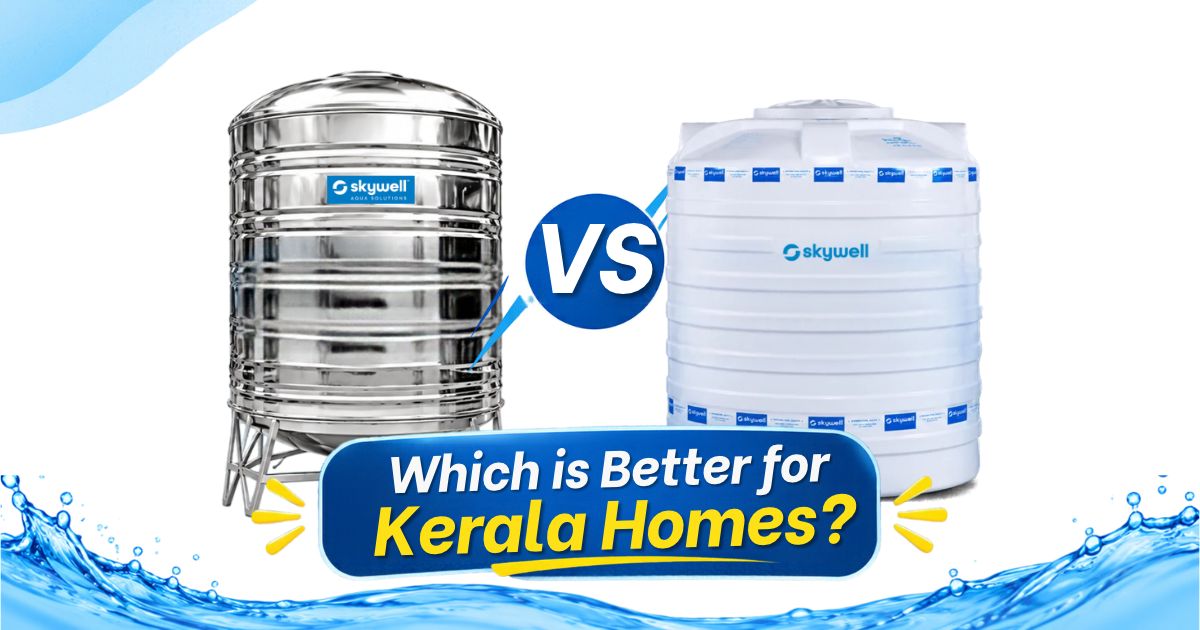
The stainless steel vs plastic water tank decision for a Kerala home depends on your budget, water source, location and maintenance requirements. A BIS-licensed polyethylene tank is a practical, lower-initial-cost option. A genuine AISI 304 stainless steel tank offers a durable metal construction and convenient cleaning access. Neither material is automatically better for every home.
Key takeaways
- Certified plastic tanks are a practical option when your initial budget is limited.
- Genuine AISI 304 stainless steel offers a durable alternative for household water storage.
- IS 12701:1996 applies to rotationally molded polyethylene water storage tanks.
- Coastal exposure and chloride levels matter when selecting stainless steel grades.
- Neither material corrects contamination in your original water supply.
Want help comparing the two materials?
Message Skywell on WhatsApp for practical advice based on your location, water source and requirements.
What do Indian standards actually require from a water tank?
Indian Standard IS 12701:1996 specifies requirements for rotationally moulded polyethylene water storage tanks. It is the relevant standard to check when purchasing a BIS-certified plastic water tank.
It is important to understand what this standard covers and what it does not. It is not a universal certification for every type of water storage tank.
The Bureau of Indian Standards identifies IS 12701:1996 as the specification for rotationally moulded polyethylene water storage tanks.
Source: BIS – IS 12701 product manual.
What should you check on a plastic tank?
Look beyond the brand name and the number of layers.
Check the following before purchasing:
- Whether the tank carries a valid BIS license applicable to IS 12701.
- Whether the manufacturer’s license covers the particular tank type and capacity.
- Whether the tank has the required markings.
- Whether the lid fits properly.
- Whether the manufacturer provides documentation about its material and construction.
The BIS product manual classifies polyethylene tanks into single-layer and double-layer varieties. It also recognises cylindrical vertical tanks and rectangular loft tanks.
Therefore, a five-layer construction should not automatically be treated as a BIS requirement.
What about stainless steel certification?
Stainless steel buyers need to verify the actual material grade.
AISI 304 and AISI 316 are different stainless steel grades. The grade should be specified in the manufacturer’s documentation and invoice.
For additional verification, request a mill test certificate carrying the relevant heat number.
A manufacturer’s brand name or a statement saying premium stainless steel does not establish the actual grade.
Here is a practical comparison of the information worth checking.
| What to verify | Plastic tank | Stainless steel tank |
|---|---|---|
| Material | Polyethylene | AISI 304 or 316 |
| Documentation | Applicable BIS licence | Grade declaration and mill test certificate |
| Construction | Single or double layer under BIS product classification | Sheet grade and fabrication details |
| Lid | Proper fit and closure | Secure closure and cleaning access |
| Maintenance | Regular cleaning | Regular cleaning |
| Location | Installation and UV exposure | Chloride exposure and coastal conditions |
The important point is simple. Verify the product, not just the sales description.
What is the difference between SS-304 and SS-316?
SS-304 and SS-316 are stainless steel grades with different resistance to chloride-related corrosion. SS-316 generally offers better resistance in chloride-rich environments because of its alloy composition.
This difference matters in Kerala, particularly for homes exposed to coastal air.
The British Stainless Steel Association discusses the relationship between chloride concentration and crevice corrosion in stainless steel water systems.
Its technical guidance identifies concentrations below which crevice corrosion is considered rare:
| Stainless steel grade | Chloride concentration |
|---|---|
| SS-304 | Below 200 ppm |
| SS-316 | Below 1,000 ppm |
Source: British Stainless Steel Association – Stainless steels in supply and waste water systems.
These are international technical reference values, not guaranteed corrosion limits or Kerala-specific regulations.
The association also explains that temperature, oxygen, surface condition and water chemistry influence corrosion behaviour.
Does coastal Kerala require extra attention?
Yes. Coastal exposure deserves attention when selecting a stainless steel tank.
Homes near Kollam, Alappuzha, Ernakulam and Kannur may experience different levels of salt exposure depending on their distance from the coast and local surroundings.
The British Stainless Steel Association’s guidance on external applications identifies marine environments as more demanding for stainless steel selection.
Source: BSSA – Selection of stainless steels for building external applications.
Do not assume that every coastal home automatically needs SS-316. Ask the manufacturer to assess your specific conditions and recommend a grade in writing.
At Skywell, stainless steel tanks are manufactured using food-grade AISI 304 sheet at our ISO 9001:2015 certified manufacturing plant in Kanjikode, Palakkad. Our stainless steel tanks carry a 10-year warranty.
Considering stainless steel for your home?
Talk to Skywell on WhatsApp about your location and water source before deciding on a grade.
How does your water source change the answer?
Your water source can be just as important as the tank material. Borewell water, open-well water and piped water can have different chemical characteristics.
A groundwater survey by the Central Ground Water Board provides useful historical information about Kerala’s groundwater conditions.
The CGWB Ground Water Information Booklet for Malappuram recorded the following ranges in shallow groundwater samples collected in April 2009:
| Parameter | Recorded range |
|---|---|
| Total hardness as calcium carbonate | 8–160 ppm |
| Chloride | 5–124 mg/L |
| Electrical conductivity | 50–974 µS/cm |
Source: CGWB – Ground Water Information Booklet, Malappuram District.
These figures describe historical samples from a particular district. They do not establish the current quality of your well or borewell.
Which water tests should you consider?
If you depend on groundwater, consider testing:
- Chloride.
- Total hardness.
- Iron.
- Electrical conductivity.
- Other relevant parameters identified by your local water-testing laboratory.
Coastal groundwater also deserves attention because seawater ingress can affect freshwater aquifers.
The Central Ground Water Board’s Kerala groundwater assessment discusses seawater ingress and the effects of groundwater over-extraction in coastal areas.
The practical lesson is that you should understand your water before choosing a tank.
Does a plastic tank solve water-quality problems?
No. A tank stores water; it does not correct contamination in the source.
The World Health Organization’s 2019 review of microplastics in drinking water described the available evidence as limited and assessed the health risk as low, while highlighting the need for further research.
It also emphasised the importance of keeping attention on established drinking-water risks.
Source: WHO – Microplastics in drinking-water, 20 August 2019.
Neither a plastic nor a stainless steel tank should be treated as a substitute for appropriate water testing and treatment.
Which tank is easier to maintain?
Both plastic and stainless steel tanks need regular cleaning. Neither material eliminates sediment accumulation or the need to inspect stored water.
The practical difference is often the tank’s design and the access provided for cleaning.
| Maintenance consideration | Plastic tank | Stainless steel tank |
|---|---|---|
| Interior inspection | Depends on opening size and design | Depends on opening size and design |
| Cleaning | Requires suitable access and brushing | Requires suitable access and brushing |
| Lid inspection | Check fit and closure | Check fit and closure |
| Sediment | Can accumulate | Can accumulate |
| Regular maintenance | Necessary | Necessary |
A tank with a wide, accessible opening makes inspection and cleaning easier.
Before purchasing, ask whether you can comfortably access the interior with a suitable cleaning brush.
What should you do after flooding?
Floodwater can contaminate household water-storage systems. Cleaning and disinfection should follow the applicable public-health guidance.
The Kerala government’s flood-health guidance provides a specific procedure:
- Drain the existing water completely.
- Scrub and wash the tank thoroughly.
- Refill the tank with water.
- Follow the prescribed super-chlorination procedure.
- Flush the taps for at least five minutes.
The guidance specifies 5 grams of commercial bleaching powder per 1,000 liters for its stated super-chlorination procedure.
Source: Government of Kerala – Flood Health Jagratha Guidelines.
Use the official instructions and appropriate public-health advice for the actual situation. Do not guess chlorine quantities or apply the procedure without checking the product concentration and instructions.
Where should you install a water tank in a Kerala home?
The installation location affects accessibility, structural safety and maintenance. A tank must be placed where the supporting structure can safely carry its filled weight.
Many Kerala homes use a ground-level sump and an overhead tank. Some also use smaller loft tanks where space is limited.
Consider these practical points:
- Is the supporting structure suitable for the filled tank?
- Can you access the lid without difficulty?
- Is the overflow pipe visible and properly directed?
- Can you inspect the tank periodically?
- Is the installation protected against unnecessary exposure to weather?
A 1,000-litre tank contains approximately 1,000 litres of water when full. The weight of the tank and its supporting arrangement must also be considered.
Ask your mason or structural engineer to assess the installation location rather than relying on a manufacturer’s capacity recommendation alone.
What about Kerala’s monsoon?
The southwest monsoon normally sets in over Kerala around 1 June, with a standard deviation of approximately seven days.
Source: India Meteorological Department, Forecast of the Onset Date of Southwest Monsoon – 2026 over Kerala, 15 May 2026.
This makes pre-monsoon maintenance and installation planning useful for homeowners.
If you are replacing an overhead tank, arrange the plumbing and supporting work before the heavy rains whenever possible.
Do not postpone a leaking or structurally unsafe installation simply to wait for a particular season.
Which water tank should you choose for your budget?
The right material depends on what you value most.
A certified plastic tank is a practical choice when initial purchase cost is important. Stainless steel is worth considering when you prefer a metal construction and are prepared to pay for the material and fabrication.
Skywell manufactures both plastic and stainless steel water tanks for Kerala households.
Our plastic range uses a food-grade 100% virgin polyethylene inner layer and three-layer, UV-stabilised construction. Our stainless steel range uses food-grade AISI 304.
Both product ranges carry a 10-year warranty.
You can compare the available options here:
For a broader understanding of material selection, see our stainless steel vs plastic water tank comparison for Kerala.
When should you NOT buy a stainless steel tank?
Stainless steel is not the right purchase for every household. There are situations where a certified plastic tank makes more practical sense.
When your budget is limited
If your budget is genuinely tight, consider a BIS-licensed plastic tank that meets IS 12701:1996.
You can allocate the remaining budget towards a proper supporting structure, plumbing improvements and regular maintenance.
A more expensive material is not automatically a better purchase for your circumstances.
When you live near the coast but have not checked the grade
Do not purchase a stainless steel tank based only on the word stainless.
Coastal exposure can influence the performance of different grades. Ask the manufacturer about the suitability of the material for your particular location.
When you cannot maintain the tank
If your household does not plan to inspect or clean the tank, changing the material will not solve the maintenance problem.
Sediment can accumulate in both plastic and stainless steel tanks.
A cleanable design and a realistic maintenance routine matter more than the material alone.
The honest verdict: choose the material that suits your budget, water conditions and maintenance requirements.
What should you ask before buying a water tank?
Take these questions to your plumber, engineer or supplier before placing an order.
- What is the exact material grade, and can you provide written documentation?
- If I am buying a plastic tank, does its BIS licence cover this model and capacity?
- Is the supporting structure suitable for the filled tank and its installation?
- Can I access the interior easily for cleaning, and what after-sales support is available?
Also confirm delivery, installation responsibilities and the applicable warranty terms before making payment.
These checks are useful whether you purchase plastic or stainless steel.
Skywell supplies water tanks through a dealer network across Kerala, with WhatsApp support for product enquiries.
Need help choosing between plastic and stainless steel?
Message Skywell on WhatsApp with your district, water source and preferred capacity. The team can help you understand the available options without requiring you to commit to a purchase.
Skywell Aqua Solutions makes food-grade stainless steel and plastic water tanks in Palakkad, Kerala.
Not sure which tank suits your home? Message us on WhatsApp for free, honest advice.
Still have a question?
Choosing a water tank involves more than comparing two materials. If you are unsure about the grade, capacity or installation, contact Skywell on WhatsApp for assistance.
Cite as: skywell.in/stainless-steel-vs-plastic-water-tank/
Frequently asked questions
Which is better, stainless steel or plastic water tank for a Kerala home?
Neither is automatically better. The stainless steel vs plastic water tank decision depends on your budget, water source, location and maintenance requirements. A BIS-licensed plastic tank meeting IS 12701:1996 is a practical option at a lower initial cost. Genuine AISI 304 stainless steel is an alternative for households that prefer metal construction and convenient cleaning access.
Is a three-layer or five-layer plastic water tank required by BIS?
No. The BIS product manual for IS 12701:1996 classifies rotationally moulded polyethylene water storage tanks into single-layer and double-layer varieties. Additional layers are not automatically a BIS requirement. Ask the manufacturer to provide the applicable standard documentation rather than assuming that a higher layer count establishes compliance.
Does stainless steel rust when used for storing water?
Stainless steel offers corrosion resistance, but it is not completely immune to corrosion. Chloride concentration, temperature, surface condition and installation environment influence its performance. SS-316 generally offers better chloride resistance than SS-304. Homes near the Kerala coast should discuss the appropriate grade with the manufacturer before purchasing.
What is the difference between SS-304 and SS-316 water tanks?
SS-304 and SS-316 are different stainless steel grades. SS-316 contains molybdenum, which generally improves its resistance to chloride-related corrosion. The British Stainless Steel Association identifies different chloride-related corrosion benchmarks for the two grades. However, actual performance depends on environmental conditions, water chemistry and surface finish.
Can I store household drinking water in a plastic tank?
A plastic water tank designed and manufactured to meet the applicable requirements of IS 12701:1996 is intended for polyethylene water storage. Check its BIS licence, product markings and material documentation before purchasing. Also ensure that the tank is properly installed, covered and maintained. A certified tank does not make contaminated source water safe.
How often should I clean my water tank in Kerala?
Inspect your water tank regularly and establish a cleaning schedule appropriate to your water source and storage conditions. Clean it after flooding or whenever contamination is suspected. Kerala’s flood-health guidance specifies draining, scrubbing, refilling, super-chlorination and flushing taps for five minutes. Follow applicable public-health instructions for the correct disinfection procedure.
What does a Skywell water tank cost?
Skywell tank prices are provided through quotation based on the product, capacity and delivery location. The stainless steel range includes capacities from 500 litres to 5,000 litres, while the plastic range offers capacities from 500 litres to 10,000 litres. Contact Skywell through WhatsApp with your district and preferred capacity to request current pricing.
Does a stainless steel water tank need less maintenance than a plastic tank?
Both stainless steel and plastic water tanks require regular inspection and cleaning. Stainless steel does not eliminate sediment accumulation, and plastic tanks also need proper cleaning access and a securely fitting lid. The actual maintenance requirements depend on the tank design, water source, installation and usage. Choose a tank that you can inspect and clean conveniently.