Short answer:
In this guide
- What is a single-wall water tank?
- What is a multi-layer water tank?
- What does each layer actually do?
- Does more layers mean a better water tank?
- What should you check before buying a tank?
- What changes when the tank is installed in Kerala?
- What about stainless steel water tanks?
- Who should not buy a stainless steel tank?
- Single wall vs multi layer water tank: what should you choose?
- Still have a question?
- Frequently asked questions
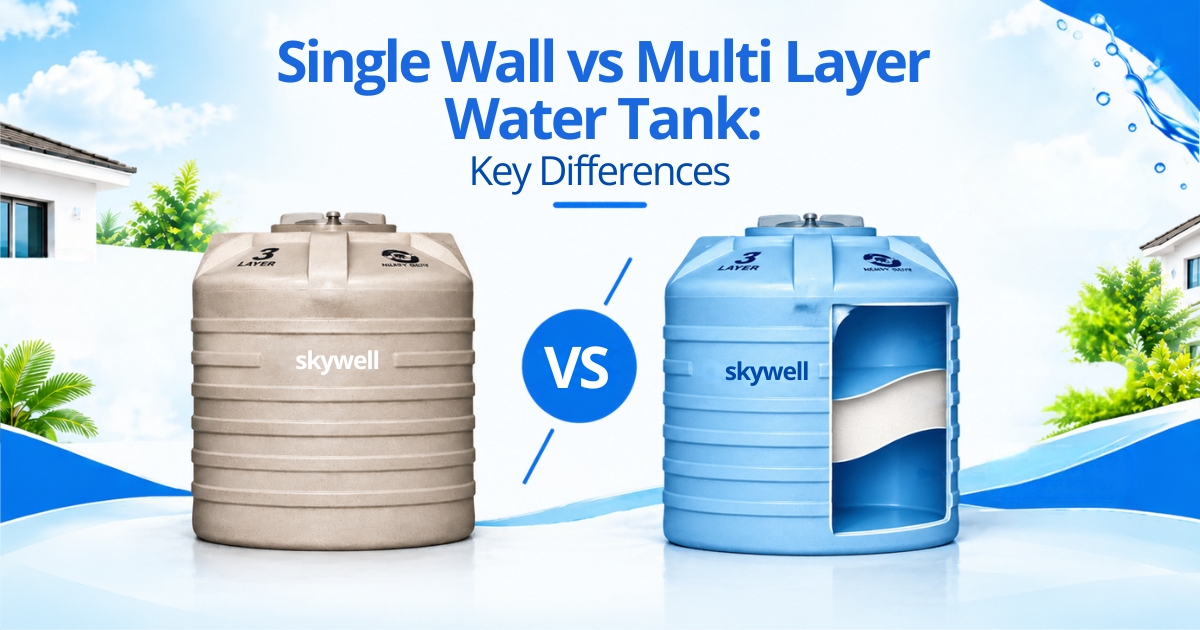
A single wall vs multi layer water tank comparison should focus on construction, material, testing and intended use rather than layer count alone. Single-layer and double-layer polyethylene tanks are recognised as separate varieties under IS 12701:1996. A multi-layer design may assign different layers to structural, UV, insulation or water-contact functions, depending on the manufacturer.
Key takeaways
- Layer count alone does not establish tank quality.
- Different layers can perform different functions.
- BIS recognises single-layer and double-layer tank varieties.
- Installation and maintenance matter alongside tank construction.
- Not every multi-layer tank provides insulation.
If you have a tank quotation and want help understanding the specification, message Skywell on WhatsApp with the capacity and installation details.
What is a single-wall water tank?
A single-wall water tank has one primary wall rather than separate functional layers. Its suitability depends on the material, design, capacity, installation and applicable requirements.
That sounds simple because it is. The useful question is not whether one wall sounds basic, but whether the tank’s construction is appropriate for the job.
BIS’s January 2019 product manual for IS 12701:1996 classifies rotational moulded polyethylene water storage tanks by number of layers, including single-layer and double-layer varieties. It also states that separate samples are to be tested for single-layer and double-layer tanks.
This gives you a better starting point when comparing products. Instead of asking only, “How many layers does it have?”, ask what the construction is designed and tested to do.
For plastic tanks, you can also compare the stated construction with Skywell’s plastic water tank range, where the manufacturer describes different tank constructions and materials.
What is a multi-layer water tank?
A multi-layer water tank uses more than one material layer within its construction, with individual layers potentially serving different structural or functional purposes.
For example, a manufacturer’s design may use an outer layer for UV or weather exposure, a structural layer for the tank body, and an inner layer intended to contact stored water. Some designs may also incorporate insulation.
There is no universal rule that every three-layer or four-layer tank uses the same materials or delivers the same performance. Layer count therefore should not be treated as a quality score.
A water tank layer is a distinct material layer within the tank construction that performs a particular structural or functional role.
If a salesperson tells you that “four layers” automatically means better quality, ask what each of those four layers is made to do.
What does each layer actually do?
The function of each layer depends on the manufacturer’s construction, so the specification matters more than the number printed on the brochure.
A useful way to examine a multi-layer tank is to ask what each part contributes.
| Construction feature | What you should ask |
|---|---|
| Outer layer | Is it designed for outdoor exposure or UV resistance? |
| Structural layer | What role does it play in the tank body? |
| Insulating layer | Is actual insulation incorporated into the design? |
| Inner layer | What material contacts the stored water? |
| Overall construction | Which standard or testing requirements apply? |
Do not assume that every multi-layer tank contains all five features. The same layer terminology can mean different things across manufacturers.
Skywell’s current plastic tank information, for example, describes its marble-finish range as a three-layer construction with an outer UV-stabilised layer, an inner layer made from 100% food-grade virgin material, and an insulating layer. That is a manufacturer-specific construction description, not a universal definition of every three-layer tank.
For a Kerala homeowner, this distinction matters on the terrace. A tank installed outdoors has to suit the actual exposure, plumbing arrangement, available access and maintenance requirements. The construction should match the installation rather than simply winning a layer-count comparison.
Does more layers mean a better water tank?
No. More layers do not automatically establish better quality.
BIS treats single-layer and double-layer rotational moulded polyethylene tanks as separate varieties under IS 12701 and requires separate testing of those varieties.
The BIS testing scheme includes requirements such as resistance to deformation, impact resistance, top-load resistance for applicable capacities, tensile strength, flexural modulus and overall migration. It also states that single-layer and double-layer tanks are treated as different varieties.
That is more useful than assuming a higher number is automatically better.
When comparing tanks, ask about the material, construction, applicable standard, testing, warranty and installation requirements. If a supplier cannot explain the construction clearly, the layer count by itself tells you very little.
If you are comparing a plastic multi-layer tank with a stainless steel alternative, you can also review our stainless steel water tank range separately rather than treating metal construction as another version of the same layer-count question.
What should you check before buying a tank?
Before choosing a tank, check the exact material, construction, applicable standard, testing, warranty and installation requirements.
Ask your supplier these questions:
- What material is the tank made from?
- What does each layer actually do?
- What standard applies to this tank?
- Is the tank certified or tested to the claimed standard?
- Is there a separate insulating layer, or is “insulated” being used loosely?
- What warranty applies to the exact model?
- Can the tank be inspected and cleaned properly after installation?
The last question is easy to forget.
WHO guidance on household water storage recommends covered storage containers that are accessible for inspection and maintenance, with suitable arrangements around the container. This is international guidance rather than Kerala-specific municipal data.
WHO’s July 2026 sanitary inspection package for piped-distribution storage tanks also focuses on identifying risk factors, corrective action, and ongoing operation, maintenance and monitoring.
A tank that is difficult to reach for inspection remains difficult to maintain, regardless of how impressive its layer specification sounds.
What changes when the tank is installed in Kerala?
The installation environment matters in Kerala because rainfall, exposure and water sources vary across the state.
Government of Kerala data for the 2024 southwest monsoon recorded actual rainfall of 3,024 mm in Kannur and 866 mm in Thiruvananthapuram between June 1 and September 30, 2024. The state total was 1,748 mm, compared with a normal 2,019 mm.
Those figures show variation in rainfall; they do not establish that one tank construction is automatically better across Kerala.
Your installation matters. A tank on an exposed terrace in Kannur faces different conditions from one installed in a shaded loft in an urban house.
Your water source matters too. Kerala’s Ground Water Department reports groundwater resource computations for 152 assessment units across 14 districts and notes that groundwater availability varies with climatic, geomorphological and hydrogeological conditions.
That does not mean every well in a district has identical water characteristics. A district name should not be treated as a diagnosis of your individual water supply.
For more Kerala-specific buying context, see our other water tank guides before making a final decision.
What about stainless steel water tanks?
Stainless steel is a separate material choice, so it should not be judged using the same layer-count logic as polyethylene tanks.
Skywell’s current stainless steel range uses food-grade AISI 304 stainless steel and is available in 500 L, 1,000 L, 1,500 L, 2,000 L, 3,000 L and 5,000 L capacities. The product page also states that the tanks are designed for installation and maintenance with an accessible lid and drain valve.
Skywell states that its manufacturing unit is in Kanjikode, Palakkad, Kerala, and that the company is ISO 9001:2015 certified. Its current website also states a 10-year warranty for its water storage products.
These are Skywell product and company claims. They should not be interpreted as evidence that stainless steel is universally superior to every plastic tank.
The same practical requirements still apply. A stainless steel tank needs suitable support, correct plumbing, an accessible lid and periodic inspection.
The material does not remove the need for sensible installation.
Who should not buy a stainless steel tank?
Stainless steel is not necessary simply because it sounds like the more premium material.
If straightforward water storage is your requirement and a suitable plastic tank already meets your installation, capacity, specification and maintenance needs, there may be no practical reason to choose stainless steel.
That distinction matters. Material selection should follow the application rather than a general assumption that one material is always superior.
Skywell’s stainless steel range is available from 500 L to 5,000 L, so the starting point should still be your actual storage requirement and installation location.
The same principle applies in reverse. If a particular stainless steel construction suits your requirements, there is no need to reject it merely because plastic tanks have more layers.
If you have a quotation or brochure that uses terms such as “three-layer”, “four-layer” or “insulated”, send the specification to Skywell on WhatsApp and ask what each layer is designed to do.
Single wall vs multi layer water tank: what should you choose?
Choose the construction you can explain, verify and maintain.
If a single-wall design meets the applicable requirements and suits your installation, its lower layer count is not automatically a defect. If a multi-layer design provides a specific function you actually need, its additional construction may be useful.
The important distinction is between a feature and a marketing number.
| What you are comparing | What matters |
|---|---|
| Single-wall tank | Material, design, applicable requirements and intended use |
| Multi-layer tank | Material and purpose of each layer |
| Insulated tank | Whether a purpose-designed insulating layer is actually present |
| Outdoor installation | Exposure, support, access and maintenance |
| Any tank | Capacity, specification, warranty and installation |
These are practical comparison points rather than a universal ranking.
For a Kerala home, check the tank specification, installation position, access for cleaning, water source, plumbing arrangement and warranty before worrying about whether the brochure says two, three or four layers.
Capacity comes first. Construction comes next.
Action checklist
Take these questions to your plumber, engineer or supplier before ordering:
- What capacity do I actually need for my household and water supply?
- What material and exact construction does this model use?
- What does each layer do, and what standard or testing applies?
- Can the installed tank be inspected, cleaned and maintained easily?
- What warranty applies to this exact model?
Skywell Aqua Solutions makes food-grade stainless steel and plastic water tanks in Palakkad, Kerala.
Not sure which tank suits your home? Message us on WhatsApp for free, honest advice.
Still have a question?
Send the tank capacity, installation location and product specification to Skywell on WhatsApp, and ask what the construction actually means.
Cite as: skywell.in/single-wall-vs-multi-layer-water-tank/
Frequently asked questions
Is a multi-layer water tank better than a single-layer tank?
Not automatically. BIS recognises single-layer and double-layer rotational moulded polyethylene water tanks as separate varieties under IS 12701:1996. The useful comparison is the construction, applicable testing, material, installation conditions and maintenance requirements. Layer count by itself does not establish that one tank is universally better.
What does each layer in a water tank do?
Each layer can have a different purpose depending on the manufacturer’s construction. Possible functions include structural support, UV resistance, light blocking, insulation or providing the inner surface that contacts stored water. Ask the manufacturer to explain the material and function of each layer rather than judging the tank only by its total layer count.
How many layers should a water tank have?
There is no universal layer count that suits every household. BIS’s IS 12701 product manual recognises single-layer and double-layer polyethylene tanks as separate varieties and requires separate testing of those varieties. The appropriate construction depends on material, design, capacity, installation environment and applicable requirements.
Does a multi-layer tank keep water cooler?
Not every multi-layer tank has the same construction, so a higher layer count should not automatically be treated as insulation. Cooling performance depends on the actual materials and design. If temperature control matters, ask whether the specific tank contains a purpose-designed insulating layer and request the manufacturer’s technical specification.
Is stainless steel suitable for a Kerala home?
Stainless steel can be suitable when its material characteristics match the homeowner’s requirements and installation conditions. Skywell’s current stainless steel range uses AISI 304 stainless steel and is offered from 500 L to 5,000 L. The tank still requires suitable support, accessible inspection and regular maintenance.
Who should not choose a stainless steel water tank?
A homeowner should not choose stainless steel simply because it sounds like the premium option. If a suitable plastic tank already meets the intended use, installation, capacity and household requirements, stainless steel may not be necessary. Material selection should follow the actual application, specification and maintenance expectations.
Does a tank still need cleaning if it has multiple layers?
Yes. Multiple layers do not remove the need for inspection and cleaning. WHO guidance emphasises covered storage, inspection, maintenance and corrective action for household and piped-distribution water-storage settings. The July 2026 storage-tank package specifically addresses risk identification and ongoing operation, maintenance and monitoring.
What should I ask before buying a multi-layer water tank?
Ask what material the tank uses, what each layer does, which standard applies, whether the claimed standard has been tested or certified, whether an actual insulating layer is present, what warranty covers the exact model, and whether the installed tank can be inspected and cleaned. These questions give you more useful information than layer count alone.