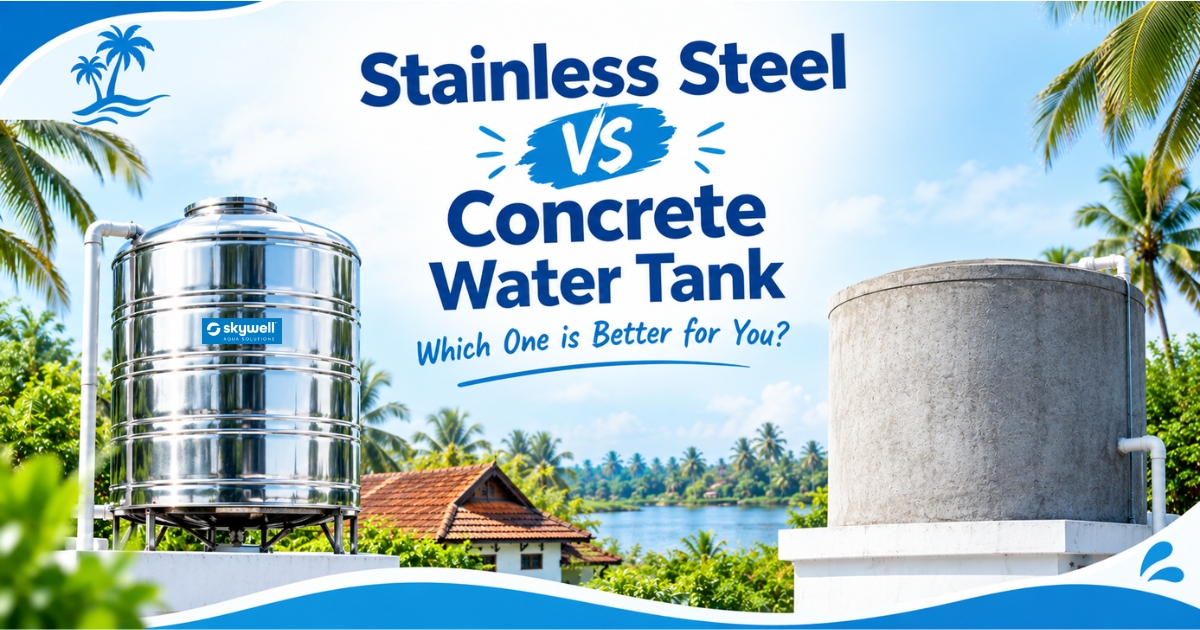
If you are choosing between a stainless steel and concrete water tank, the right answer depends on where the tank will sit, how the structure is built, how easily you need to inspect it, and how permanent the installation should be. Stainless steel suits homeowners who want a manufactured, accessible tank. Concrete suits projects where the tank is designed as part of the building itself.
In this guide
- What is the real difference between stainless steel and concrete water tanks?
- When does stainless steel make more sense?
- What does concrete do particularly well?
- Stainless steel vs concrete water tank: the practical differences
- Will stainless steel rust in Kerala?
- What about the water itself?
- Does Kerala’s monsoon change the decision?
- Who should not buy a stainless steel tank?
- What does Skywell actually offer?
- The honest verdict
What is the real difference between stainless steel and concrete water tanks?
A stainless steel water tank is a factory-fabricated storage vessel that uses corrosion-resistant steel to hold water, while a concrete water tank is a civil structure designed and built to retain water.
That distinction matters more than the material names.
A concrete tank is normally part of the construction plan. Its dimensions, reinforcement, waterproofing and construction sequence need to be considered by the civil team. India’s BIS standard IS 3370 (Part 1):2021 covers general requirements for concrete structures designed to retain aqueous liquids, while IS 3370 (Part 2):2021 covers plain and reinforced concrete liquid-retaining structures. BIS reviewed these standards in 2026. [BIS, reviewed 2026]
A stainless steel tank arrives as a manufactured product. The installation still needs a suitable, level support and correctly planned plumbing, but the storage vessel itself does not need to be cast on site.
That makes the two options fundamentally different building decisions.
When does stainless steel make more sense?
For a Kerala homeowner renovating a house, adding a tank to an existing terrace or looking for a manufactured tank that can be inspected and drained, stainless steel can be a practical choice.
Skywell stainless steel water tanks use food-grade AISI 304 stainless steel and are offered in 500 L to 5000 L capacities, with vertical and horizontal configurations. Skywell states that its stainless steel tanks carry a 10-year warranty and are manufactured at its Kanjikode, Palakkad facility. [Skywell Aqua Solutions, accessed September 2026]
Skywell stainless steel water tanks
The useful feature here is not simply that the tank is stainless steel. Look at the complete system.
Can the lid be opened for inspection? Can the tank be drained properly? Can a plumber reach the inlet, outlet and drain connections? Can the tank be installed safely on the existing support?
Those questions matter on a real Kerala terrace.
Skywell’s stainless steel tank specification includes an accessible lid and drain valve for inspection, emptying and flushing. [Skywell Aqua Solutions, accessed September 2026]
What does concrete do particularly well?
Concrete has one major advantage that should not be ignored: it can be designed as a permanent part of a building.
If your house is still at the structural design stage and the architect or engineer has already planned a reinforced-concrete storage tank, changing the material simply because stainless steel looks newer may make little sense.
BIS specifically provides design and construction guidance for concrete structures intended to retain water through IS 3370. [BIS, reviewed 2026]
Concrete can also make sense for large, fixed installations where the storage structure is deliberately integrated into the building.
The catch is workmanship.
A concrete water tank is a civil construction job. Reinforcement, concrete quality, curing, joints, waterproofing and detailing all affect the finished structure. A manufactured stainless steel tank shifts much of that fabrication work away from the construction site.
Neither material removes the need for proper installation.
Stainless steel vs concrete water tank: the practical differences
| Factor | Stainless steel tank | Concrete tank |
| Basic construction | Factory-fabricated vessel | Civil construction |
| Typical role | Manufactured storage unit | Building-integrated structure |
| Inspection | Accessible tank opening can be provided | Depends on the tank design |
| Drainage | Dedicated drain arrangement can be provided | Depends on design and plumbing |
| Installation | Requires suitable support and connections | Requires structural and civil work |
| Modification after construction | Tank can be selected as a separate product | Changes may involve civil work |
| Standard reference | Stainless steel material standards apply to the steel | BIS IS 3370 covers liquid-retaining concrete structures |
| Best planning stage | Renovation, replacement or planned tank installation | New construction where storage is integrated into the structure |
The table is a practical construction guide, not a claim that one material is universally superior.
Will stainless steel rust in Kerala?
Stainless steel is corrosion-resistant, but “stainless” does not mean “immune to every environment.”
A peer-reviewed study published in 2017 tested SS304 and SS316 under atmospheric, underground and seawater-splash conditions in Jubail, an industrial coastal city in the Arabian Gulf. Both materials showed corrosion under those conditions, with chloride and sulphate concentrations identified among the factors affecting corrosion. This is international evidence, not Kerala-specific evidence. [Corrosion Engineering, Science and Technology, 2017]
Corrosion study of SS304 and SS316
That matters for coastal Kerala.
A house near the coast in Kannur, Kozhikode, Alappuzha or Kollam should not treat stainless steel as a magic word. Grade, fabrication quality, weld quality, installation conditions and exposure all matter.
For that reason, the honest question is not “Can stainless steel ever corrode?”
It can.
The better question is whether the specified grade and manufactured tank are appropriate for the installation environment.
What about the water itself?
Your tank material is only one part of the water-storage system.
Kerala households may depend on groundwater, private wells, rainwater systems or piped public supply. Groundwater conditions also vary across the state.
The Central Ground Water Board’s Kerala pre-monsoon 2024 assessment used about 545 groundwater monitoring wells for water-quality evaluation. The report covered parameters including pH, electrical conductivity, hardness, calcium, magnesium, sodium, chloride, sulphate, nitrate and iron. [CGWB, 2024]
CGWB Kerala Groundwater Quality Bulletin, Pre-Monsoon 2024
That does not mean every Kerala household has hard or corrosive water. It means you should avoid buying a tank based on a generic claim about “Kerala water.”
If your household relies on a private well and you have concerns about water quality, test the water first. Kerala’s Ground Water Department lists domestic water-quality analysis parameters including total hardness, chloride, sulphate, nitrate and iron. [Government of Kerala, accessed September 2026]
Kerala Ground Water Department water-quality services
Does Kerala’s monsoon change the decision?
It changes the installation conversation.
Kerala received 1748.1 mm of rainfall during June to September 2024, compared with a long-period normal of 2018.6 mm, according to the India Meteorological Department. This is Kerala-specific rainfall data for the 2024 southwest monsoon. [IMD, 2024]
India Meteorological Department 2024 Monsoon Report
Rain also exposes bad plumbing decisions quickly.
During heavy monsoon periods, check the tank lid, overflow route, inlet arrangement, support, surrounding drainage and access for inspection. A tank that is technically good but awkward to reach is a maintenance problem waiting for the next rainy season.
For a Kerala house, the terrace layout matters as much as the catalogue specification.
Who should not buy a stainless steel tank?
Stainless steel is not automatically the right answer.
You may not need one if your new house already has a properly engineered concrete storage tank incorporated into the structural design. You may also want to stay with the concrete design if the project requires a fixed, building-integrated reservoir rather than a separate manufactured tank.
And if your terrace cannot safely support the proposed tank and its full water load, stop there. Ask your structural engineer to assess the support before choosing the material.
Do not buy stainless steel simply because a salesperson says it is “premium.”
Buy it when its installation format, accessibility, material specification and maintenance requirements fit your house.
What does Skywell actually offer?
Skywell Aqua Solutions is based in Kanjikode, Palakkad, and states that its manufacturing facility is ISO 9001:2015 certified. The company also states that it provides a 10-year warranty across its water tank products. [Skywell Aqua Solutions, accessed September 2026]
Its stainless steel range is listed as food-grade AISI 304, with capacities from 500 L to 5000 L. The product page also recommends professional installation and regular cleaning and inspection. [Skywell Aqua Solutions, accessed September 2026]
Skywell stainless steel tank specifications
That is the level at which you should compare manufacturers: actual steel grade, fabrication, installation requirements, warranty terms and after-sales support.
Not just the word “steel.”
Have a question about your tank installation?
If you already know your required capacity but are unsure about vertical or horizontal installation, terrace placement or fittings, message Skywell on WhatsApp and ask the specific question. The company lists its Kanjikode, Palakkad contact details publicly. [Skywell Aqua Solutions, accessed September 2026]
The honest verdict
For a new building designed around a permanent reinforced-concrete storage structure, concrete can be the logical choice.
For a homeowner who wants a separately manufactured tank with an accessible design, defined stainless steel grade, factory fabrication and a documented warranty, stainless steel can make more sense.
The material should follow the building situation, not the other way around.
FAQ
Is stainless steel better than a concrete water tank?
Neither material is universally better. A concrete tank can suit a new building where water storage is engineered as part of the structure. A stainless steel tank can suit a homeowner who wants a separately manufactured vessel with defined material specifications, accessible inspection and factory-backed warranty coverage.
Can a stainless steel water tank rust in Kerala?
Stainless steel is corrosion-resistant, but it is not completely immune to corrosion. International research has documented corrosion of SS304 under aggressive coastal conditions involving chlorides and humidity. That evidence should be treated as an international benchmark, not as proof of a specific Kerala failure rate.
Is concrete suitable for storing water?
Yes. BIS IS 3370 provides requirements for concrete structures intended to retain aqueous liquids. A concrete water tank still requires proper structural design, construction, joints, curing and waterproofing. The suitability of a particular tank depends on how it has been designed and constructed.
What stainless steel grade does Skywell use?
Skywell states that its stainless steel water tanks use food-grade AISI 304 stainless steel. The listed capacities range from 500 L to 5000 L, with vertical and horizontal options. The product information also recommends professional installation and regular cleaning and inspection.
Which tank is easier to inspect and maintain?
A manufactured stainless steel tank can provide direct access through its lid and can include a drain arrangement for emptying and flushing. A concrete tank’s inspection and maintenance access depends on the structure’s original design. For either option, accessible plumbing and safe maintenance space should be planned before installation.
Should a Kerala homeowner test well water before choosing a tank?
If your home depends on private groundwater and you have concerns about hardness, chloride, iron or other water-quality parameters, testing the source water is sensible. The Kerala Ground Water Department lists these among its domestic water-quality analysis parameters.
Is stainless steel suitable for every home?
No. Stainless steel may not be necessary if your house already has a properly engineered concrete storage tank designed as part of the building. It is also unsuitable if the proposed installation cannot provide adequate structural support, safe access or appropriate plumbing connections.