Short answer:
In this guide
- What is SS-304 stainless steel?
- Why is SS-304 widely used for drinking-water storage?
- Does SS-304 mean the tank cannot rust?
- What does Kerala’s climate have to do with your tank?
- Does a good SS-304 tank guarantee clean drinking water?
- What should you check before buying an SS-304 water tank?
- Who should not buy a stainless-steel water tank?
- What does Skywell provide beyond the steel grade?
- Is SS-304 the “world standard” for drinking-water tanks?
- How should you decide whether SS-304 suits your home?
- Author information
- Still have a question?
- Frequently asked questions
SS 304 drinking water safe is a reasonable conclusion when genuine SS-304 is used in a properly manufactured tank intended for drinking-water storage. But the steel grade alone is not enough. Material authenticity, fabrication, fittings, water chemistry, installation and maintenance also affect the finished system.
Key takeaways
- Genuine SS-304 is widely recognised for suitable drinking-water contact applications.
- SS-304 resists corrosion but is not immune to corrosion in every water condition.
- Water chemistry, fabrication quality and fittings matter alongside the steel grade.
- A stainless-steel tank cannot correct contamination already present in the water supply.
- Coastal or aggressive water conditions may require more careful material selection.
If you want to check whether stainless steel suits your home, explore Skywell’s stainless steel water tank range or message Skywell on WhatsApp for a quote.
What is SS-304 stainless steel?
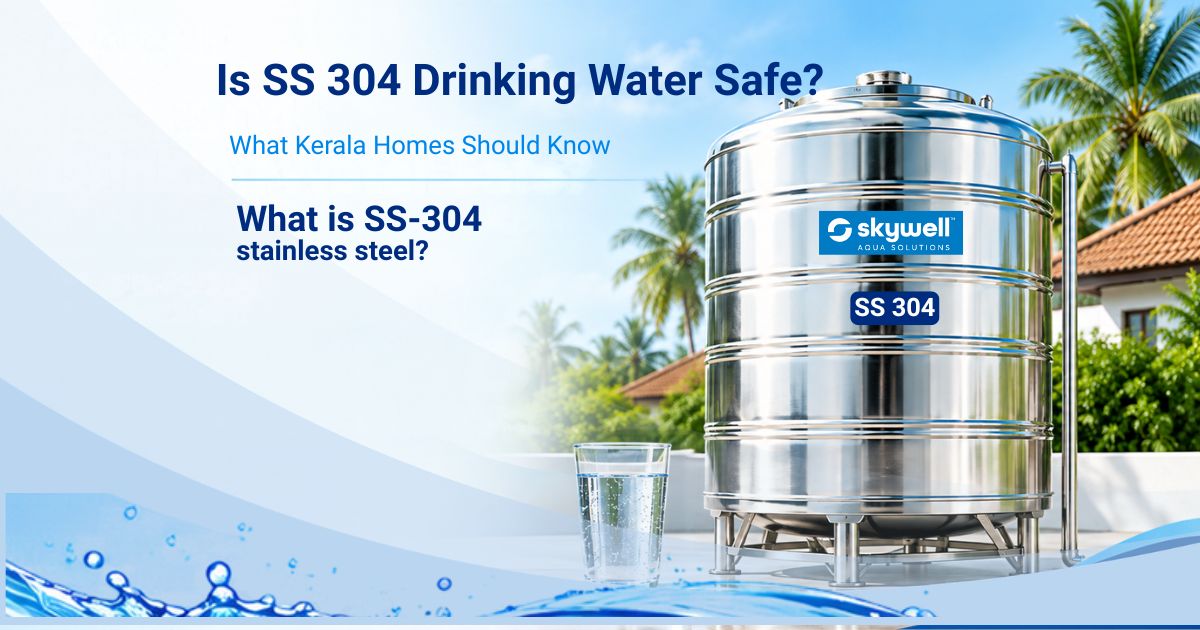
SS-304 is an austenitic stainless-steel grade widely used where corrosion resistance and suitability for contact applications matter. The term “304” identifies a specific stainless-steel grade rather than a general description of stainless steel.
India’s Bureau of Indian Standards lists IS 6911:2026, Stainless Steel Plate, Sheet and Strip – Specification, as the current standard in this series, with the record showing it as the third revision and reviewed in 2026. ⟦VERIFY SOURCE URL⟧
For a drinking-water tank, however, the useful question is not simply whether stainless steel is safe. You should ask which grade is used, whether the finished product is intended for drinking-water contact, and how the tank has been manufactured.
The UK’s Drinking Water Inspectorate guidance published in December 2025 identifies stainless-steel grades including 304 and 316 among grades suitable for drinking-water use, while distinguishing material suitability from requirements applying to finished products and their intended use. Drinking Water Inspectorate, stainless-steel guidance, December 2025. ⟦VERIFY SOURCE URL⟧
That distinction matters. A grade specification tells you what the material is; it does not by itself describe every part of the finished tank.
Why is SS-304 widely used for drinking-water storage?
SS-304 is widely used because it combines corrosion resistance with established use in applications involving water and food contact. Its suitability still depends on the application and the conditions in which the finished product operates.
The Drinking Water Inspectorate’s December 2025 guidance identifies 304 and 316 among recognised austenitic stainless-steel grades suitable for drinking-water use under relevant product requirements. Drinking Water Inspectorate, stainless-steel guidance, December 2025. ⟦VERIFY SOURCE URL⟧
WHO takes a broader approach to drinking-water safety. Its Guidelines for Drinking-water Quality describe drinking-water safety as a risk-management process extending from the source through to the consumer. World Health Organization, Guidelines for Drinking-water Quality, 2026. ⟦VERIFY SOURCE URL⟧
That means the tank material is one part of the system. Your source water, pipes, fittings, tank condition and maintenance all remain relevant.
So the practical answer is simple: SS-304 is a credible material choice for drinking-water storage, but “304” should not be treated as a guarantee covering the entire water system.
Does SS-304 mean the tank cannot rust?
No. SS-304 is corrosion-resistant, but it is not immune to corrosion under every combination of water chemistry, temperature, surface condition and fabrication quality.
A peer-reviewed study published in December 2025 examined 304 stainless steel under simulated potable-water conditions with different chloride and hypochlorite concentrations at several temperatures. The study reported changes in corrosion behaviour under the tested conditions. ⟦VERIFY SOURCE URL⟧
Chloride deserves particular attention because stainless-steel performance can vary as chloride exposure increases. International technical guidance distinguishes between 304 and 316 for some more aggressive chloride environments, although such guidance should be treated as an engineering reference rather than automatically as a Kerala regulatory limit.
This matters for Kerala homes because water conditions are not identical everywhere. A coastal property, a home using a private well and a house receiving treated piped water can present different conditions.
Do not accept either extreme: “SS-304 never rusts” is too broad, while “SS-304 will rust” is equally unsupported without knowing the conditions.
What does Kerala’s climate have to do with your tank?
Kerala’s climate makes tank placement, access, overflow routing and installation particularly practical considerations, but rainfall alone does not determine whether SS-304 is suitable.
The India Meteorological Department reported 1,748.1 mm of rainfall across Kerala during June to September 2024, compared with a normal of 2,018.6 mm. India Meteorological Department, Southwest Monsoon 2024 report, published 2025. ⟦VERIFY SOURCE URL⟧
That rainfall figure does not prove that a Kerala home needs a stainless-steel tank. It does show why your water-storage system needs to be planned for substantial seasonal rainfall and changing conditions.
Your overhead tank should remain accessible for inspection. Overflow water needs a suitable route. Inlet and outlet connections should be installed without placing unnecessary stress on the tank.
Your water source matters too. Private well water should not automatically be assumed to have the same chemistry as treated piped water. If the source or its quality changes seasonally, that should be considered when selecting materials and planning maintenance.
Does a good SS-304 tank guarantee clean drinking water?
No. A stainless-steel tank can provide a suitable water-contact surface, but it cannot make unsuitable source water suitable for drinking.
WHO’s drinking-water guidance treats safety as a risk-management process from source to consumer. World Health Organization, Guidelines for Drinking-water Quality, 2026. ⟦VERIFY SOURCE URL⟧
That means several separate questions need to be answered. Is the source water suitable? Are the pipes and fittings appropriate? Is the tank properly covered? Is the system maintained? Has contamination entered somewhere before or after storage?
A tank cannot correct poor-quality well water. It cannot repair a dirty inlet pipe. It cannot compensate for a damaged lid or unsuitable plumbing.
This is why material selection should be treated as one decision within the complete water-storage system.
What should you check before buying an SS-304 water tank?
Before buying an SS-304 tank, verify the actual material grade, water-contact surface, fabrication quality, fittings, installation requirements, warranty and manufacturer support.
Do not stop at the phrase “food-grade stainless steel.” Ask what grade is used and whether the stated grade applies to the surface that contacts your stored water.
For a Kerala homeowner, the following checklist is more useful than a broad claim that stainless steel is automatically superior.
| What to check | Why it matters |
|---|---|
| Stainless-steel grade | Confirms the material you are actually buying |
| Water-contact surface | Establishes what material your stored water contacts |
| Fabrication and welds | Poor workmanship can undermine otherwise suitable material |
| Water source | Well and treated piped water can present different conditions |
| Installation access | Practical access supports inspection and maintenance |
| Fittings | The tank is part of a wider plumbing system |
| Warranty | Defines the manufacturer’s stated support after purchase |
| Manufacturer | Traceability matters for technical and warranty questions |
Skywell states that its stainless-steel tanks use food-grade AISI 304 stainless steel. The company manufactures in Kanjikode, Palakkad, at an ISO 9001:2015-certified manufacturing plant.
Skywell’s stated stainless-steel capacities are 500 L, 1,000 L, 1,500 L, 2,000 L, 3,000 L and 5,000 L, with vertical and horizontal options. These are manufacturer specifications and should be checked against the documentation supplied with your tank.
What if your plumber recommends another tank?
Your plumber’s advice matters because the plumber understands your pipe layout, pump, terrace and installation constraints. You should still ask what material grade the proposed tank uses and what the manufacturer’s warranty covers.
A sensible purchase is one where the installation advice and the manufacturer’s technical specification agree. If they do not, resolve the difference before placing the order.
What if you are worried about rust?
Ask about your water conditions rather than accepting an absolute promise. Chloride exposure, temperature, water chemistry, fabrication and surface condition can all affect corrosion behaviour.
If your home is near the coast or your water has unusually high chloride levels, ask the supplier whether the proposed grade is appropriate for those conditions. Where the water chemistry is uncertain, testing can provide more useful information than a general claim about stainless steel.
The practical question is not whether stainless steel can ever corrode. It is whether the specified material and finished tank are appropriate for your actual application.
If you are comparing materials, see Skywell’s guide to stainless steel versus plastic water tanks in Kerala before making the final choice.
If your requirement is straightforward, you can also review Skywell’s plastic water tank range alongside the stainless-steel options.
Who should not buy a stainless-steel water tank?
A stainless-steel tank may not be the right choice if your only requirement is the lowest upfront cost. Material selection should follow the application, installation conditions and household budget rather than the assumption that a more premium-sounding material is automatically necessary.
You also should not choose SS-304 solely because a salesperson says it is “the world standard.” There is international recognition of 304 for suitable drinking-water applications, but that does not establish one mandatory worldwide standard for every drinking-water tank.
If your water has unusually aggressive chemistry or your installation has high chloride exposure, get specific technical advice rather than relying on the grade name alone.
If another material has been specified for your particular building or water-storage application, follow that requirement unless the relevant professional confirms a change is appropriate.
For a typical homeowner, the important checks remain straightforward: genuine material, suitable fabrication, appropriate installation and a manufacturer that can provide support after purchase.
Have a question about whether SS-304 suits your home, water source or tank size? Message Skywell on WhatsApp for free, practical guidance.
What does Skywell provide beyond the steel grade?
Skywell Aqua Solutions manufactures stainless-steel water tanks in Kanjikode, Palakkad, Kerala. The company states that its manufacturing plant is ISO 9001:2015 certified and that its stainless-steel tanks use food-grade AISI 304 stainless steel.
The stated stainless-steel range covers 500 L to 5,000 L in vertical and horizontal configurations. Skywell also states a 10-year warranty on its stainless-steel and plastic tanks.
These are manufacturer specifications, not independent test findings. They should be checked against the product documentation and warranty supplied for your purchase.
The local manufacturing location can also matter practically. If your home is in Thrissur, Kochi, Palakkad, Kozhikode or another part of Kerala, access to a state-wide dealer network and a reachable manufacturer can be useful when questions arise after installation.
A tank remains part of your home infrastructure for years. Support after delivery is therefore worth considering alongside the material specification.
Is SS-304 the “world standard” for drinking-water tanks?
No single worldwide rule makes SS-304 the mandatory material for every drinking-water tank. SS-304 is widely recognised internationally for suitable drinking-water applications, but finished-product requirements and local rules still matter.
The UK’s Drinking Water Inspectorate identifies 304 and 316 among recognised stainless-steel grades suitable for drinking-water use. Drinking Water Inspectorate, stainless-steel guidance, December 2025. ⟦VERIFY SOURCE URL⟧
That is useful international evidence, but it should not be presented as a Kerala regulatory requirement.
For a homeowner, the more useful question is whether the specific tank is genuine SS-304, properly manufactured, suitable for the actual water conditions, correctly installed and supported by the manufacturer.
The grade matters. The finished tank matters more.
How should you decide whether SS-304 suits your home?
Start with the application, then verify the material and installation conditions. You do not need to make the decision from the steel grade alone.
Take these questions to your plumber, engineer or supplier:
- What water source will fill the tank, and is its chemistry known?
- What stainless-steel grade is specified for the water-contact surface?
- How are the tank, welds, inlet, outlet and fittings fabricated and installed?
- What warranty applies, and who will handle service questions after installation?
- Is the proposed tank capacity suitable for the household’s actual storage requirement?
If your supplier cannot answer these questions clearly, pause before ordering. A clear specification is more useful than a broad material claim.
Author information
Skywell Aqua Solutions makes food-grade stainless steel and plastic water tanks in Palakkad, Kerala.
Not sure which tank suits your home? Message us on WhatsApp for free, honest advice.
Still have a question?
If you are unsure whether SS-304 suits your water source or installation, send Skywell your requirements and ask for practical guidance.
WhatsApp Skywell: Message us for a water tank quote
Cite as: skywell.in/ss-304-drinking-water-safe/
Frequently asked questions
Is SS 304 drinking water safe?
Yes, genuine SS-304 is widely recognised internationally as a stainless-steel grade suitable for appropriate drinking-water contact applications. The UK’s Drinking Water Inspectorate guidance published in December 2025 identifies 304 and 316 among recognised stainless-steel grades suitable for drinking-water use. Finished-product suitability, fabrication, fittings and water conditions still need to be considered.
Does SS-304 make water safe to drink?
No. SS-304 can provide a suitable material for water storage, but it cannot correct poor-quality source water or contamination elsewhere in the plumbing system. WHO’s Guidelines for Drinking-water Quality describe drinking-water safety as a risk-management process extending from the source through the distribution and storage system to the consumer.
Can SS-304 stainless steel rust?
SS-304 is corrosion-resistant but is not immune to corrosion under every condition. Chloride concentration, temperature, water chemistry, fabrication and surface condition can influence performance. A peer-reviewed study published in December 2025 examined 304 stainless steel under simulated potable-water conditions and reported changes in corrosion behaviour under different tested conditions. ⟦VERIFY SOURCE URL⟧
Is SS-304 suitable for a Kerala home?
SS-304 can be suitable for Kerala household water storage, but the actual water source and installation conditions matter. Coastal exposure, chloride levels and private-well water chemistry may require additional consideration. Practical issues such as tank access, overflow routing and installation quality also matter. The material grade should therefore be assessed as part of the complete application.
Is SS-304 better than SS-316 for drinking water?
There is no universal answer. Both 304 and 316 are recognised internationally for suitable drinking-water applications, while 316 can provide greater resistance in some more aggressive chloride environments. The appropriate choice depends on water chemistry and exposure conditions. The UK’s December 2025 Drinking Water Inspectorate guidance recognises both grades for suitable drinking-water applications.
What should I check before buying an SS-304 water tank?
Check the stated stainless-steel grade, the material used on the water-contact surface, fabrication and weld quality, fittings, installation requirements and warranty terms. You should also consider your water source and local exposure conditions. A reputable manufacturer should be able to explain the specification clearly rather than relying only on the phrase “food-grade stainless steel.”
What sizes does the Skywell SS-304 tank range cover?
Skywell’s stated stainless-steel water tank range covers 500 L, 1,000 L, 1,500 L, 2,000 L, 3,000 L and 5,000 L, with vertical and horizontal configurations. Skywell states that these tanks use food-grade AISI 304 stainless steel and carry a 10-year warranty. These are manufacturer specifications and should be confirmed against current product documentation.