Short answer:
In this guide
- Key takeaways
- Why does my drinking water smell like the tank?
- Can stored water develop a taste or smell?
- Can the tank material affect taste or odour?
- What should you check before replacing the tank?
- What changes during Kerala’s monsoon?
- What about well water and KWA water?
- Does stainless steel guarantee odour-free water?
- Who should not buy a stainless steel tank?
- What should you ask your plumber or supplier?
- What does a Skywell stainless steel tank actually solve?
- Still have a question?
- Frequently asked questions
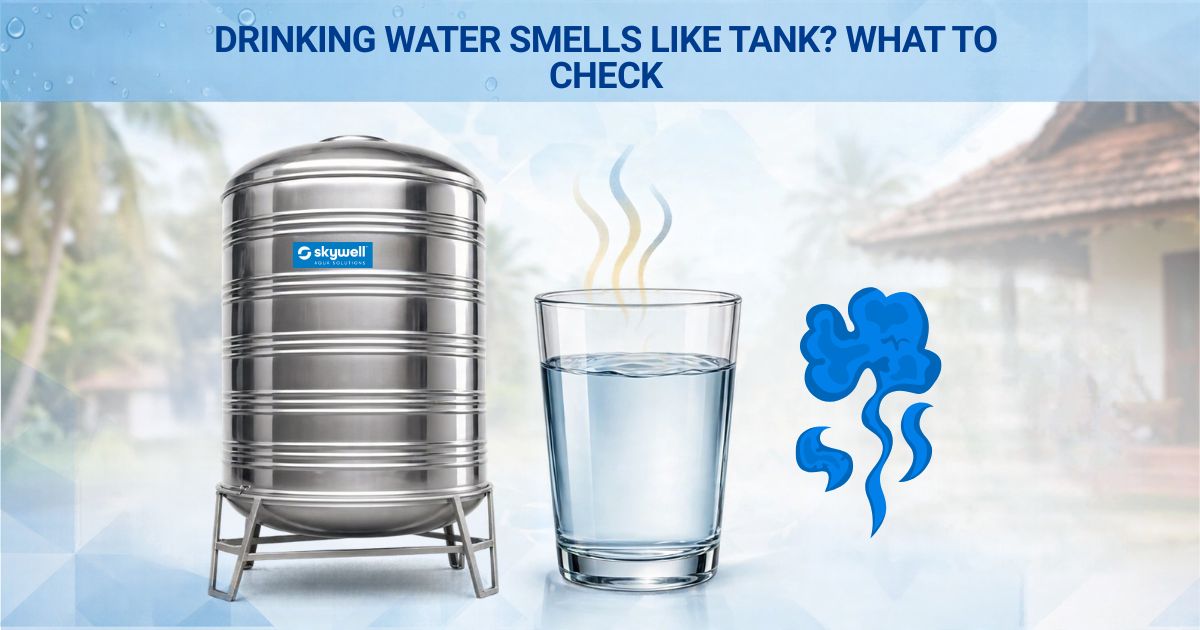
Drinking water smells like tank when something changes between the water source, storage tank, plumbing or tap. Stagnation, sediment, storage conditions and some material-related effects can contribute to taste or odour. Check the water before storage, at the tank outlet and at the tap before deciding to replace the tank.
Key takeaways
- A tank is only one possible source of unusual drinking-water taste or odour.
- Compare water at the source, tank outlet and kitchen tap before replacing anything.
- Stagnation, sediment, temperature and cleaning can affect stored-water characteristics.
- Tank material can matter, but it does not explain every odour problem.
- Persistent or unexplained changes may justify laboratory water testing.
If you are unsure whether the tank itself is responsible, message Skywell on WhatsApp with your tank capacity and water-source details. We can help you identify what to check before you buy.
Why does my drinking water smell like the tank?
A water tank can contribute to changes in drinking-water taste or odour, but the source, plumbing and storage conditions must also be considered. The World Health Organization treats taste, odour and appearance as important acceptability characteristics of drinking water. Government and water-quality guidance also emphasises managing water-quality risks across the route from source to consumer. (WHO, Guidelines for drinking-water quality: fourth edition incorporating the first, second and third addenda, 2026)
Think of your home’s water route:
Source → sump → pump → overhead tank → pipe → kitchen tap
A smell from your kitchen tap does not tell you where the smell started. If the water already smells before entering the tank, replacing the tank will not remove the original source.
If the water is normal before storage but changes at the tank outlet, storage deserves closer inspection. If the tank outlet is normal but the kitchen tap smells, look downstream at the pipework, fittings or tap.
That is the first distinction to make.
Can stored water develop a taste or smell?
Yes. Prolonged storage, stagnation, poor circulation, temperature effects, infrequent cleaning and sediment can contribute to changes in stored-water quality, including taste and odour. Research on drinking-water storage tanks identifies these factors as contributors to deterioration during extended storage. (Physical and compositional characteristics of drinking water storage tank sediment, 2024)
This does not mean every stored tank will develop an odour. The actual conditions in your tank matter.
A tank that receives and supplies water regularly is different from one where water remains for long periods. Sediment can also accumulate at the bottom and become disturbed when water enters or leaves the tank. Research on storage cisterns has identified stagnation and sediment accumulation as factors associated with declining water quality. (Evaluation of Water Quality of Water Storage Cisterns in Apartments, 2024)
So if your water smells different after a long period of low use, inspect the storage system before assuming the tank material is the problem.
For practical maintenance guidance, you can also read our [water tank maintenance guide for Kerala]water tank maintenance guide for Kerala.
Can the tank material affect taste or odour?
It can under some conditions, but material research should not be turned into a blanket claim about every tank. Specific materials and exposure conditions can produce different results.
For example, a 1994 Water Research study found detectable taste and odour development in water stored in LDPE containers exposed to direct sunlight for two weeks. The study concerned particular LDPE containers and laboratory exposure conditions, not every polyethylene tank used in a home. (Calvosa et al., “Taste and odour development in water in polyethylene containers exposed to direct sunlight,” Water Research, 1994)
That distinction matters.
Skywell plastic water tanks use a food-grade 100% virgin polyethylene inner layer in a three-layer, UV-stabilised construction. That is a product specification, not a guarantee that stored water can never develop an odour.
The sensible question is therefore not simply, “Which material never affects water?” It is, “Is this particular tank suitable for my intended water storage, and are the source, installation and maintenance conditions appropriate?”
Material matters. It is not the whole diagnosis.
What should you check before replacing the tank?
Start at the beginning of the water line and compare the same water at different points. This helps separate a source-water issue from a storage or plumbing issue.
| Check point | What you are trying to find |
|---|---|
| Source or incoming supply | Does the water already have the smell or taste? |
| Sump | Has the change appeared before pumping? |
| Tank outlet | Does stored water smell different from incoming water? |
| Kitchen tap | Is the issue limited to one outlet or pipe run? |
| Tank interior | Is there visible sediment or a maintenance issue? |
The table is a diagnostic sequence, not a laboratory test. A difference between sampling points can help locate where to investigate, but it does not identify a chemical or microbiological cause by itself.
Kerala Water Authority states that its Quality Control Wing tests water from KWA schemes as well as wells and private samples. Its district laboratories analyse basic physical, chemical and bacteriological parameters according to IS 10500-2012. (Kerala Water Authority, Quality Control, accessed September 2026)
KWA also states that private-party water samples can be tested through its district laboratories. (Kerala Water Authority, Quality Testing, accessed September 2026)
If the smell persists and you cannot identify the source, testing can be more useful than replacing equipment based only on taste or odour.
What changes during Kerala’s monsoon?
Kerala’s monsoon can change the conditions around your water source and storage system, so a new taste or odour should be investigated rather than automatically blamed on the tank.
For homes using wells or other groundwater sources, seasonal changes in groundwater conditions can vary by location. The Central Ground Water Board publishes Kerala-specific groundwater quality reports, including the Ground Water Quality Yearbook 2024-25. (CGWB, Ground Water Quality Yearbook 2024-25 Kerala, 2025)
Your overhead tank also sits in an exposed environment. Heat, rain, dust, the condition of the cover, inlet, overflow and access for cleaning can all matter operationally.
A covered and accessible tank is easier to inspect than one that has been difficult to open since installation. Your plumber should also confirm that the tank is properly supported and that connections can be inspected without creating unnecessary access problems.
The practical lesson is simple: inspect the complete storage arrangement, not just the tank wall.
If you are comparing storage options, our [plastic water tank range]plastic water tank range and [stainless steel water tank range]stainless steel water tank range show the materials and capacities available from Skywell.
What about well water and KWA water?
The starting water matters because a storage tank cannot remove a taste or odour that is already present in the incoming supply.
A home using private well water has a different source-water situation from a home receiving Kerala Water Authority supply. KWA’s quality-control system covers water from its supply schemes, wells and private samples. (Kerala Water Authority, Quality Control, accessed September 2026)
If you are investigating an odour, compare samples from different points instead of judging only from the kitchen tap.
| Observation | What it suggests you investigate |
|---|---|
| Smell exists before the tank | Source water, incoming plumbing or sump |
| Smell appears at tank outlet | Storage, sediment, tank condition or material exposure |
| Tank outlet is normal but tap smells | Downstream pipework, fittings or tap |
| Smell varies by season | Source conditions and storage environment |
| Smell persists without an obvious cause | Water testing and professional inspection |
These are diagnostic clues, not proof of a particular cause. A laboratory result is needed when you need to identify a specific water-quality problem.
If you want to understand how different tank materials compare more broadly, see our guide to [stainless steel versus plastic water tanks in Kerala]stainless steel versus plastic water tanks in Kerala.
Does stainless steel guarantee odour-free water?
No. Stainless steel does not guarantee that stored water will never develop an odour.
A stainless steel tank cannot correct poor source water, dirty plumbing, neglected cleaning or an issue originating elsewhere in your household water system.
Skywell stainless steel water tanks use food-grade AISI 304 stainless steel and are available in 500 L, 1,000 L, 1,500 L, 2,000 L, 3,000 L and 5,000 L capacities, in vertical and horizontal options. Skywell states that its manufacturing plant in Kanjikode, Palakkad is ISO 9001:2015 certified.
Skywell also states that its stainless steel and plastic water tanks carry a 10-year warranty.
These are product specifications. They should not be confused with a guarantee about the taste or odour of water in every household.
What about coastal Kerala?
Coastal exposure deserves separate consideration because chloride-rich environments can create corrosion challenges for stainless steel under particular conditions.
A 2020 Materials study examined chloride-related stress corrosion cracking and crevice corrosion in 304L stainless steel under saline test conditions. The researchers found that chloride concentration, exposure time and environmental conditions affected corrosion behaviour. This was laboratory research on 304L steel, not a prediction of corrosion in every household water tank in coastal Kerala. (Yeh, Tsai and Huang, “Influence of Chloride Concentration on Stress Corrosion Cracking and Crevice Corrosion of Austenitic Stainless Steel in Saline Environments,” Materials, 2020)
That is why grade, fabrication, surface condition, installation and exposure should all be considered.
Capacity comes first. Material comes after.
If you are considering stainless steel and want practical guidance before ordering, message Skywell on WhatsApp with your required capacity, water source and installation details. There is no need to replace a tank simply because the kitchen tap smells unusual.
Who should not buy a stainless steel tank?
If your only reason for changing your tank is an unexplained smell from the kitchen tap, do not buy a new tank yet. Find the source first.
If your existing tank is suitable for your storage requirement, properly maintained and not the source of the problem, replacement may add cost without solving the odour.
If your household has a tight budget and a suitable plastic tank already meets your requirements, stainless steel may not be the purchase you need.
You also should not choose a particular tank until your installation conditions are clear. Available space, support, access, connections, water source and required capacity all matter.
The right tank is the one that fits your water source, storage requirement, installation conditions and maintenance expectations.
What should you ask your plumber or supplier?
Take these questions with you before ordering a replacement.
- Does the water already smell before it enters the storage tank?
- Can we compare the source, tank outlet and kitchen tap separately?
- Is the existing tank clean, accessible and suitable for the required storage capacity?
- Does the proposed tank material and construction suit my water source and installation conditions?
- If the odour remains after cleaning or inspection, should I arrange laboratory water testing?
Do not let a single smell at the kitchen tap decide the entire purchase.
A proper diagnosis can show that the tank is responsible. It can also show that the tank is not responsible.
What does a Skywell stainless steel tank actually solve?
It gives you a food-grade AISI 304 stainless steel storage option manufactured by Skywell in Kanjikode, Palakkad. Skywell states that its manufacturing plant is ISO 9001:2015 certified and that its stainless steel water tanks are covered by a 10-year warranty.
It does not test your well water.
It does not repair old plumbing.
It does not remove an odour that originates before the water enters the tank.
It does not eliminate the need for sensible inspection and maintenance.
That distinction is useful because you are choosing a storage system, not buying a cure for every water-quality problem in the house.
The same principle applies when comparing stainless steel and plastic: choose according to the actual storage requirement rather than assuming the material alone determines water quality.
Skywell Aqua Solutions makes food-grade stainless steel and plastic water tanks in Palakkad, Kerala.
Not sure which tank suits your home? Message us on WhatsApp for free, honest advice.
Still have a question?
If you still cannot tell whether the smell comes from the source, tank or plumbing, send Skywell the tank capacity, water source and a short description of when the odour appears. Message us on WhatsApp for practical guidance before replacing the tank.
Cite as: skywell.in/drinking-water-smells-like-tank/
Frequently asked questions
Can a water tank make drinking water smell?
Yes, storage conditions can contribute to changes in drinking-water taste or odour. Prolonged storage, stagnation, poor circulation, temperature effects, infrequent cleaning and sediment are recognised factors that can affect stored-water quality. The tank is only one possible source, so compare water before storage, at the tank outlet and at the tap before replacing it. (Physical and compositional characteristics of drinking water storage tank sediment, 2024)
Why does my drinking water smell like plastic?
An unusual taste or odour can sometimes be associated with particular materials that contact drinking water under specific conditions. A 1994 Water Research study found taste and odour development in LDPE containers exposed to direct sunlight for two weeks. That result does not mean every polyethylene tank causes the same effect because product construction, exposure and conditions differ. (Calvosa et al., Water Research, 1994)
Should I replace my water tank if the water smells bad?
Not immediately. First compare the source water, sump, tank outlet and kitchen tap. If the smell exists before storage, the tank may not be responsible. If the smell appears after storage, inspect the tank, sediment, storage conditions and plumbing connections. If the cause remains unclear, laboratory water testing can provide evidence before you spend money on replacement.
Does stainless steel stop water from developing an odour?
No. Stainless steel cannot guarantee that water will never develop an odour because source water, stagnation, sediment, temperature, cleaning and plumbing can all influence water characteristics. Skywell specifies food-grade AISI 304 stainless steel for its stainless steel tanks, but that material specification does not guarantee a particular taste or odour outcome in every household.
Is AISI 304 suitable for water storage?
Skywell specifies food-grade AISI 304 stainless steel for its stainless steel water tanks. The company’s stated stainless steel capacities range from 500 L to 5,000 L, with vertical and horizontal options, and Skywell states that its tanks carry a 10-year warranty. These are product specifications and should be considered alongside capacity, installation and water-source requirements.
Can coastal conditions affect stainless steel?
Chloride-rich saline environments can create corrosion conditions for 304L stainless steel under particular laboratory conditions. A 2020 Materials study examined chloride concentration, exposure time and corrosion behaviour in 304L stainless steel under saline conditions. That research should not be treated as a prediction that every stainless steel tank in coastal Kerala will corrode. (Yeh, Tsai and Huang, Materials, 2020)
Where can I test my drinking water in Kerala?
Kerala Water Authority operates district laboratories for water-quality testing and states that private-party samples can also be tested. Its Quality Control Wing monitors drinking water supplied through KWA schemes and tests physical, chemical and bacteriological parameters according to IS 10500-2012. KWA also publishes district laboratory contact details for consumers seeking testing services. (Kerala Water Authority, Quality Control and Quality Testing, accessed September 2026)
What should I check if drinking water smells like tank?
Check the water source first, then compare it with water from the sump, tank outlet and kitchen tap. Inspect the tank for sediment and maintenance issues, and consider the condition of downstream plumbing. If the smell persists or the cause remains uncertain, arrange appropriate water testing rather than assuming that changing the tank will solve the problem.