What Is a Food Grade Stainless Steel Water Tank? And Why Does It Matter?
Short answer:
In this guide
- What does “food grade” mean for a stainless steel water tank?
- Is SS-304 the same thing as food grade?
- Why does the steel grade matter for stored water?
- Can a food grade stainless steel water tank make drinking water safe?
- What does Kerala’s climate mean for tank selection?
- What should you check before buying a food grade stainless steel water tank?
- Who should not buy a stainless steel water tank?
- What does Skywell specify for its stainless steel tanks?
- What can and cannot a food grade stainless steel water tank do?
- What is the practical test before you order?
- Still have a question?
- Frequently asked questions
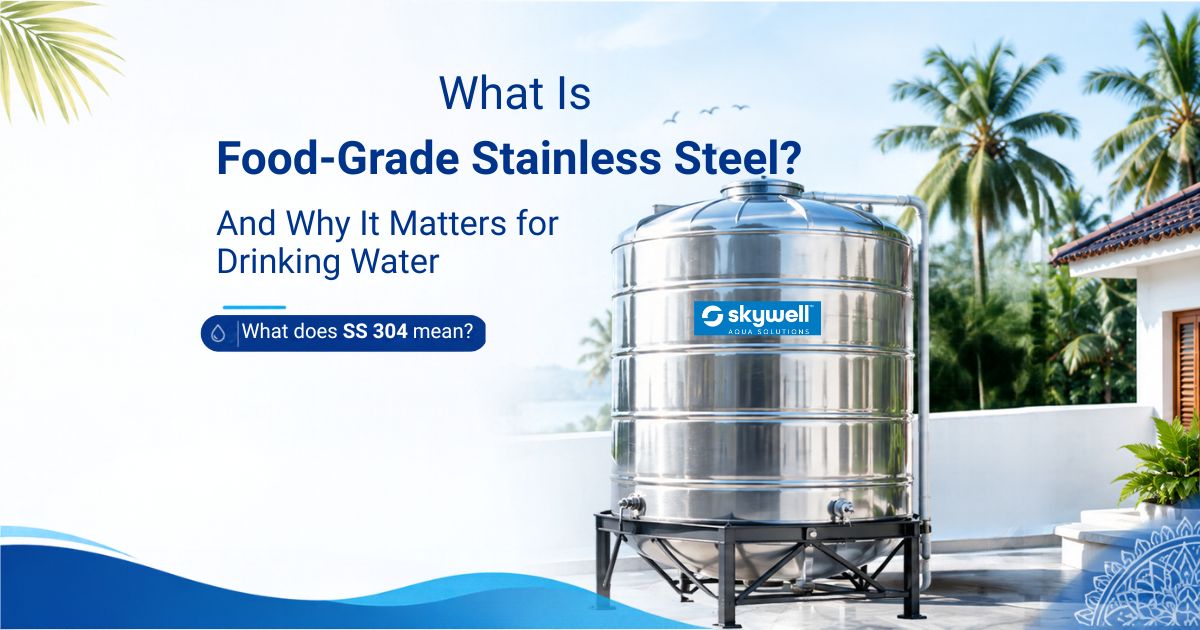
A food grade stainless steel water tank uses stainless steel selected for an intended food- or drinking-water contact application. SS-304 is commonly used for water-storage applications, but the grade alone is not enough. Fabrication, welds, fittings, surface condition, water chemistry, installation and maintenance also affect the finished tank.
Key takeaways
- Food grade describes suitability for an intended contact application, not a magic guarantee.
- SS-304 is commonly used for drinking-water and water-storage applications.
- Tank fabrication, welds, fittings and surfaces matter alongside the steel grade.
- Incoming water quality remains a separate issue from the tank material.
- Coastal or unusual water chemistry can require a more careful material assessment.
WhatsApp advice: If you are comparing tank materials, send Skywell your water source and proposed installation location for practical guidance.
What does “food grade” mean for a stainless steel water tank?
A food grade stainless steel water tank uses material intended for contact with food or drinking water, with the finished application considered as a whole. The phrase should therefore be supported by an identifiable material specification and appropriate manufacturing controls.
“Food grade” is not itself a stainless-steel grade. Stainless steel is a family of alloys, so a buyer should ask which exact grade is being used.
For a tank, the water-contact system includes more than the large visible sheet of metal. Welds, seams, fittings, internal surfaces and the lid can all form part of the storage environment.
FSSAI’s food-contact framework treats materials and articles intended to contact food in terms of their suitability for that intended use. That principle is useful when assessing a household tank, although a water tank should still be evaluated according to its actual application and applicable requirements.
The practical question is simple: can the manufacturer identify the material and explain how the finished tank is fabricated and checked?
Is SS-304 the same thing as food grade?
No. SS-304 is a material grade; “food grade” describes suitability for an intended contact application. A tank made from SS-304 still needs appropriate fabrication, fittings, surfaces and quality controls.
AISI 304 is widely used for drinking-water and water-storage applications. Technical guidance from the British Stainless Steel Association states that 304 and 316 grades are generally suitable for storing and handling cold drinking water when the tank is properly designed, fabricated and finished.
That distinction matters when you compare a food grade stainless steel water tank with another stainless-steel tank.
| What to check | What it tells you |
|---|---|
| Stainless-steel grade | Identifies the alloy specified for the tank |
| Material documentation | Supports the manufacturer’s stated grade |
| Welds and seams | Shows how the tank has been fabricated |
| Internal surface | Identifies the surface directly exposed to stored water |
| Water-contact fittings | Confirms that connected components suit the application |
| Quality testing | Shows how production quality is checked |
| Warranty | Clarifies what the manufacturer agrees to cover |
| Installation requirements | Helps confirm the tank suits the site |
BIS’s published material on drinking-water standards makes an important distinction: IS 10500 specifies requirements and test methods for drinking water itself. It should not be confused with automatic certification of every finished storage tank.
That is why the material grade should be one question, not the only question.
Why does the steel grade matter for stored water?
The steel grade matters because stainless-steel alloys have different corrosion characteristics in different environments. SS-304 provides corrosion resistance for many water-storage applications, but it is not immune to every corrosion condition.
Stainless steel’s corrosion resistance comes from a passive chromium-rich surface layer. The British Stainless Steel Association notes that localised corrosion can still occur when conditions such as chlorides, temperature, design and fabrication create a suitable environment.
For ordinary cold drinking-water storage, 304 is widely used. For water with higher chloride exposure or other demanding conditions, a different grade may be more appropriate.
The exact choice depends on the water chemistry and tank design. Do not treat “SS-304” as meaning “corrosion-proof under every condition.”
What about coastal Kerala?
Coastal exposure deserves more attention because chloride is one of the factors that can influence stainless-steel corrosion. Technical guidance from the British Stainless Steel Association specifically identifies chlorides and temperature among the factors affecting corrosion behaviour in water tanks.
This does not mean every coastal Kerala house has a corrosion problem. It means site conditions should be considered rather than assuming every installation is identical.
For unusual water chemistry, ask the supplier whether the proposed grade is appropriate for the actual water conditions.
Can a food grade stainless steel water tank make drinking water safe?
No. A food grade stainless steel water tank can provide an appropriate storage material, but it cannot make poor-quality incoming water suitable for drinking.
The World Health Organization’s current drinking-water guidance takes a whole-system approach to water safety, covering risks from the source through to the consumer rather than treating one component as a complete solution.
Kerala Water Authority’s Quality Control Wing tests drinking-water samples for physical, chemical and bacteriological parameters and also accepts private samples through its laboratories. Its published information includes parameters such as pH, turbidity, TDS, hardness, chloride, iron, nitrate, total coliforms and E. coli.
If your home uses well or borewell water and you have doubts about its quality, test the water itself.
| Question | What the tank can address | What it cannot address |
|---|---|---|
| Is the material appropriate for storage? | Material selection can address this | — |
| Is the incoming water suitable? | — | Requires water-quality assessment |
| Is the tank correctly fabricated? | Manufacturer controls and inspection matter | Material grade alone cannot prove fabrication quality |
| Is the plumbing correct? | Tank connections can be specified | Installation must be checked separately |
| Is the water maintained properly? | Tank design can support access | Cleaning and maintenance remain necessary |
The tank is one part of the water system. It is not the whole system.
What does Kerala’s climate mean for tank selection?
Kerala’s climate makes access, installation and site conditions important, but climate alone does not determine the correct tank material.
The India Meteorological Department reported that Kerala received 1,748.1 mm of southwest monsoon rainfall during June–September 2024, compared with a normal 2,018.6 mm. That is a historical rainfall figure for that specific season, not a prediction for every Kerala location or year.
For a homeowner, the practical questions are more immediate.
Can you reach the tank safely for inspection? Is the lid properly fitted? Can the tank be drained when necessary? Is the overflow routed correctly? Does the support structure suit the selected capacity?
If you are constructing a new house, decide the tank position while the plumbing and structural work are being planned. Leaving the tank location until the end can create avoidable installation constraints.
Your water source also matters. A municipal supply, well and borewell can present different water-quality conditions, so the same material recommendation should not automatically be applied to every property.
What should you check before buying a food grade stainless steel water tank?
Before buying a food grade stainless steel water tank, check the exact grade, supporting documentation, fabrication, fittings, testing, capacity, installation requirements and warranty.
You do not need to become a metallurgist. You need enough information to distinguish a documented specification from a marketing statement.
Ask the manufacturer these questions:
- What exact stainless-steel grade is used?
- Can you provide material or quality documentation supporting that specification?
- How are the tank seams and welds fabricated and checked?
- What quality testing is carried out during manufacturing?
- What exactly does the warranty cover?
You should also confirm the tank capacity and whether the proposed vertical or horizontal configuration suits the available space.
Skywell specifies its stainless steel water tanks as food-grade AISI 304 stainless steel, with capacities from 500 L to 5,000 L in vertical and horizontal configurations. Skywell also states a 10-year warranty for its stainless steel and plastic tanks and an ISO 9001:2015 certified manufacturing plant.
For product details, you can compare the specifications in our stainless steel water tank range.
The specification should be clear before you place the order.
Need help checking the specification? Message Skywell on WhatsApp with your water source, required capacity and installation location before ordering.
Who should not buy a stainless steel water tank?
A stainless steel tank is not automatically the right choice for every household. If another suitable storage option meets your requirements and your budget is tight, you should not choose stainless steel solely because the words “food grade” sound reassuring.
You also should not order a tank before confirming its capacity, dimensions, support structure, plumbing arrangement and installation position.
Material choice is a use-case decision.
Skywell also supplies food-grade plastic water tanks, so stainless steel is not the only material available within the product range. You can compare options through Skywell’s water tank range.
If you are unsure, discuss your water source, location, capacity requirement and installation position with the supplier before ordering.
What does Skywell specify for its stainless steel tanks?
Skywell specifies food-grade AISI 304 stainless steel for its stainless steel water tanks, with 500 L to 5,000 L capacities and vertical and horizontal configurations. Skywell states that its manufacturing plant is in Kanjikode, Palakkad, Kerala, and that its manufacturing facility is ISO 9001:2015 certified.
Skywell also states a 10-year warranty for its stainless steel and plastic tanks. Warranty terms should still be read for the specific product and application before purchase.
The useful point for a Kerala homeowner is that the specification can be discussed directly with the manufacturer rather than inferred from photographs or generic descriptions.
If you are still comparing materials, our tank types explained guide can help you consider the wider choice before focusing on one material.
What can and cannot a food grade stainless steel water tank do?
A properly specified food grade stainless steel water tank can provide a stainless-steel storage vessel intended for household water storage. It cannot solve every water or installation problem.
It cannot test your well water.
It cannot correct an incorrectly sized tank.
It cannot compensate for poor plumbing.
It cannot make every water source suitable for drinking.
It cannot remove the need for sensible inspection and cleaning.
That is why the decision should start with your water requirement and site conditions, then move to material.
For water-quality concerns, Kerala Water Authority provides testing through its district quality-control laboratories, including facilities for private samples.
For broader tank maintenance considerations, see our water tank maintenance guide for Kerala homes.
The material should suit your use case. The tank should suit your water requirement.
What is the practical test before you order?
If you are standing on a Kerala terrace comparing three tank brochures, ignore the adjectives for a minute. Look for the actual steel grade, fabrication details, quality controls, warranty and installation requirements.
Then consider your water source and local conditions.
Use this checklist with your plumber, engineer or supplier:
- What exact capacity does my household and water-supply pattern require?
- Is SS-304 appropriate for my water chemistry and site conditions?
- How will the tank be supported, connected and accessed for inspection?
- What documentation and warranty will I receive with the tank?
- Who should I contact if the installation conditions differ from the original plan?
Capacity comes first. Material comes after.
Skywell Aqua Solutions makes food-grade stainless steel and plastic water tanks in Palakkad, Kerala.
Not sure which tank suits your home? Message us on WhatsApp for free, honest advice.
Still have a question?
If you are unsure whether SS-304, plastic or another configuration fits your home, send Skywell your water source, required capacity and installation location on WhatsApp for practical guidance.
Cite as: skywell.in/food-grade-stainless-steel-water-tank/
Frequently asked questions
Is SS-304 suitable for a food grade stainless steel water tank?
SS-304 is widely used for cold drinking-water and water-storage applications when the tank is properly designed, fabricated and finished. However, the grade alone does not guarantee the suitability of every finished tank. Water chemistry, chloride exposure, fabrication, fittings, surface condition and installation should also be considered. British Stainless Steel Association guidance supports this distinction.
What does food-grade stainless steel mean?
Food-grade stainless steel means stainless steel selected for an intended food-contact or drinking-water application and used within a suitable finished product. The phrase should not be treated as a standalone guarantee. For a tank, the exact alloy grade, fabrication, welds, internal surface, fittings and quality controls all matter when assessing the finished storage system.
Is every stainless-steel water tank food grade?
No. Stainless steel describes a family of alloys, so the exact grade and finished construction matter. A homeowner should ask which stainless-steel grade is used and what documentation or manufacturing controls support the specification. The words “stainless steel” alone do not provide enough information to assess whether a finished tank is appropriate for the intended water-storage application.
Can an SS-304 water tank rust?
SS-304 has good corrosion resistance, but stainless steel is not completely immune to corrosion. Chloride concentration, temperature, design, fabrication and local conditions can affect corrosion behaviour. British Stainless Steel Association guidance notes that properly designed and fabricated tanks handling clean drinking water generally perform well, while more demanding water chemistry may require a different assessment.
Does a food grade stainless steel water tank make drinking water safe?
No. A suitable tank material is only one part of a drinking-water system. Incoming water quality, plumbing, fittings, storage conditions and maintenance also matter. Kerala Water Authority tests private water samples through its quality-control laboratories, while WHO guidance uses a broader source-to-consumer approach to managing drinking-water risks.
What should I check before buying a food grade stainless steel water tank?
Check the exact stainless-steel grade, material documentation, fabrication and weld quality, internal surface, water-contact fittings, manufacturing tests, capacity, installation requirements and warranty terms. If your home uses well or borewell water, consider testing the water itself. The tank material should not be expected to resolve an unknown water-quality problem.
Is SS-304 suitable for every Kerala home?
Not necessarily. SS-304 is commonly used for drinking-water storage, but suitability depends on the actual application and water conditions. Coastal exposure or higher chloride levels can change the corrosion assessment, and unusual water chemistry may require specialist advice. The British Stainless Steel Association specifically identifies chlorides and temperature among factors affecting stainless-steel performance.
Who should not choose a stainless steel water tank?
A stainless steel tank may not suit a household where another suitable storage option meets the requirements at a lower project cost. It should also not be selected before confirming capacity, dimensions, support structure, plumbing and water chemistry. The right choice depends on the home’s water source, installation conditions, required capacity and the owner’s actual priorities.