In this guide
- What is SS 304 and why does the grade matter in a water tank?
- Does the magnet test actually work on SS 304?
- What markings should a genuine SS 304 tank carry?
- What is a mill test certificate and why does it settle the question?
- How do you check SS 304 quality in five minutes?
- How do SS 304, SS 201 and SS 316 compare for a water tank?
- What should the welds look like?
- Will SS 304 rust near the Kerala coast?
- How does Skywell prove its grade?
- Who should not buy a stainless steel tank?
- What to ask before you pay: five questions for your dealer
- Not sure which tank suits your home?
- Still have a question?
- Frequently asked questions
Short answer:
To check SS 304 quality, use a neodymium magnet on the flat sheet, look for a 304 or 18/8 marking on the tank itself, and ask for the mill test certificate before you pay. The magnet screens out crude fakes. The certificate proves the grade.
Key takeaways
- A neodymium magnet on the flat sheet screens out crude fakes, not clever ones.
- SS 201 is also non-magnetic, so a magnet alone cannot catch it.
- The mill test certificate names the grade and heat number of your sheet.
- Ask for the marking on the tank delivered to your gate, not the display piece.
- A tank stores water; it does not treat water that arrives contaminated.
Before you pay an advance, get a second opinion. Message Skywell on WhatsApp for a free quote and a plain answer on grades and sizes. Replies usually arrive within an hour.
What is SS 304 and why does the grade matter in a water tank?
SS 304 is an austenitic stainless steel with roughly 18% chromium and 8% nickel, which is why the trade calls it 18/8. Its composition is specified in ASTM A240/A240M, the standard specification for chromium and chromium-nickel stainless steel plate, sheet and strip (ASTM International). The Indian equivalent for sheet is IS 6911, Stainless Steel Plate, Sheet and Strip (Bureau of Indian Standards).
Chromium forms the passive oxide layer that makes stainless steel stainless. Nickel holds the austenitic structure and gives the steel its formability and toughness. Take nickel out and you save money. You also lose part of what you paid for.
In a water tank, the grade decides how the tank behaves after ten monsoons, not after ten days. A tank is a long purchase. The sheet is the one part you cannot inspect again once the tank is welded shut and sitting on your terrace.
Does the magnet test actually work on SS 304?
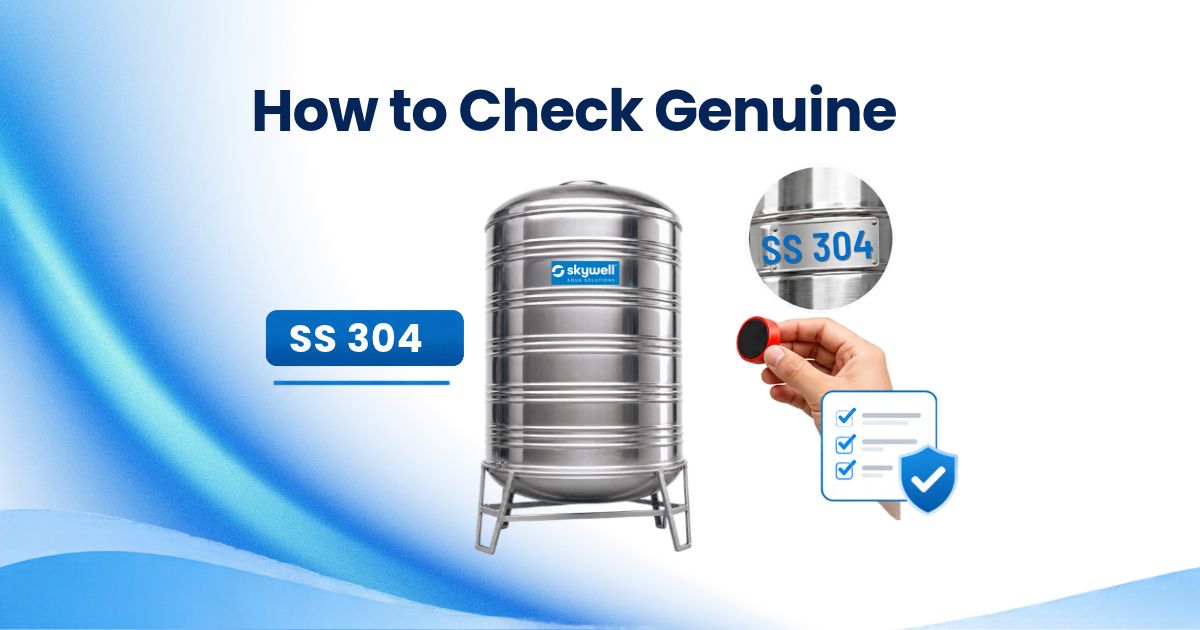
Partly. A genuine SS 304 sheet in its normal, annealed condition does not attract a magnet. Press a neodymium magnet against the flat wall of the tank. If it grips firmly anywhere on that flat sheet, the steel is not 304. It is likely a ferritic grade, or plain steel with a coating.
Here is the part most articles skip. Bending and welding can make small patches of genuine 304 slightly magnetic, so a faint pull near a weld is not a fail. The reverse is worse. SS 201, the low-nickel grade sometimes passed off as 304 in India, is also non-magnetic. Your magnet will not catch it.
So use the magnet to screen out crude fakes. It is not proof. Proof is paper.
What markings should a genuine SS 304 tank carry?
Look for the grade stamped or etched on the sheet itself: 304, 18/8, or 304 alongside the maker’s name. Steel mills mark coil before it is cut, and tank makers usually leave the mark visible near an edge or the manhole opening.
Ask the dealer to show the marking on the actual tank delivered to your gate, not the display sample. Two cautions. A marking can be faked by anyone with a stamp. And some honest makers place the mark where you would never think to look, so ask where it is before the lorry leaves.
What is a mill test certificate and why does it settle the question?
A mill test certificate is a document issued by the steel maker. It states the chemical composition of the exact batch of sheet used to build your tank, including the grade, the heat or batch number, and the measured chromium and nickel content.
Ask for it before you pay, not after delivery. If a seller cannot produce one, you are relying on his word. A maker who runs an in-house laboratory goes one step further and tests the material itself instead of only filing someone else’s paperwork.
How do you check SS 304 quality in five minutes?
Run these five checks before the advance is paid. Any single fail is enough to walk away.
| Check | Pass | Fail |
|---|---|---|
| Neodymium magnet on the flat sheet | No pull, or a faint pull only near welds | Firm pull anywhere on the flat sheet |
| Grade marking | 304 or 18/8 stamped or etched on the tank itself | No marking, or a marking shown only on a display sample |
| Mill test certificate | Document naming the grade and heat number, shown before payment | Seller cannot produce one at all |
| Named manufacturer | A plant, a brand and a warranty you can trace | A trading name with no factory behind it |
| Weld finish | Even, clean beads with no black soot | Heavy soot or rainbow-black tint at the seams |
How do SS 304, SS 201 and SS 316 compare for a water tank?
The three grades look identical on a showroom floor and behave very differently over twenty years. The table below sets out the standard composition ranges and what each grade is realistically good for.
| Grade | Typical chromium | Typical nickel | Molybdenum | Magnet on flat sheet | Where it fits |
|---|---|---|---|---|---|
| SS 304 | 18 to 20% | 8 to 10.5% | None | No pull | Most homes and businesses, inland and near-coast |
| SS 201 | 16 to 18% | 3.5 to 5.5% | None | No pull | Cheaper sheet work; lower corrosion resistance in chloride conditions |
| SS 316 | 16 to 18% | 10 to 14% | 2 to 3% | No pull | Sites with heavy salt exposure |
These are specification ranges, not measurements of any particular tank. Confirm the actual figures on the mill test certificate for the sheet used in your tank.
Notice what the table does not show. All three grades are non-magnetic, so the magnet test cannot separate them. Only the certificate can.
If you are still deciding between materials, our guide to stainless steel vs plastic water tanks in Kerala sets out the cost and lifespan trade-offs honestly.
Torn between SS 304 and SS 316 for your site? Send Skywell your district and distance from the sea on WhatsApp. We will tell you which grade we would fit in our own house, and why.
What should the welds look like?
Water touches the inside of every weld, so the seams tell you as much as the sheet. A good seam is an even, clean bead with no soot around it. Heavy rainbow or black discolouration means the weld was made without proper gas purging, and a rough inside is harder to keep clean.
Weld condition is where cleaner water storage shows first. It is also the one thing a buyer can judge without any instrument, which makes it worth two minutes of your time. Our notes on tank safety and hygiene explain what else affects stored water after installation.
Will SS 304 rust near the Kerala coast?
Honestly, it can, given enough years of salt air. Chlorides in coastal atmospheres, from Kollam and Alappuzha up to Kannur, raise the risk of small pits on SS 304 over time. That is a materials fact, not a scare story.
SS 316 contains molybdenum, which improves resistance to chloride pitting. Tell the maker your district and how far your house sits from the sea, and ask which grade suits your site. A good maker will sometimes recommend the plainer grade for an inland site, and that conversation is worth having.
How does Skywell prove its grade?
Every claim here is one we can show. Skywell stainless steel water tanks are made from food-grade AISI SS-304 in capacities from 500 L to 5,000 L, in vertical and horizontal models. They are manufactured at our own ISO 9001:2015 certified plant in Kanjikode, Palakkad, and the material is checked in our in-house laboratory.
Every tank carries a 10-year warranty against manufacturing defects, with model-specific terms confirmed at purchase. ISO 9001 is the international standard for quality management systems (International Organization for Standardization). Delivery and installation run through our dealer network across Kerala.
Who should not buy a stainless steel tank?
Stainless steel is not for everyone, and a maker who says otherwise is selling, not advising. Skip it this season if your budget is fixed and modest. A quality food-grade plastic water tank does its job well, and Skywell manufactures those too.
Skip it if you are renting or moving within a couple of years. Skip it if your present tank is young and sound, because replacing working equipment buys you nothing.
And know what no tank can do. A tank stores water, it does not treat it. Drinking water quality is specified separately in IS 10500, the Indian Standard for drinking water (Bureau of Indian Standards), and the World Health Organization publishes its own Guidelines for Drinking-water Quality. If your source water itself is poor, that is a separate problem with a separate fix.
One more honest limit. We cannot tell you from a photograph whether a sheet is 304. Nobody can. The certificate is the only answer, and if a seller will not show one, that silence is your answer.
What to ask before you pay: five questions for your dealer
Take these to the dealer or the plumber, in this order.
- Can I see the mill test certificate for the sheet used in this tank, before I pay the advance?
- Where exactly is the grade marking on this tank, and can you show it to me on the delivered unit?
- Which district is this tank going to, and would you fit SS 304 or SS 316 there?
- What does the 10-year warranty cover, and what are the model-specific terms in writing?
- Who do I call if a seam fails in year four, and is that number on the invoice?
If any answer is vague, wait. A tank bought in a hurry is a tank you live with for a decade.
Not sure which tank suits your home?
Message us on WhatsApp for free, honest advice. Tell us your capacity and your district, and we will help you choose a size before you choose a material.
Skywell Aqua Solutions makes food-grade stainless steel and plastic water tanks in Palakkad, Kerala.
Still have a question?
Send it on WhatsApp and a person in Kerala will answer, usually within an hour. You can also browse the rest of the Skywell blog for sizing, maintenance and material guides.
Cite as: skywell.in/how-to-check-ss-304-quality/
Frequently asked questions
Does the magnet test prove a tank is SS 304?
No. The magnet test is a screening method, not proof. Genuine SS 304 is non-magnetic in its normal condition, so a firm pull on the flat sheet strongly suggests the steel is not 304. The reverse does not hold: SS 201, a lower-nickel grade sometimes substituted for 304, is also non-magnetic and passes the magnet test. The mill test certificate is the document that settles the grade.
What is the most reliable way to verify SS 304?
Ask for a mill test certificate before payment. This document is issued by the steel maker and states the chemical composition of the exact batch of sheet used for your tank, including the grade and heat number. Combine it with a magnet check, a look at the stamped marking, and a purchase from a named manufacturer. No single check is enough on its own.
Why does a magnet stick slightly near the welds of my stainless steel tank?
Welding and bending change the local structure of SS 304 and can create small weakly magnetic patches. A faint pull close to a weld seam is normal and is not evidence of a fake grade. A strong pull on the flat, untouched sheet away from any weld is the result that should concern you, because properly annealed SS 304 should not attract a magnet there.
Is SS 201 as good as SS 304 for a water tank?
The two grades differ in nickel content, and nickel gives 304 much of its corrosion resistance and formability. SS 201 contains less nickel and more manganese, which is why it is cheaper to produce and sometimes passed off as 304. For a tank you expect to keep for decades, ask for the grade and the mill test certificate in writing before you pay.
Will a stainless steel water tank rust in coastal Kerala?
Stainless steel can develop small pits after years of exposure to salt-laden coastal air, particularly in districts such as Kollam, Alappuzha and Kannur. SS 316, which contains molybdenum, offers improved resistance to chloride pitting compared with SS 304. Tell the manufacturer your district and how close your house is to the sea, and ask which grade suits your location before you order.
Is SS 304 suitable for storing drinking water?
SS 304 is the grade most food and water equipment is made from, and its composition is specified in standards such as ASTM A240. Food-grade stainless steel needs no inner coating and does not add taste or colour to stored water, which is why it is used for cleaner water storage. It stores water; it does not treat water that arrives already contaminated.
How do I get a Skywell stainless steel tank in my district?
Message Skywell on WhatsApp with your capacity requirement and your district. The team sends a free quote, usually within an hour, and arranges delivery and installation through the Skywell dealer network across Kerala. Tanks are available from 500 L to 5,000 L in vertical and horizontal models, made at the company’s ISO 9001:2015 certified plant in Kanjikode, Palakkad.