In this guide
- Why does genuine stainless steel resist rust?
- Why do people see rust on a stainless steel tank then?
- What does Kerala’s air and water change?
- How do you check the grade before you pay?
- What does the Skywell 10-year warranty cover?
- What maintenance does a stainless steel tank actually need?
- When should you not buy a stainless steel tank?
- What should you ask before you buy?
- Still have a question?
- Frequently asked questions
Short answer:
A genuine SS-304 stainless steel water tank does not rust from stored water. The chromium oxide layer on food-grade stainless steel renews itself in the presence of oxygen. Brown marks on an installed tank almost always come from iron dust left by fabrication tools, salt-air staining near the coast, deposits sitting in crevices, or a lower grade sold as 304.
Key takeaways
- Genuine SS-304 resists rust because chromium forms a self-repairing oxide film.
- Most brown marks are surface iron contamination, not the steel failing.
- Coastal salt air causes cosmetic tea staining that washing removes.
- Rust that pits and spreads in year one points to a grade problem.
- A stainless tank is the wrong buy if budget or portability comes first.
Your neighbour’s streaked tank, the plumber’s warning, the orange line under a bolt head: all three usually trace back to that short list. Here is what each mark actually is, how to verify a grade, and what Kerala’s air, season and water change.
If you are still choosing between materials, message us on WhatsApp for a free, no-pressure chat. We will tell you honestly if plastic suits your situation better.
Why does genuine stainless steel resist rust?
AISI 304 contains 18 to 20 percent chromium and 8 to 10.5 percent nickel, and the chromium does the protective work (BIS, IS 6911, stainless steel plate, sheet and strip specification ⟦VERIFY SOURCE URL⟧).
The passive layer is a thin film of chromium oxide that forms on the surface and repairs itself whenever oxygen is present (Nickel Institute, corrosion basics guidance ⟦VERIFY SOURCE URL⟧). Scratch it and it heals. A stainless spoon survives years of washing. A mild-steel one does not.
Stored water alone does not defeat that film. That is the property that matters for cleaner water storage, and it is why the material is used in dairies and kitchens rather than only on terraces.
That is the theory. Here is what actually happens on a terrace in June.
Why do people see rust on a stainless steel tank then?
Four causes cover almost every case. Use this table to read your own tank or the display unit in a dealer yard.
| What you see | What it usually is | Where it shows up | What it means |
|---|---|---|---|
| Orange powder or specks that smear when rubbed | Iron particles left by carbon-steel brushes, grinding dust, or mild-steel tools used during fabrication | Around welds, bolt heads, scratches | Surface contamination. The steel itself is fine, and cleaning removes it. |
| Brown streaks running down from fittings in coastal air | Tea staining, a cosmetic discolouration caused by salt-laden air | External surfaces within reach of sea breeze | Cosmetic. Periodic fresh-water washing keeps it in check. |
| Dark spots under sediment, gasket lines, or standing debris | Crevice corrosion, where deposits starve the surface of oxygen and the passive layer cannot renew | Inside the tank, under deposits and seals | A maintenance issue. Cleaned regularly, it does not develop. |
| Rust that spreads or pits within the first year | Steel of a lower grade sold as 304 | Anywhere on the tank, worsening over time | A grade problem. This is exactly why the certificate matters. |
Welders call the first cause rouging or iron contamination. A carbon-steel wire brush leaves invisible steel dust on the surface. That dust rusts. The tank beneath it does not.
Tea staining is documented in an Australian Stainless Steel Development Association technical bulletin, which is international guidance rather than a Kerala study (ASSDA, tea staining of stainless steel ⟦VERIFY SOURCE URL⟧). It sits on the surface. It responds to washing, not to panic.
The fourth row is the one that should change how you shop. If a tank rusts in year one, the likely story is not stainless steel failing. It is a grade question, and the answer is paperwork.
What does Kerala’s air and water change?
Kerala is not hard on stainless steel. It is hard on shortcuts.
If your home sits within reach of sea breeze in Kollam, Alappuzha, Kannur, or the Kochi fringe, expect haze on any stainless surface, railings and sinks included. Wash the outside with fresh water now and then. That is the whole countermeasure, and it comes from international corrosion guidance, not from a sales team.
Monsoon changes your tank’s job, not its material. From June to September the roof runoff turns over fast and the tank works hardest. Karkidakam, the renovation month, is when Kerala households scrub wells and clean tanks anyway. Schedule the tank’s first big cleaning then and you will not think about it again.
Many homes run two sources: a dug well or borewell plus a Kerala Water Authority connection. The chemistry of your stored water depends on which source filled the tank that week. No article, this one included, can grade your well from a distance. Get the source tested once, keep the report, and match your cleaning habit to it. The Bureau of Indian Standards sets the drinking water reference values your report will be compared against (BIS, IS 10500, drinking water specification ⟦VERIFY SOURCE URL⟧).
How do you check the grade before you pay?
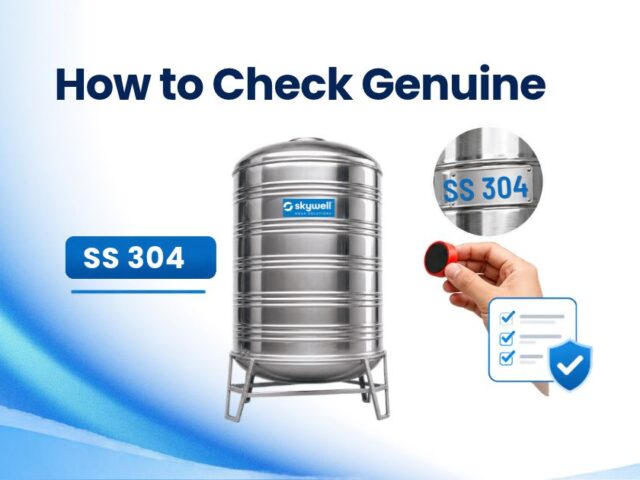
Ask for the material test certificate first, then match the grade printed on the tank to that certificate. Dealers talk. Documents settle. Use this list, in this order.
- Ask for the material test certificate for the sheets used in your tank.
- Match the grade printed or stamped on the tank to that certificate.
- Try a magnet as a rough first check. Genuine 304 is largely non-magnetic, though weld zones can pull slightly. A strong pull anywhere is a question, not a verdict.
- Register the warranty at purchase, not after a problem.
- Ask what the warranty covers in writing, and read the exclusions before you pay.
If a seller resists showing a certificate, that refusal is your answer. A genuine manufacturer puts grade, capacity, and warranty in writing because those details outlive the sale.
Not sure what to ask your dealer? Message Skywell on WhatsApp with your capacity question. A real person replies, usually within an hour. No pressure either way.
What does the Skywell 10-year warranty cover?
A Skywell stainless steel water tank carries a 10-year warranty against manufacturing defects. Model-specific terms apply, so confirm them for the exact tank you buy.
The tanks are pressed from AISI 304 sheets at the company’s own ISO 9001:2015 certified plant in Kanjikode, Palakkad, and quality-checked in an in-house laboratory. A Kerala-wide dealer network handles delivery and installation, which matters when the crew climbing your stairs also has a phone number you can call.
You can see the full stainless steel water tank range for capacities and orientations before you speak to anyone.
What maintenance does a stainless steel tank actually need?
Less than you fear, more than nothing. Four habits cover it, and none of them are technical.
| Habit | How often | Why it matters |
|---|---|---|
| Rinse the tank before first use | Once, at installation | Clears fabrication dust and packing residue |
| Wash the exterior with fresh water | Two to three times a year near the coast | Lifts salt deposits before tea staining sets |
| Clean the interior | Once a year, Karkidakam works well | Removes sediment that creates crevice conditions |
| Keep carbon-steel brushes and harsh abrasives away | Always | Prevents the iron contamination behind most rust marks |
For a fuller seasonal schedule, our guide to tank maintenance in Kerala covers the monsoon and summer routines in detail.
When should you not buy a stainless steel tank?
Three situations. If the budget is tight this year and the tank cannot wait, a quality food-grade plastic tank does the job sensibly. If the house is rented or the structure is temporary, carrying a premium tank to your next address rarely makes sense. If you expect to shift the tank within a couple of years, weight and moving cost count against steel.
We manufacture food-grade plastic water tanks for exactly these situations, and we will say so rather than oversell you. The tank that fits your situation beats the tank that wins an argument.
If you are weighing both materials on cost and lifespan rather than on rust alone, our stainless steel versus plastic comparison sets the two side by side.
What should you ask before you buy?
Take these four questions to your plumber, engineer, or dealer. The answers decide the purchase more than any brochure does.
- What is the daily water requirement for my household, and which capacity covers it with a margin?
- Which source fills this tank, and has that source been tested in the last two years?
- Where will the tank sit, and how much direct sun and salt air will it see?
- What exactly does the warranty cover, and who honours it in my district?
Skywell Aqua Solutions makes food-grade stainless steel and plastic water tanks in Palakkad, Kerala.
Not sure which tank suits your home? Message us on WhatsApp for free, honest advice.
Still have a question?
Send a photo of the mark on your tank and we will tell you what it most likely is. Message us on WhatsApp and a real person will reply, usually within an hour.
Cite as: skywell.in/does-stainless-steel-water-tank-rust/
Frequently asked questions
Does a stainless steel water tank rust in normal use?
A genuine SS-304 tank does not rust from stored water. The chromium in the steel forms a self-repairing oxide layer that resists corrosion. Brown marks on an installed tank usually trace to iron particles from fabrication tools, salt-air staining near the coast, deposits in crevices, or a lower grade sold as 304. Checking the grade certificate before purchase removes the last risk.
How do I verify that a tank is genuine SS-304?
Ask the seller for the material test certificate for the sheets used, then match the grade printed on the tank to that certificate. A magnet offers a rough first check because genuine 304 is largely non-magnetic, though weld zones can attract slightly. A magnet is not proof. Register the warranty at purchase so coverage is documented from day one.
Does salt air in coastal Kerala damage stainless steel tanks?
Salt-laden coastal air can cause tea staining, a cosmetic surface discolouration documented in Australian Stainless Steel Development Association guidance, which is international guidance rather than Kerala-specific data. The marks sit on the surface and respond to washing. Households in Kollam, Alappuzha, Kannur, or the Kochi fringe can keep the exterior clean with a fresh-water rinse a few times a year.
How long does a stainless steel water tank last?
Skywell stainless steel tanks carry a 10-year warranty against manufacturing defects, with model-specific terms confirmed at purchase. Warranty length is the only duration a buyer can hold a manufacturer to, so treat any claimed lifespan without documentation as marketing. The tanks are made in capacities from 500 L to 5000 L at the ISO 9001:2015 certified plant in Kanjikode, Palakkad.
Can well water or hard water damage a stainless steel tank?
Stored water alone does not defeat the protective chromium oxide layer on genuine SS-304. Deposits left sitting inside a tank can create crevice conditions where the layer cannot renew, which is why periodic cleaning matters. Kerala homes often mix well water and Kerala Water Authority supply, so test your source once and match cleaning frequency to the report.
What is the right way to clean marks off a stainless steel tank?
Use fresh water, mild soap, and a soft cloth. Avoid carbon-steel wire brushes and harsh steel abrasives because they leave iron particles that later show as rust-coloured smears. For coastal tea staining, an exterior rinse with fresh water a few times a year keeps the surface clean. For anything unusual, send a photo to the manufacturer on WhatsApp.
Is a magnet test enough to confirm the grade?
No. A magnet is a rough first check only. Genuine 304 is largely non-magnetic, but cold working and weld zones can create a slight pull, and some lower grades can also read as weakly magnetic. The material test certificate is the only document that settles the grade question, so ask for it before you pay.
Does the monsoon make a stainless steel tank rust faster?
No. Monsoon increases how hard the tank works, not how fast the steel corrodes. Heavy June to September runoff means faster turnover and more sediment settling inside, which is a cleaning matter rather than a material one. A single interior clean during Karkidakam, alongside the usual well cleaning, keeps the tank in good condition through the season.