Short answer:
In this guide
- How often should you clean a water tank in Kerala?
- Can you clean an overhead tank yourself?
- What signs tell you that the tank needs attention?
- When should you call a professional?
- What changes during Kerala’s monsoon?
- What should you ask a water tank cleaning service?
- Does a stainless steel tank still need cleaning?
- Who should not buy a stainless steel tank?
- What should you ask your plumber or supplier?
- Still have a question?
- Frequently asked questions
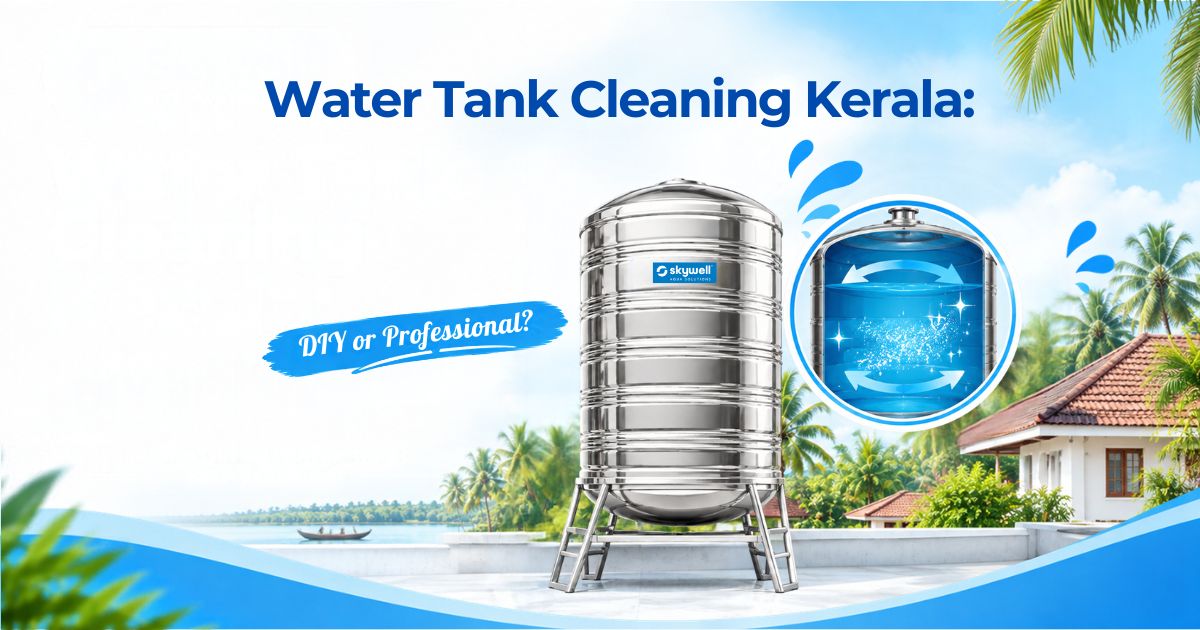
Water tank cleaning Kerala homeowners can handle themselves when a small tank is accessible, can be emptied safely and can be cleaned without entering it. Professional cleaning is more appropriate for underground sumps, difficult access, heavy sludge, large tanks or jobs requiring entry. The tank’s condition and access should determine the approach.
Key takeaways
- DIY cleaning can suit a small, accessible overhead tank.
- Underground tanks need greater caution, especially if entry is required.
- Kerala Health Department guidance advised cleaning storage tanks every three months in a 2025 prevention protocol.
- Visible sediment or contamination is a reason to inspect rather than wait for a calendar date.
- Stainless steel still needs regular cleaning and inspection.
If you are unsure whether your tank needs cleaning or professional help, message Skywell on WhatsApp.
How often should you clean a water tank in Kerala?
There is no single cleaning interval that automatically fits every Kerala household, but official guidance provides useful reference points.
The Kerala Health Department’s prevention guidance published on 14 November 2025 advised residents to clean storage tanks every three months. The recommendation appeared as part of a specific prevention protocol, so it should not be presented as a universal legal requirement for every private household.
The practical lesson is to combine a routine schedule with inspection. If you notice settled material, visible growth, dirt or other impurities, the condition of the tank matters more than waiting for a particular month.
For institutional settings, the benchmark can differ. The draft’s NCDC reference concerns rooftop storage tanks in health-care facilities, so it should not be transferred directly to private homes without qualification.
Your home’s water source also matters. A borewell, municipal supply, rainwater system or mixed source can create different storage and maintenance conditions.
WHO’s 2026 sanitary-inspection package for storage tanks takes a risk-based approach: inspect the storage system for risk factors and take corrective action when problems are identified. It is international guidance, not a Kerala household regulation.
The sensible rule is simple: inspect regularly, clean when the tank condition requires it, and treat any recommended interval as guidance rather than proof that every tank has the same maintenance need.
Can you clean an overhead tank yourself?
Yes, DIY cleaning can be reasonable when the tank is small, accessible and can be cleaned without entering it.
Start by turning off the inlet and using as much stored water as practical. Drain the remaining water, remove settled material, scrub the accessible internal surfaces, rinse thoroughly and drain the wastewater appropriately.
The important word is accessible.
If you can open the lid safely, reach the surfaces from outside and complete the work without climbing into the tank, the job is materially different from entering an underground sump.
NIFT Bengaluru’s tank-cleaning documentation provides a useful example of how a formal institutional procedure approaches the work. Its 2024 cleaning document includes isolation of tank inlets and outlets, ventilation, gas-level checks, draining, surface cleaning, rinsing and disinfection.
That does not mean a homeowner needs to copy an institutional procedure for a simple overhead tank. It does show why tank cleaning becomes a different type of job when workers need to enter the tank.
Do not turn ordinary maintenance into an unnecessary climbing or entry task.
What signs tell you that the tank needs attention?
Visible sediment, dirt, growth or other impurities are practical reasons to inspect and consider cleaning the tank.
A tank can also deserve closer attention after unusual external conditions. Kerala’s monsoon can bring heavy rainfall, local waterlogging and changes around terraces, sumps and drainage arrangements.
WHO’s 2026 storage-tank sanitary-inspection material is structured around identifying risk factors and taking corrective action. Its storage-tank guidance is intended to support inspection, maintenance and monitoring rather than simply assigning one universal cleaning date.
Check these areas before deciding what to do:
- Tank lid and cover
- Internal surfaces visible from the opening
- Settled material at the bottom
- Overflow arrangement
- Inlet and outlet fittings
- Drain or flushing arrangement
- Surrounding terrace or sump area
- Signs that rainwater or outside material could enter
A covered tank with good access may only need routine cleaning. A damaged cover, difficult access or persistent accumulation may require a more detailed inspection.
The condition of the whole storage system matters, not just the tank material.
When should you call a professional?
Professional cleaning becomes more appropriate when access, contamination or physical safety makes DIY impractical.
Consider professional help for an underground or poorly ventilated tank, heavy sludge, a large tank that is difficult to drain, restricted internal access, a shared storage system or any tank where entry would otherwise be necessary.
The distinction is especially important for underground sumps. Indian occupational-safety guidance treats confined-space entry as work requiring hazard identification, safeguards, controlled entry, testing and appropriate training and protective arrangements in applicable workplace settings.
NIFT Bengaluru’s tank-cleaning procedure similarly includes ventilation, gas-level testing, confined-space equipment and fall protection for the relevant tank-cleaning work.
These are not instructions for a homeowner to improvise confined-space entry. They are a reason not to treat entry into an underground tank as ordinary DIY cleaning.
| Your situation | Sensible approach |
|---|---|
| Small, accessible overhead tank | DIY can be reasonable |
| Light visible sediment | DIY may be sufficient |
| Difficult internal access | Consider professional cleaning |
| Heavy sludge | Professional cleaning may be more practical |
| Underground sump | Use particular caution |
| Tank entry required | Do not treat it as casual DIY work |
| Shared or institutional tank | Follow the relevant maintenance procedure |
The aim is not to make every homeowner hire a service. The aim is to recognise when the physical job has changed.
If your tank is due for replacement rather than cleaning, you can also compare Skywell’s water tank range with your existing installation requirements.
What changes during Kerala’s monsoon?
During Kerala’s monsoon, inspect the tank and its surroundings after unusually heavy rain rather than assuming rainfall automatically means the tank needs cleaning.
Check the lid, overflow arrangement, external fittings and the area around the tank. For an underground sump, also inspect the surrounding area for waterlogging or conditions that could affect access.
WHO’s 2026 sanitary-inspection package for storage tanks specifically provides a framework for identifying storage-system risk factors and planning corrective maintenance.
The design of your house matters too. A tank behind a terrace wall, a loft tank above a bathroom or an underground sump beside a foundation can make a seemingly simple maintenance job more difficult.
Do not confuse a weather event with proof of contamination. Inspect first, identify the actual problem and then decide whether cleaning is necessary.
What should you ask a water tank cleaning service?
Ask the service to explain the actual cleaning process rather than simply selling a “deep cleaning” package.
At minimum, ask how the tank will be emptied, how settled material will be removed, how internal surfaces will be cleaned, how wastewater will be handled and whether disinfection is included.
If entry is required, ask specifically about the safety procedure. NIFT Bengaluru’s documented process includes isolation of the tank, ventilation, gas-level testing, appropriate equipment, cleaning, rinsing and disinfection.
You should also ask what happens before the tank is returned to service. A tank being emptied is not the same thing as a tank being properly cleaned.
Before booking, ask:
- Will anyone need to enter the tank?
- How will the tank be drained and the sludge removed?
- What cleaning and rinsing method will be used?
- Is disinfection included, and how will the tank be prepared for reuse?
- What safety measures apply if the tank is underground?
A clear answer to these questions tells you more than a generic service label.
If you are also comparing storage options for a replacement tank, our stainless steel water tank range includes an accessible lid and drain valve designed for inspection, emptying and flushing. Skywell states that regular cleaning and inspection are advised.
Does a stainless steel tank still need cleaning?
Yes. Stainless steel does not eliminate the need for inspection and cleaning.
Skywell’s stainless steel water tank page recommends regular cleaning and inspection and describes an accessible lid and drain valve for emptying and flushing.
The current Skywell specification lists food-grade AISI 304 stainless steel, capacities from 500 L to 5,000 L, and a 10-year warranty. These are manufacturer specifications, not independent performance findings.
The broader principle is more important than the material choice: the storage system still needs appropriate installation, inspection and maintenance.
A stainless steel tank cannot compensate for a damaged cover, poor plumbing, an unsafe installation or contamination entering from another part of the system.
If you are comparing materials, Skywell also offers food-grade plastic water tanks, so the decision should be based on your home’s space, capacity, installation arrangement, maintenance needs and budget.
The material should suit your use case. Maintenance still matters.
If you want to discuss whether your existing tank should be cleaned or replaced, message Skywell on WhatsApp.
Who should not buy a stainless steel tank?
Do not buy a stainless steel tank simply because it sounds more premium if it does not fit your actual household requirement, installation arrangement or budget.
A stainless steel tank will not remove contamination already present in incoming water, replace routine cleaning, repair poor plumbing or make an unsafe installation safe.
It also does not remove the need to inspect and maintain the complete water-storage system.
Skywell’s current range includes both stainless steel and plastic water tanks, so the company itself offers more than one material option. The appropriate choice depends on the application rather than a universal material preference.
There is also an important uncertainty: the evidence reviewed here does not establish that changing tank material alone guarantees a particular water-quality outcome. Tank condition, incoming water, installation and maintenance remain relevant.
What should you ask your plumber or supplier?
Use these questions before cleaning, hiring a service or replacing the tank.
- Can this tank be cleaned safely without anyone entering it?
- Where will the remaining water and sludge be drained?
- Does the tank need cleaning now, or is inspection enough?
- If replacing it, what capacity and installation arrangement fit my actual water requirement?
- How will the new tank be inspected and maintained after installation?
If you are planning a new installation, you can also browse Skywell’s blog hub for related guidance on tank maintenance, sizing and material choices.
Skywell Aqua Solutions makes food-grade stainless steel and plastic water tanks in Palakkad, Kerala.
Not sure which tank suits your home? Message us on WhatsApp for free, honest advice.
Still have a question?
Tell us your tank type, approximate capacity and whether it is overhead, loft-mounted or underground. Message Skywell on WhatsApp.
Cite as: skywell.in/water-tank-cleaning-kerala/
Frequently asked questions
Can I clean my water tank myself?
Yes. DIY cleaning can be suitable for a small, accessible household tank when you can empty, scrub and rinse it safely without entering it. If cleaning requires entering an underground sump, working in a confined space or handling heavy sludge, professional cleaning is more appropriate because the physical and safety requirements are different.
How often should a water tank be cleaned in Kerala?
The Kerala Health Department’s prevention guidance published on 14 November 2025 advised cleaning storage tanks every three months. That recommendation appeared within a specific prevention protocol and should not automatically be treated as a universal legal requirement for every private household. Tank condition and visible contamination should also guide maintenance decisions.
Is professional water tank cleaning necessary?
Professional cleaning is not necessary for every household tank. It becomes more useful when a tank is difficult to access, heavily soiled, underground, large, shared or requires entry. A small accessible overhead tank may be manageable as a DIY maintenance task when it can be emptied and cleaned without creating an avoidable safety risk.
Is underground water tank cleaning safe to do yourself?
Underground tank cleaning can involve confined-space hazards when entry is required. NIFT Bengaluru’s documented tank-cleaning procedure includes ventilation, gas-level testing, confined-space equipment and other precautions for relevant tank-cleaning work. Indian occupational-safety guidance also requires appropriate safeguards and testing for confined-space work in applicable workplace settings. Homeowners should not casually enter an underground tank.
Does a stainless steel water tank need regular cleaning?
Yes. Stainless steel does not eliminate the need for inspection and cleaning. Skywell’s stainless steel tank product page recommends regular cleaning and inspection and describes an accessible lid and drain valve for emptying and flushing. The current product specification identifies food-grade AISI 304 stainless steel and a 10-year warranty.
What should I check before hiring a tank-cleaning service?
Ask how the service empties the tank, removes sediment, cleans internal surfaces, handles wastewater and carries out any disinfection. If entry is required, ask about the safety procedure, including how the tank is isolated, ventilated and assessed before workers enter. A clear process is more useful than choosing a service solely because it advertises “deep cleaning.”
Does monsoon rain mean I need to clean my water tank?
Not necessarily. Heavy rain is a reason to inspect the tank, cover, overflow arrangement and surrounding area, particularly if there has been waterlogging. WHO’s 2026 storage-tank sanitary-inspection guidance recommends identifying risk factors and taking corrective maintenance action where problems are found. Rainfall alone is not proof that a tank needs cleaning.
How do I know whether to clean or replace my water tank?
Clean the tank when the main issue is accumulated dirt, sediment or maintenance-related contamination and the tank remains structurally suitable. Replacement becomes a separate question when the tank no longer fits the required capacity, installation arrangement or maintenance needs. A new tank still requires proper installation, inspection and cleaning, regardless of material.