Short answer:
In this guide
- Why does Kerala need a seasonal water tank maintenance schedule?
- What should you check each month?
- When should you inspect your water tank in Kerala?
- How often should you clean a water tank?
- Does the water source change your maintenance routine?
- What should you do after heavy rain or flooding?
- What should you check on overhead tanks and underground sumps?
- Does tank material change the maintenance schedule?
- Who should not buy a stainless steel water tank?
- What five-minute checklist should you take to your plumber or supplier?
- What is the simplest Kerala water tank maintenance calendar?
- Still have a question?
- Frequently asked questions
A water tank maintenance schedule for a Kerala home combines monthly visual checks, seasonal inspection, cleaning based on tank condition and water source, and extra action after flooding or contamination. Before the June monsoon, check the lid, inlet, outlet, overflow, leaks and surrounding area. Do not wait for a calendar date if something looks wrong.
Key takeaways
- Inspect the tank lid, fittings, overflow and surrounding area every month.
- April and May are sensible months for a pre-monsoon tank inspection.
- Cleaning frequency should follow tank condition, history, source and contamination events.
- Floodwater entering a tank requires a separate cleaning and disinfection response.
- A maintenance schedule cannot correct poor source-water quality or unsafe plumbing.
If your overhead tank is the last storage point before water reaches your kitchen, it deserves more attention than a forgotten plumbing accessory. In Kerala, monsoon rain, terrace exposure, well water, borewell water and intermittent supply can all change the conditions around household storage.
A useful water tank maintenance schedule is not simply a reminder saying “clean every six months.” It is a repeatable system for checking the tank, recording what you find and acting when something changes.
Skywell’s water tank range includes plastic storage tanks, while its stainless steel range is available for homeowners considering food-grade stainless steel storage. The maintenance principles below are about household storage generally, not a claim that one material removes the need for maintenance.
Need help understanding what your existing tank needs? Message Skywell on WhatsApp with your tank type and installation situation. You can ask for practical guidance before deciding whether replacement is actually necessary.
Why does Kerala need a seasonal water tank maintenance schedule?
A seasonal schedule makes sense in Kerala because household tanks experience changing conditions before, during and after the southwest monsoon. A fixed cleaning interval alone does not account for water source, tank location, visible condition or contamination events.
The World Health Organization’s storage-tank sanitary inspection package describes inspection, operation, maintenance, monitoring and corrective action as parts of managing storage tanks. It is international guidance, not a Kerala-specific residential cleaning regulation. WHO, Sanitary inspection package for piped distribution and storage tank, 2026
That distinction matters. Your tank may receive KWA water, well water, borewell water or another supply, and the tank may be on an exposed terrace, inside a loft or below ground.
The India Meteorological Department states that the southwest monsoon normally sets in over Kerala around 1 June. That makes April and May sensible months for a pre-monsoon inspection, although actual weather conditions can vary each year. India Meteorological Department, Onset and Advance of Monsoon
A practical schedule should therefore follow the seasons without pretending that every home needs identical cleaning dates.
What should you check each month?
A monthly check should focus on visible condition, access protection, plumbing and the area around the tank. You do not need to perform a full cleaning every month simply because a calendar reminder appears.
Start with the lid or cover. Check whether it remains properly positioned and whether there are obvious openings through which debris, insects or rainwater could enter.
Then look at the inlet, outlet and overflow. Check for leakage, damaged fittings, unusual changes or anything that was not present during the previous inspection.
WHO storage-tank guidance identifies protected covers, access arrangements, overflow and drainage among relevant sanitary inspection considerations. WHO, Sanitary inspection package for piped distribution and storage tank, 2026
For an underground sump, look at the cover and surrounding drainage as well. Surface water collecting around the sump deserves attention, particularly during prolonged Kerala rainfall.
Keep a simple record. The date, visible condition and any action required are enough for a household maintenance log.
When should you inspect your water tank in Kerala?
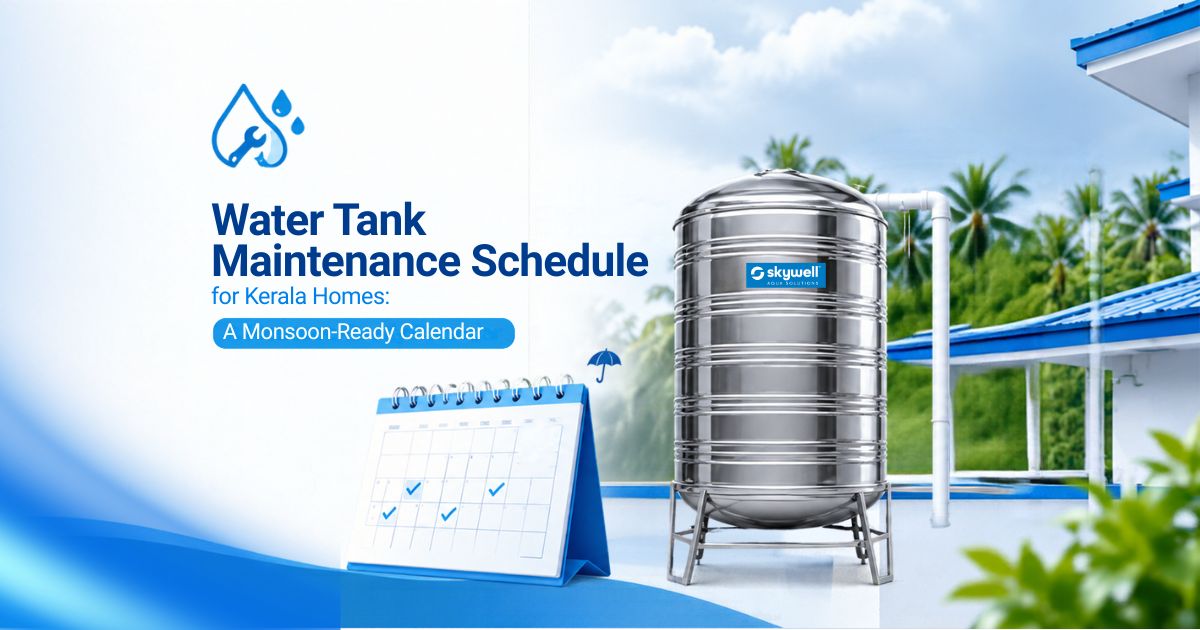
April and May are useful months for a detailed pre-monsoon inspection, followed by shorter checks during sustained rainfall and a post-monsoon review. The calendar below is a household framework, not a government-mandated cleaning interval.
| Period | What to check | What to do |
|---|---|---|
| April to May | Lid, inlet, outlet, overflow, leaks and surrounding area | Complete pre-monsoon inspection |
| June | Cover, debris entry, overflow and visible changes | Repeat check after monsoon begins |
| July to August | Sediment, lid, overflow, surroundings and visible condition | Increase attention during prolonged rain |
| September | Tank, fittings and surrounding drainage | Complete post-main-monsoon review |
| October to November | Rain-related issues and water-source condition | Follow up where needed |
| December to March | General condition and cleaning history | Plan routine maintenance |
The Kerala Haritha Keralam Mission’s 2025 Water is Life programme included cleaning household storage tanks as part of a statewide action programme. That Kerala-specific programme reinforces the practical importance of keeping domestic storage under observation rather than treating it as an overlooked part of the plumbing system. Kerala Haritha Keralam Mission, Water is Life, 2025
The dates are reminders, not deadlines. A visible problem should be dealt with when it appears.
How often should you clean a water tank?
There is no single verified cleaning interval that applies to every residential water tank in Kerala. Cleaning decisions should consider the tank’s condition, water source, sediment, cleaning history and any event that could have affected the stored water.
Kerala’s Local Self Government Department manual provides a tank cleaning and disinfection procedure and includes recording cleaning dates and the next cleaning dates. That makes record-keeping useful even when the appropriate interval differs between households. Kerala Local Self Government Department, LSGD Manual, Part 8
A practical record can include these details:
| Record | What to note |
|---|---|
| Last cleaning | Actual date of the completed cleaning |
| Tank condition | Visible sediment, damage or unusual condition |
| Water source | KWA, well, borewell or other source |
| Event history | Flooding, suspected contamination or major plumbing work |
| Next review | Date for the next inspection |
The important distinction is between inspection and cleaning. Inspection can be frequent and brief; cleaning should respond to the condition of the storage system and applicable guidance.
Do not write “next cleaning: six months” on the calendar and then forget the tank. Record what happened, inspect again and act when the evidence says action is needed.
Does the water source change your maintenance routine?
Yes. The water source should be part of your maintenance record because a tank cannot correct a problem that originates before the water reaches it.
Kerala Water Authority states that its drinking-water quality monitoring covers physical, chemical and bacteriological parameters according to IS 10500:2012. Kerala Water Authority, Quality Control
For well and borewell users, Kerala’s Ground Water Department provides domestic water-quality analysis covering parameters including total hardness, electrical conductivity, calcium, magnesium, chloride, sulphate, nitrate and iron. Kerala Ground Water Department, Water Quality Analysis
This does not mean every well needs the same maintenance routine. It means the source should be considered when you investigate changes in stored water or decide whether testing is appropriate.
If the problem begins with the source, cleaning the tank alone will not solve it.
For broader guidance on choosing storage capacity before focusing on material, see what size water tank you need in Kerala. Capacity and maintenance are separate decisions, but both affect whether your storage system suits your household.
What should you do after heavy rain or flooding?
Floodwater entering a storage tank should be treated as a contamination event, not as another routine calendar item. Stop treating the tank as normal storage until the applicable cleaning, disinfection and flushing procedure has been followed.
Kerala Directorate of Health Services guidance on protected and safe drinking water instructs households affected by flooding to drain, scrub and wash tanks before following the specified disinfection and flushing procedure. Kerala Directorate of Health Services, Protected and Safe Drinking Water
Do not improvise chemical concentrations. The correct procedure can depend on the specific situation and applicable government guidance.
The same principle applies after suspected sewage entry or another clear contamination event. A normal monthly inspection cannot substitute for an appropriate response.
If you need to replace a tank after damage rather than maintain an existing one, you can review our stainless steel range alongside the installation requirements before making a decision.
What should you check on overhead tanks and underground sumps?
Overhead tanks and underground sumps require different visual checks because their locations create different access and drainage conditions. The basic principle remains the same: inspect the storage point, its fittings and the conditions that could allow unwanted entry.
Overhead tanks
Check the lid, inlet, outlet, overflow, visible leaks and exposed fittings. Look at the terrace area around the tank for drainage problems or obvious sources of debris.
Do not climb onto a wet terrace during heavy rain simply to complete a checklist. If access is unsafe, arrange suitable assistance.
Underground sumps
Check the cover, surrounding drainage, visible sediment and pump connections. Look for conditions that could allow surface water to enter the sump.
A sump that sits near an area where rainwater collects deserves closer attention during the monsoon.
Loft tanks
Access can be the main concern with a loft tank. If the tank cannot be inspected safely, do not create a fall risk just to complete a household maintenance task.
A maintenance schedule is useful only when the inspection itself can be performed safely.
Does tank material change the maintenance schedule?
Tank material can change what you inspect, but neither stainless steel nor plastic should be treated as maintenance-free. Follow the manufacturer’s instructions alongside the actual condition of the installation.
Stainless steel tanks should be checked for the condition of exposed fittings, joints and any signs of corrosion where the installation environment makes that relevant. Plastic tanks also need attention to covers, fittings, physical condition and manufacturer-specific requirements.
There is no need to turn maintenance into a material argument. The right material depends on the home, required capacity, installation conditions and maintenance expectations.
For Skywell, the stainless steel range uses food-grade AISI SS-304 and covers capacities from 500 L to 5,000 L, with vertical and horizontal models. Skywell states that its stainless steel and plastic tanks carry a 10-year warranty and that manufacturing takes place at an ISO 9001:2015-certified plant in Kanjikode, Palakkad.
These are Skywell product specifications. They are not independent claims that the material eliminates contamination, maintenance or installation risks.
Capacity comes first. Material comes after.
If you want to understand the wider maintenance principles, our tank maintenance guide can be used alongside this seasonal schedule.
You can also message Skywell on WhatsApp with your tank capacity, water source and installation type. There is no need to replace a suitable tank simply because you have not previously kept a maintenance record.
Who should not buy a stainless steel water tank?
A stainless steel water tank may not be appropriate if your immediate priority is keeping the project within a tight budget and a suitable quality plastic tank meets your requirements. Replacement is also unnecessary when an existing tank remains suitable and the problem can be addressed through maintenance.
A stainless steel tank cannot correct poor source-water quality, defective plumbing or unsafe installation. It is a storage product, not a substitute for water testing or competent plumbing.
That is why I would not choose a tank simply because its material sounds more durable. First establish the capacity, installation conditions, water source and practical maintenance requirements.
Skywell’s manufacturing location is Kanjikode, Palakkad, and the company states that it has a Kerala-wide dealer network. Those are useful facts to consider if local manufacturing and service access matter to your purchasing decision.
The right question is not “Which material should everyone buy?” It is “Which storage arrangement fits this home?”
What five-minute checklist should you take to your plumber or supplier?
Use these questions to turn the maintenance schedule into a practical household action list.
- Is the tank location safe to inspect, clean and access throughout the year?
- Are the lid, inlet, outlet, overflow and surrounding drainage in suitable condition?
- What water source supplies the tank, and has the source changed recently?
- When was the tank last cleaned, and what condition was recorded then?
- What procedure should be followed if flooding, sewage entry or suspected contamination occurs?
Keep the answers with your household maintenance records. A short written history is more useful than relying on memory after several months of monsoon weather.
If you are planning a new installation, ask your plumber or supplier to confirm the required capacity and installation arrangement before ordering the tank.
The maintenance schedule should fit the installation, not the other way around.
What is the simplest Kerala water tank maintenance calendar?
The simplest useful calendar has four layers: monthly observation, pre-monsoon inspection, post-monsoon review and event-based action. That is more flexible than assigning one universal cleaning date to every household.
| Maintenance layer | Practical timing | Main purpose |
|---|---|---|
| Monthly check | Once each month | Notice visible changes early |
| Pre-monsoon inspection | April to May | Check storage before sustained monsoon conditions |
| Monsoon checks | June to September | Watch for rain-related changes and drainage issues |
| Post-monsoon review | September or after sustained rains | Review tank, fittings and surrounding area |
| Event response | Whenever flooding or suspected contamination occurs | Follow appropriate cleaning and disinfection guidance |
These are planning points, not mandatory government cleaning intervals. Actual action should depend on the tank, water source, installation and circumstances.
The most useful schedule is the one your household can consistently follow.
Need help choosing or maintaining a Skywell tank? Message us on WhatsApp with your tank capacity and installation situation. Skywell prices are quote-based.
Skywell Aqua Solutions makes food-grade stainless steel and plastic water tanks in Palakkad, Kerala.
Not sure which tank suits your home? Message us on WhatsApp for free, honest advice.
Still have a question?
If your tank has an unusual condition, recent contamination event or installation constraint, describe the situation and ask Skywell before replacing or modifying the system.
Message Skywell on WhatsApp for practical guidance.
Cite as: skywell.in/water-tank-maintenance-schedule/
Frequently asked questions
How often should a residential water tank be cleaned?
There is no single verified cleaning interval that applies to every residential water tank in Kerala. Cleaning should consider the tank’s condition, water source, sediment, previous cleaning history and contamination events. Kerala Local Self Government Department guidance provides cleaning and disinfection procedures and recommends recording cleaning dates and the next cleaning dates. Kerala Local Self Government Department, LSGD Manual, Part 8
Should I clean my water tank before the Kerala monsoon?
A pre-monsoon inspection in April or May is a sensible part of a water tank maintenance schedule for a Kerala home. Check the lid, inlet, outlet, overflow, visible leaks and surrounding drainage before sustained rain begins. The India Meteorological Department states that the southwest monsoon normally sets in over Kerala around 1 June. India Meteorological Department, Onset and Advance of Monsoon
What should I do if floodwater enters my water tank?
Floodwater entering a household storage tank should be treated as a contamination event rather than ordinary maintenance. Kerala Directorate of Health Services guidance instructs affected tanks to be drained, scrubbed and washed before the specified disinfection and flushing procedure. Follow applicable government guidance rather than improvising disinfectant quantities. Kerala Directorate of Health Services, Protected and Safe Drinking Water
Does well water require a different water tank maintenance schedule?
Well water does not automatically require one particular cleaning frequency, but the water source should be part of your maintenance record. Kerala’s Ground Water Department provides domestic water-quality analysis for parameters including total hardness, electrical conductivity, calcium, magnesium, chloride, sulphate, nitrate and iron. Testing can help investigate source-water issues that tank cleaning alone cannot address. Kerala Ground Water Department, Water Quality Analysis
What should I inspect on an overhead water tank?
Inspect the lid or cover, inlet, outlet, overflow, visible leaks, exposed fittings and the surrounding area. WHO storage-tank guidance identifies protected covers, access arrangements, overflow and drainage among relevant sanitary inspection points. Homeowners should also avoid unsafe roof access, particularly during wet weather. WHO, Sanitary inspection package for piped distribution and storage tank, 2026
Is a stainless steel water tank maintenance-free?
No. A stainless steel water tank still needs inspection and appropriate maintenance. Stainless steel does not correct poor source-water quality, faulty plumbing, unsafe installation or contamination events. Skywell’s stainless steel water tanks use food-grade AISI SS-304, are available from 500 L to 5,000 L and carry a 10-year warranty, subject to the company’s applicable warranty terms.
Is stainless steel suitable for every Kerala home?
Not necessarily. A homeowner with a tight project budget may reasonably choose a suitable quality plastic tank if it meets the home’s requirements. Stainless steel also cannot solve source-water problems or poor installation. Material selection should consider the home’s layout, required capacity, installation conditions, maintenance expectations and the manufacturer’s specifications.