Short answer:
In this guide
- What is TDS in drinking water?
- What TDS level is acceptable for drinking water in India?
- Does high TDS mean your water is unsafe?
- Does low TDS mean your water is safe?
- Why does TDS vary across Kerala?
- What about well water, borewell water and KWA water?
- Is TDS the same as water hardness?
- Should you trust a home TDS meter?
- What does your water tank have to do with TDS?
- What should you do if your TDS reading is high?
- What should you ask your plumber, engineer or supplier?
- Still have a question?
- Frequently asked questions
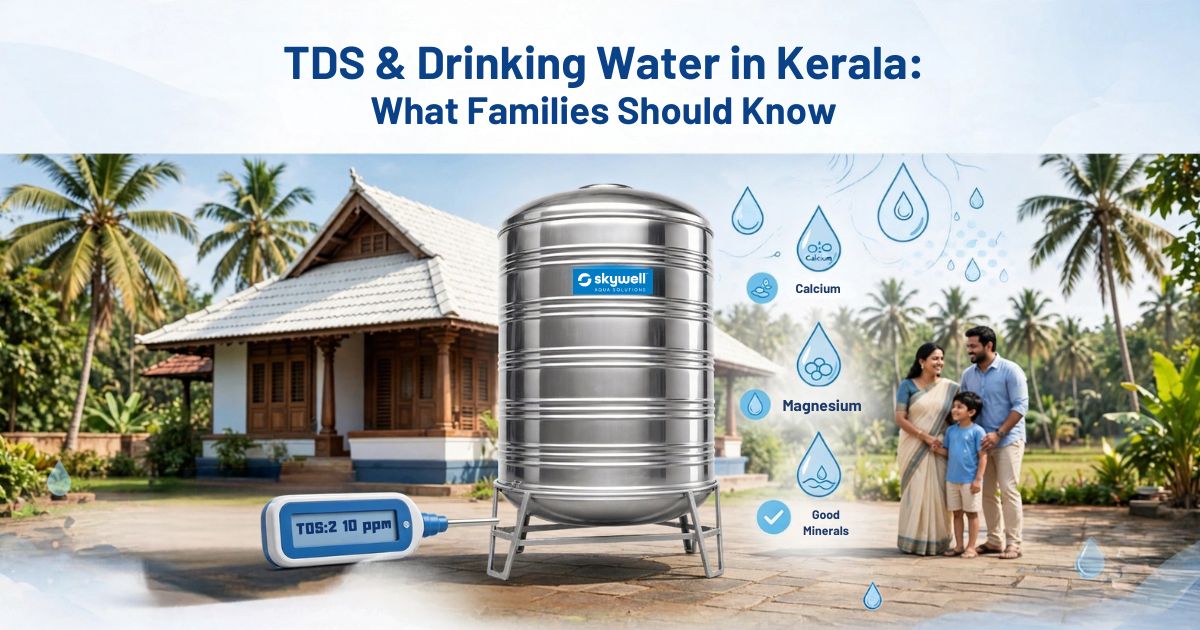
TDS drinking water Kerala cannot be judged from one number alone. BIS specifies 500 mg/L as the acceptable TDS limit and 2,000 mg/L as the permissible limit where no alternate source is available. TDS is one water-quality parameter, not a complete safety test. Your water source and other test results matter too.
Key takeaways
- BIS sets 500 mg/L as the acceptable TDS limit for drinking water under IS 10500:2012.
- A TDS reading alone cannot identify bacteria, nitrate, fluoride, iron or other specific contaminants.
- Kerala Water Authority tests TDS alongside physical, chemical and bacteriological parameters.
- Groundwater quality can vary by location and season, including within coastal parts of Kerala.
- A tank stores water; it should not be presented as a TDS-treatment device.
If your TDS reading has made you unsure about your water, start with the water source and the wider test result. Message Skywell on WhatsApp if you also need help understanding the storage side of your setup.
What is TDS in drinking water?
Total dissolved solids, or TDS, is the combined concentration of dissolved substances in water, usually reported in milligrams per litre. WHO discusses TDS mainly in relation to drinking-water acceptability and taste and does not propose a health-based guideline value for TDS itself. (WHO, Guidelines for Drinking-water Quality, fourth edition incorporating the first, second and third addenda, 2026)
Those dissolved substances can include minerals and salts such as calcium, magnesium, sodium, bicarbonates, chlorides and sulphates. The important point is that a TDS number combines different dissolved substances into one measurement.
A home TDS meter is therefore useful for a quick reading, but it is not a laboratory analysis of every substance in your water.
If your meter shows 450 mg/L, you know the approximate dissolved-solids level. You do not know from that number alone whether the water contains bacteria, excess nitrate, fluoride, iron or another specific contaminant.
What TDS level is acceptable for drinking water in India?
For Indian drinking water, 500 mg/L is the key TDS figure in BIS IS 10500:2012. BIS specifies 500 mg/L as the acceptable limit and 2,000 mg/L as the permissible limit when no alternate source is available. These are Indian standards, not Kerala-specific limits. (BIS, IS 10500:2012, Drinking Water — Specification, Second Revision)
The figures are easier to interpret when the two limits are kept separate.
| TDS reading | What the BIS framework means |
|---|---|
| Up to 500 mg/L | Within the acceptable TDS limit |
| Above 500 mg/L | Above the acceptable limit; the wider water-quality picture matters |
| Up to 2,000 mg/L | Within the conditional permissible limit where no alternate source is available |
| Above 2,000 mg/L | Outside the BIS permissible TDS limit |
A reading of 501 mg/L should not automatically be described as proof that your water is dangerous. It means the reading is above the acceptable TDS limit, and the water should be considered in the context of the applicable standard and other quality parameters.
WHO’s international guidance says water with TDS below about 600 mg/L is generally considered palatable, while higher concentrations can increasingly affect acceptability. WHO does not set a health-based guideline value for TDS itself. (WHO, Guidelines for Drinking-water Quality, fourth edition incorporating the first, second and third addenda, 2026)
The standards answer different questions. BIS provides an Indian drinking-water specification, while WHO provides international guidance on water quality and acceptability.
Does high TDS mean your water is unsafe?
No. A high TDS reading tells you that the water contains a higher concentration of dissolved material, but it does not identify exactly what that material is.
Kerala Water Authority tests TDS alongside parameters including pH, electrical conductivity, total hardness, calcium, magnesium, chloride, fluoride, iron, nitrate, residual chlorine, total coliforms and E. coli. (Kerala Water Authority, Quality Control Wing, current quality-control information)
That wider testing approach is important for a Kerala household. A TDS meter measures one property of the water; it does not replace microbiological or chemical testing.
A high TDS reading is a reason to investigate your water, not a diagnosis of what is wrong with it.
Does low TDS mean your water is safe?
No. A low TDS number does not establish complete drinking-water quality because TDS does not identify individual contaminants or replace microbiological testing.
Kerala Water Authority’s testing programme uses several physical, chemical and bacteriological parameters rather than relying on TDS as the sole indicator. Private water samples can also be tested through Kerala Water Authority district laboratories. (Kerala Water Authority, Quality Testing, current information)
This distinction matters if your household uses a private well or borewell. A consistently low TDS reading can tell you something about dissolved solids, but it cannot by itself confirm that the water has passed every relevant drinking-water test.
For a broader understanding of household water hygiene, see our guide to tank safety and hygiene.
Why does TDS vary across Kerala?
Kerala does not have one single household water chemistry. A well in Palakkad, a groundwater source in coastal Thiruvananthapuram, a KWA connection in Kochi and a borewell elsewhere can have different water characteristics.
A 2024 peer-reviewed study examined 40 groundwater samples from coastal villages in Thiruvananthapuram district during pre-monsoon and post-monsoon periods. It reported significant spatial and seasonal variation and measured TDS alongside electrical conductivity, pH, hardness and other chemical parameters. (Pitchaimani et al., “Multivariate statistical and hydrogeochemical analysis of seasonal groundwater quality variations in coastal villages of Trivandrum district, south India,” Discover Sustainability, 2024)
That study is evidence about the sampled coastal area, not a statewide measurement of every Kerala household.
What about monsoon and Karkidakam?
Be careful with blanket statements about monsoon effects. The Thiruvananthapuram study found seasonal variation, but it does not establish one statewide rule that TDS always rises or falls during Kerala’s monsoon. (Pitchaimani et al., Discover Sustainability, 2024)
If your household depends heavily on a well, a reading taken after a long dry period should not automatically be treated as representative of every month of the year.
Kerala-specific water decisions are therefore better made from your own source and test results than from a single statewide assumption.
What about well water, borewell water and KWA water?
Start with the source because different sources can require different testing considerations. Kerala Water Authority monitors water supplied through its schemes and also tests water from wells, private samples and other sources through its quality-control laboratories. (Kerala Water Authority, Quality Control Wing, current quality-control information)
KWA reports that its monitoring programme analyses samples from about 20,000 locations of its water-supply schemes each year. The same page states that its testing includes TDS, hardness, fluoride, nitrate, iron, total coliforms and E. coli. (Kerala Water Authority, Quality Control Wing, current quality-control information)
That figure refers to KWA’s monitoring programme. It does not mean 20,000 private Kerala households have been tested.
The Central Ground Water Board also monitors groundwater conditions across Kerala. Its Kerala pre-monsoon 2025 bulletin describes groundwater-level monitoring across the state and states that water quality is monitored from samples collected from selected monitoring wells during April. (Central Ground Water Board, Kerala Water Level Bulletin, Pre-monsoon 2025)
Coastal areas deserve attention to their individual groundwater conditions, but coastal location alone does not prove that a household has a TDS problem.
If you want to understand the storage part of the setup separately from water quality, see our stainless steel water tank range.
Message Skywell on WhatsApp if you have a TDS reading and want help separating the water-quality question from the tank-storage question. The aim is to understand what you actually need, not to turn one meter reading into a product recommendation.
Is TDS the same as water hardness?
No. TDS and hardness are related measurements, but they are not the same test.
Calcium and magnesium can contribute to hardness and also contribute to dissolved solids. A TDS meter cannot tell you the hardness of your water.
Kerala Water Authority lists TDS and total hardness as separate parameters in its water-quality testing programme. (Kerala Water Authority, Quality Control Wing, current quality-control information)
If you see scale on taps, bathroom fittings or a water heater, do not assume that the TDS number alone explains it. Ask for a hardness test as part of the wider water-quality assessment.
The practical distinction is simple: TDS tells you about total dissolved material, while hardness specifically concerns the concentration of hardness-producing minerals.
Should you trust a home TDS meter?
Use a home TDS meter as a screening tool, not as the final word on drinking-water quality.
A meter can be useful when you want to see whether readings are broadly changing over time or compare water from different sources. It cannot identify individual contaminants or provide a complete microbiological assessment.
Kerala Water Authority provides water testing through its district quality-control laboratories, including testing of private samples. (Kerala Water Authority, Quality Testing, current information)
What should you test?
The exact test package should depend on your water source and local circumstances. KWA’s published testing programme includes physical, chemical and bacteriological parameters such as TDS, pH, hardness, chloride, fluoride, iron, nitrate, residual chlorine, total coliforms and E. coli. (Kerala Water Authority, Quality Control Wing, current quality-control information)
If your concern is drinking-water quality, ask a laboratory which parameters are appropriate for your source instead of asking only for a TDS measurement.
For practical tank upkeep after the water-quality question is settled, see our tank maintenance guide for Kerala.
What does your water tank have to do with TDS?
A water tank stores water. It should not be presented as a TDS-treatment device.
If your source has a specific water-quality problem, the appropriate response may involve testing, filtration or another treatment process. Tank selection is a separate storage decision.
Skywell’s stainless steel water tanks are made from food-grade AISI 304 stainless steel and are listed in capacities from 500 litres to 5,000 litres, with vertical and horizontal options. The product page states that professional installation and regular cleaning and inspection are recommended. (Skywell Aqua Solutions, Stainless Steel Water Tanks)
Skywell states that its water tanks carry a 10-year warranty and that its manufacturing plant is located in Kanjikode, Palakkad, Kerala. The company also states that its manufacturing facility is ISO 9001:2015 certified. (Skywell Aqua Solutions, About Us)
The useful role of the tank is storage. If your concern is TDS, test the water. If your concern is storage, choose the tank according to capacity, material, installation and maintenance requirements.
Who should not buy a stainless steel tank?
Do not buy stainless steel simply because it sounds like a premium choice.
If your budget is tight, your existing storage arrangement already meets your needs, or you have no particular reason to choose the characteristics of stainless steel, there is no need to stretch your household budget for it.
The same principle applies in the other direction. If you specifically want food-grade AISI 304 stainless steel storage, evaluate the product against that requirement, your capacity needs and your installation conditions.
Skywell’s current product information states a 10-year warranty. Current pricing is not specified in the information available for this article, so ask for a current quote rather than relying on an old price.
What should you do if your TDS reading is high?
Start with the water source, then confirm the result with appropriate testing.
A useful sequence is to record whether you use a well, borewell, KWA supply or another source, repeat the reading consistently if needed, and arrange laboratory testing when the result is unexpected or the wider water quality is uncertain.
Do not choose a treatment system solely because a meter displays a number above 500 mg/L. Do not ignore the number either.
The useful middle ground is simple: measure, test, understand the result, then decide what your household actually needs.
For more buying guidance, you can also browse Skywell’s water tank blog for related tank-sizing, maintenance and comparison topics.
What should you ask your plumber, engineer or supplier?
Take these questions with you before changing your tank, treatment system or storage arrangement.
- What is my water source, and does it change significantly between seasons?
- Which laboratory tests are appropriate for this source beyond TDS?
- Does my current tank capacity match my household’s actual storage requirement?
- Do I need a treatment system for a confirmed water-quality issue, or am I reacting only to a TDS reading?
- What tank material, installation arrangement and maintenance routine suit my site?
Capacity comes first when storage is the question. Material comes after you understand the capacity, installation and use case.
Skywell Aqua Solutions makes food-grade stainless steel and plastic water tanks in Palakkad, Kerala.
Not sure which tank suits your home? Message us on WhatsApp for free, honest advice.
Still have a question?
If you have a TDS reading and are unsure what it means for your storage setup, send the reading and your tank requirement on WhatsApp.
WhatsApp Skywell: https://wa.me/916238801881?text=Hi%20Skywell%2C%20I%20would%20like%20a%20quote%20for%20a%20water%20tank
Cite as: skywell.in/tds-drinking-water-kerala/
Frequently asked questions
What is a good TDS level for drinking water in Kerala?
For India, BIS specifies 500 mg/L as the acceptable TDS limit under IS 10500:2012 and 2,000 mg/L as the permissible limit where no alternate source is available. These are Indian standards, not Kerala-specific targets. TDS should still be interpreted alongside other water-quality parameters and the household’s water source. (BIS, IS 10500:2012, Drinking Water — Specification, Second Revision)
Is 500 TDS safe for drinking water?
A TDS reading of 500 mg/L corresponds to the BIS acceptable TDS limit under IS 10500:2012. However, TDS alone does not establish complete drinking-water quality. A reading at or below 500 mg/L cannot rule out other water-quality issues, so other relevant physical, chemical and microbiological parameters should be considered when drinking-water quality is uncertain. (BIS, IS 10500:2012; Kerala Water Authority, Quality Control Wing)
Is high TDS dangerous?
High TDS does not by itself identify a specific health hazard because TDS measures the combined concentration of dissolved substances rather than identifying each substance. WHO’s drinking-water guidance does not propose a health-based guideline value for TDS itself. Higher TDS can affect taste and acceptability, while the individual substances require separate assessment. (WHO, Guidelines for Drinking-water Quality, fourth edition incorporating the first, second and third addenda, 2026)
Can a TDS meter tell me whether my well water is safe?
No. A household TDS meter provides an indication of dissolved-solids concentration, but it does not identify individual contaminants or provide a complete microbiological assessment. Kerala Water Authority laboratories test TDS alongside parameters such as hardness, fluoride, nitrate, iron, total coliforms and E. coli. (Kerala Water Authority, Quality Control Wing)
Does low TDS mean better drinking water?
Low TDS does not automatically mean that water has passed every relevant drinking-water test. TDS is only one measurement, while water quality can also involve microbiological, chemical and physical parameters. Kerala Water Authority’s monitoring programme reflects this by testing TDS together with several other parameters rather than using TDS as the sole indicator. (Kerala Water Authority, Quality Control Wing)
Does a water tank reduce TDS?
A storage tank should not be treated as a TDS-treatment system. TDS is a property of the water and must be assessed through measurement and appropriate testing. A tank’s role is water storage. Skywell’s stainless steel tanks are food-grade AISI 304 storage products, but they should not be presented as devices for reducing TDS. (Skywell Aqua Solutions, Stainless Steel Water Tanks)
Does TDS change in Kerala groundwater during the monsoon?
Groundwater TDS can vary by location and season, but there is no single statewide monsoon rule that applies to every Kerala household. A 2024 study of 40 groundwater samples from coastal villages in Thiruvananthapuram district found significant spatial and seasonal variation. The findings apply to the studied area, not to every groundwater source in Kerala. (Pitchaimani et al., Discover Sustainability, 2024)