Short answer:
In this guide
- What causes algae in a water tank?
- Is algae in a water tank dangerous?
- Why does algae keep coming back after cleaning?
- How do you remove algae from a water tank?
- Can a stainless steel water tank help with algae?
- Who should not buy a stainless steel water tank?
- How should you prevent algae from returning?
- What should you check before buying a water tank in Kerala?
- What should you do if your tank is already green?
- Still have a question?
- Frequently asked questions
Algae in water tank storage usually indicates that light and other growth-supporting conditions are reaching the stored water. The practical fix is to remove existing growth, reduce light entry, protect openings, control debris and sediment, and inspect the wider storage system. A clean tank still needs routine inspection and maintenance.
Key takeaways
- Direct sunlight can promote algal growth in stored water.
- A closed, well-protected tank reduces opportunities for growth and contamination.
- Cleaning alone may not solve recurring algae.
- Not every visible algal growth should be assumed toxic.
- Stainless steel does not make a household water system maintenance-free.
If you are already seeing green growth, you do not need to start by replacing the tank. Message Skywell on WhatsApp with your tank capacity, water source and the problem you are seeing for free, honest guidance.
What causes algae in a water tank?
Algae can develop when stored water receives light and has suitable growth conditions. WHO guidance specifically notes that sunlight reaching stored water can promote algal growth, while protected covers and openings help keep storage more sanitary. (WHO, Guidelines for Drinking-water Quality, fourth edition, 2011 reference text) https://iris.who.int/bitstream/handle/10665/204412/9789241547604_eng.pdf
Your first inspection is simple. Open the tank and look at the walls, lid, inlet, overflow and any exposed fittings.
If sunlight can reach the stored water through an open lid, transparent section or poorly protected opening, that condition needs attention. WHO also recommends protecting storage openings and cleaning them regularly where applicable. (WHO, Guidelines for Drinking-water Quality, fourth edition, 2011 reference text) https://iris.who.int/bitstream/handle/10665/204412/9789241547604_eng.pdf
Then look at what enters the tank. Leaves, dust, insects and other debris can enter through roof catchments, gutters or unprotected openings.
Kerala’s heavy monsoon makes this inspection especially practical. The Government of Kerala’s Orange Book 2025 provides district-level rainfall information and monsoon preparedness guidance, but rainfall itself should not be presented as proof that algae will grow in a particular tank. (Government of Kerala, Orange Book of Disaster Management 2025, 2025) https://sdma.kerala.gov.in/wp-content/uploads/2025/08/Orange-Book-of-Disaster-Management-2025.pdf
The useful question is not simply, “Why is my tank green?” Ask, “What conditions inside this storage system are allowing the growth to return?”
Is algae in a water tank dangerous?
Algae in a household tank should be investigated, but visible green growth does not prove that a specific toxin is present. CDC explains that not all algal blooms are harmful, while some algae and cyanobacteria can produce toxins. (CDC, Harmful Algal Blooms and Your Health, 2024) https://www.cdc.gov/harmful-algal-blooms/about/index.html
That distinction matters. You should not look at green water and automatically label it toxic.
At the same time, visible growth in a tank used for household water is a maintenance warning. Stop treating the colour as the only problem and inspect the tank, cover, inlet, overflow and water source.
There is also Kerala-specific research worth noting. A study presented at the 38th Kerala Science Congress examined seven algal samples from overhead freshwater tanks and ponds in selected areas of Kasaragod and Kannur. One sample from an overhead tank in Thankayam showed cytotoxic activity, and further testing identified aplysiatoxin among compounds detected in that sample. (38th Kerala Science Congress Proceedings, 2026) https://kscnew.kerala.gov.in/wp-content/uploads/2026/01/38-KSC-Proceddings-compressed.pdf
That study is useful evidence that algal growth in an overhead tank deserves attention. It involved seven samples from selected locations, however, so it should not be treated as evidence about all household tanks in Kerala.
If the water is visibly affected and intended for drinking or household use, investigate the cause and arrange appropriate cleaning rather than guessing from appearance alone.
Why does algae keep coming back after cleaning?
Algae often returns when the condition that supported its growth remains after cleaning. Scrubbing removes visible growth, but it does not necessarily remove light exposure, recurring debris, sediment or an unprotected opening.
This is why a tank can look clean immediately after maintenance and become green again later.
| What you notice | What to inspect |
|---|---|
| Green growth on tank walls | Direct sunlight and tank cover |
| Growth returns after cleaning | Light entry, openings and debris |
| Sediment at the bottom | Water source, inlet and cleaning routine |
| Leaves or insects inside | Lid, inlet and overflow protection |
| Growth around exposed fittings | Sunlight and exposed surfaces |
WHO’s 2026 sanitary inspection package for piped distribution and storage tanks is designed around identifying risk factors, corrective action, and ongoing operation and maintenance. (WHO, Sanitary inspection package: piped distribution – storage tank, 2026) https://www.who.int/publications/m/item/sanitary-inspection-package-%28drinking-water%29–piped-distribution—storage-tank
That is the useful way to think about recurring algae. It is not just a cleaning problem. It can be a storage-system problem.
For related maintenance guidance, see our guide to water tank maintenance in Kerala.
How do you remove algae from a water tank?
The practical approach is to clean the existing growth and correct the conditions that allowed it to develop. Do not rely on an unspecified chemical treatment or assume that one cleaning will prevent recurrence.
Start by arranging appropriate tank cleaning. Remove visible growth and accumulated sediment using a cleaning procedure suitable for the tank and intended water use.
Then inspect the cover. It should prevent unnecessary light and protect the storage opening from avoidable contamination.
Next, inspect the inlet and overflow. Look for leaves, insects, dirt or other material entering the system.
If the tank receives roof-collected water, gutters and catchment surfaces also deserve attention. WHO guidance recommends maintaining these parts of a storage system and protecting storage openings where applicable. (WHO, Guidelines for Drinking-water Quality, fourth edition, 2011 reference text) https://iris.who.int/bitstream/handle/10665/204412/9789241547604_eng.pdf
Do not pour an unknown chemical into a household water tank because an online article recommends it. Any disinfectant or treatment product needs an appropriate product, concentration and procedure for the intended water use.
The goal is not simply to make the walls look clean. The goal is to remove the visible growth and correct the conditions that allow it to return.
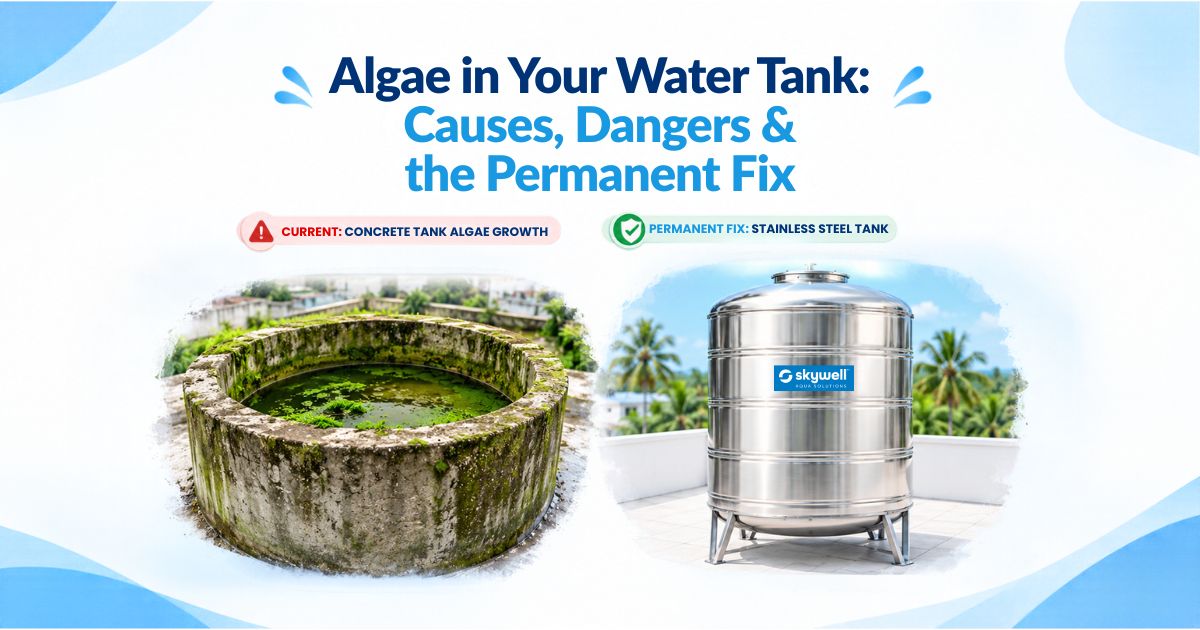
Can a stainless steel water tank help with algae?
A stainless steel tank can be part of a storage setup designed to reduce conditions associated with algae, but it should not be described as a universal algae-proof solution.
Skywell’s stainless steel range uses food-grade AISI 304 stainless steel and is available from 500 L to 5,000 L in vertical and horizontal designs. Skywell also states that its water tanks carry a 10-year warranty. (Skywell Aqua Solutions, Stainless Steel Water Tanks product page, current page) https://skywell.in/stainless-steel-water-tanks/
The material is only one part of the system. A stainless steel tank cannot clean contaminated source water, repair a dirty sump, correct a badly fitted cover or replace routine inspection.
| Storage factor | What matters |
|---|---|
| Tank material | Food-grade AISI 304 stainless steel or the specified alternative |
| Light exposure | Limit direct sunlight reaching stored water |
| Cover | Keep the tank properly covered and accessible for inspection |
| Openings | Protect inlet, overflow and other openings appropriately |
| Maintenance | Inspect and clean the storage system periodically |
| Water source | Check whether the source or upstream storage contributes debris |
For homeowners specifically considering stainless steel, you can compare the available options in our stainless steel water tank range.
Material matters. Maintenance still matters.
If you want help deciding whether changing the tank is actually necessary, message Skywell on WhatsApp with your current tank type, capacity and water source. You can ask for an opinion before deciding whether to replace it.
Who should not buy a stainless steel water tank?
Do not buy stainless steel simply because you found algae once. If the real problem is an open lid, dirty inlet, contaminated sump, poor gutter maintenance or recurring debris, changing the tank may not solve the underlying issue.
You also should not choose stainless steel merely because someone says it is automatically better for every home. Your decision should consider capacity, installation space, water source, maintenance expectations and the material specification you actually want.
Skywell offers food-grade AISI 304 stainless steel tanks, but that does not make stainless steel the correct choice for every homeowner.
For some households, a food-grade plastic tank may be more appropriate. Skywell’s plastic range uses a three-layer, UV-stabilised construction with a food-grade 100% virgin polyethylene inner layer and capacities from 500 L to 10,000 L. See our plastic water tanks if your requirements point in that direction.
That is how I would make the decision: solve the storage problem first, then choose the material.
How should you prevent algae from returning?
Preventing recurrence starts with reducing light exposure and keeping the storage system clean and protected. The exact maintenance routine depends on your tank, water source and installation.
Use this practical sequence:
- Inspect the tank cover and confirm that unnecessary sunlight cannot reach the stored water.
- Check the inlet, overflow and surrounding area for openings, leaves, insects or other debris.
- Inspect the tank bottom for sediment and arrange appropriate cleaning when needed.
- Check upstream storage, gutters or the sump if debris repeatedly reaches the tank.
- Recheck the system after cleaning instead of assuming the problem is permanently solved.
For a Kerala home, also pay attention to the terrace environment. Strong sun, monsoon debris, roof runoff and long periods between inspections can all change the condition of a storage system.
There is no single inspection interval that can honestly be prescribed for every household without knowing the source, tank design and surrounding conditions. The useful principle is regular inspection with corrective action when you find a risk.
What should you check before buying a water tank in Kerala?
Before buying a new tank, confirm the material, capacity, installation conditions, access for maintenance and warranty rather than relying only on appearance.
Ask your plumber, engineer or supplier these questions:
- What capacity does my household actually require?
- What is the exact tank material and grade?
- How will the tank be covered and accessed for inspection?
- Where will the tank sit, and how much direct sunlight will reach it?
- How will the tank and surrounding water-storage system be cleaned?
- What warranty is provided, and who handles service?
Skywell states that its manufacturing unit is in Kanjikode, Palakkad, Kerala, and that the company is ISO 9001:2015 certified. Its published water-tank warranty is 10 years. (Skywell Aqua Solutions, About Us, current page) https://skywell.in/about-us/
The manufacturing location is a practical detail rather than a reason by itself to choose a product. A tank is a physical installation that may eventually require delivery, installation or service.
Capacity comes first. Material comes after.
What should you do if your tank is already green?
If your tank is already green, arrange proper cleaning and inspect the complete storage system rather than repeatedly scrubbing the same surface.
Start with the tank itself. Check the cover, walls, bottom sediment, inlet and overflow.
Then move upstream. If the tank receives water through a sump, pump, roof catchment or other storage point, inspect those components too.
If visible growth returns quickly after cleaning, that recurrence is useful information. It suggests that one or more supporting conditions may still be present.
WHO’s 2026 storage-tank sanitary inspection guidance specifically uses risk-factor identification and corrective action as part of ongoing operation and maintenance. (WHO, Sanitary inspection package: piped distribution – storage tank, 2026) https://www.who.int/publications/m/item/sanitary-inspection-package-%28drinking-water%29–piped-distribution—storage-tank
If the source water itself is suspect, cleaning the overhead tank alone may not address the underlying issue.
The practical goal is simple: remove existing growth, reduce the conditions supporting it, and maintain the entire storage system.
Skywell Aqua Solutions makes food-grade stainless steel and plastic water tanks in Palakkad, Kerala.
Not sure which tank suits your home? Message us on WhatsApp for free, honest advice.
Still have a question?
Tell us your tank capacity, water source and what you are seeing inside the tank. We can help you think through the likely storage issue before you decide on a replacement.
WhatsApp Skywell: Message Skywell for tank advice
Cite as: skywell.in/algae-in-water-tank/
Frequently asked questions
Can algae grow inside a water tank?
Yes. Algae can grow when stored water receives sufficient light and suitable growth conditions are present. WHO guidance specifically notes that sunlight reaching stored water can promote algal growth. Keeping the tank covered, protecting openings and maintaining the storage system are therefore practical parts of algae prevention. (WHO, Guidelines for Drinking-water Quality, fourth edition, 2011 reference text) https://iris.who.int/bitstream/handle/10665/204412/9789241547604_eng.pdf
Is algae in a water tank always harmful?
No. Algae in a water tank should not automatically be described as toxic. CDC states that not all algal blooms are harmful, although some algae and cyanobacteria can produce toxins. Because appearance alone cannot establish the type or toxicity of growth, visible algae in household storage should be investigated and properly addressed. (CDC, Harmful Algal Blooms and Your Health, 2024) https://www.cdc.gov/harmful-algal-blooms/about/index.html
Why does algae keep returning after I clean my tank?
Algae can return when the conditions supporting its growth remain after cleaning. Direct sunlight, unprotected openings, recurring debris and sediment can all require attention. Cleaning removes existing growth, but recurring problems require inspection of the tank, cover, inlet, overflow and wider storage system. WHO’s 2026 guidance recommends identifying storage-tank risk factors and taking corrective action.
Does stainless steel completely prevent algae?
No. A stainless steel tank should not be described as permanently algae-proof. Skywell’s stainless steel range uses food-grade AISI 304 stainless steel, but algae control still depends on factors such as light exposure, protected openings, cleanliness and the condition of the wider water-storage system. A stainless steel tank does not replace routine inspection and maintenance. (Skywell Aqua Solutions, current product page) https://skywell.in/stainless-steel-water-tanks/
Can Kerala monsoon conditions affect water-tank maintenance?
Kerala’s monsoon makes roof, gutter and storage-system maintenance particularly relevant because rainfall can introduce debris into collection and storage systems. The Government of Kerala’s Orange Book 2025 provides district-level rainfall and monsoon preparedness information, but those rainfall figures do not establish that monsoon rain itself causes algae in a particular tank. (Government of Kerala, Orange Book of Disaster Management 2025, 2025) https://sdma.kerala.gov.in/wp-content/uploads/2025/08/Orange-Book-of-Disaster-Management-2025.pdf
What size stainless steel water tank does Skywell make?
Skywell lists stainless steel water tanks from 500 L to 5,000 L, using food-grade AISI 304 stainless steel, with vertical and horizontal designs. The appropriate capacity depends on your household requirement, water source, refill pattern and available installation space. Skywell also states that its water tanks carry a 10-year warranty. (Skywell Aqua Solutions, current product page) https://skywell.in/stainless-steel-water-tanks/
Can I add a chemical to kill algae in my water tank?
Do not add an unspecified chemical to household water storage based on an unverified online dosing instruction. If the water is intended for household or drinking use, any treatment should follow an appropriate, verified procedure for the specific product and water system. Cleaning, light control, protected openings and sanitary storage should be addressed rather than relying on an unexplained chemical shortcut. (WHO, Sanitary inspection package: piped distribution – storage tank, 2026) https://www.who.int/publications/m/item/sanitary-inspection-package-%28drinking-water%29–piped-distribution—storage-tank
What should I do if algae keeps returning in my water tank?
If algae keeps returning, inspect more than the tank walls. Check the cover, sunlight exposure, inlet, overflow, sediment, upstream sump and water source, then arrange appropriate cleaning. A recurring problem may indicate an unresolved storage-system condition rather than inadequate scrubbing alone. WHO’s 2026 sanitary inspection package recommends identifying risk factors and applying corrective actions as part of ongoing storage-tank maintenance. https://www.who.int/publications/m/item/sanitary-inspection-package-%28drinking-water%29–piped-distribution—storage-tank