Short answer: Water tank size for family use depends on household demand, the reliability of your water supply, existing sump storage and the safe installation location. Kerala’s 135 L/person/day figure is a planning benchmark, not a universal consumption rule. Calculate demand first, then match storage to your refill cycle.
In this guide
- How do I calculate water tank size for my family?
- How often does water reach your house?
- Is 1,000 litres enough for a family of four?
- Does your water source change the calculation?
- What about Kerala’s monsoon and dry months?
- Does the tank location affect the size?
- Should you choose stainless steel for your water tank?
- What should you ask your plumber before ordering?
- What size should you finally choose?
- Still have a question?
- FAQ
Key takeaways
- Start with household demand, but do not choose capacity from family size alone.
- Kerala’s 135 L/person/day figure is a planning benchmark, not measured family consumption.
- Existing sump storage can change the overhead tank capacity you need.
- Water-source reliability matters more when refills are irregular.
- A larger tank is not appropriate if the installation location cannot safely support it.
If you want help narrowing down the relevant capacity range, message Skywell on WhatsApp with your family size, water source and existing storage. This is an advice request, not a commitment to buy.
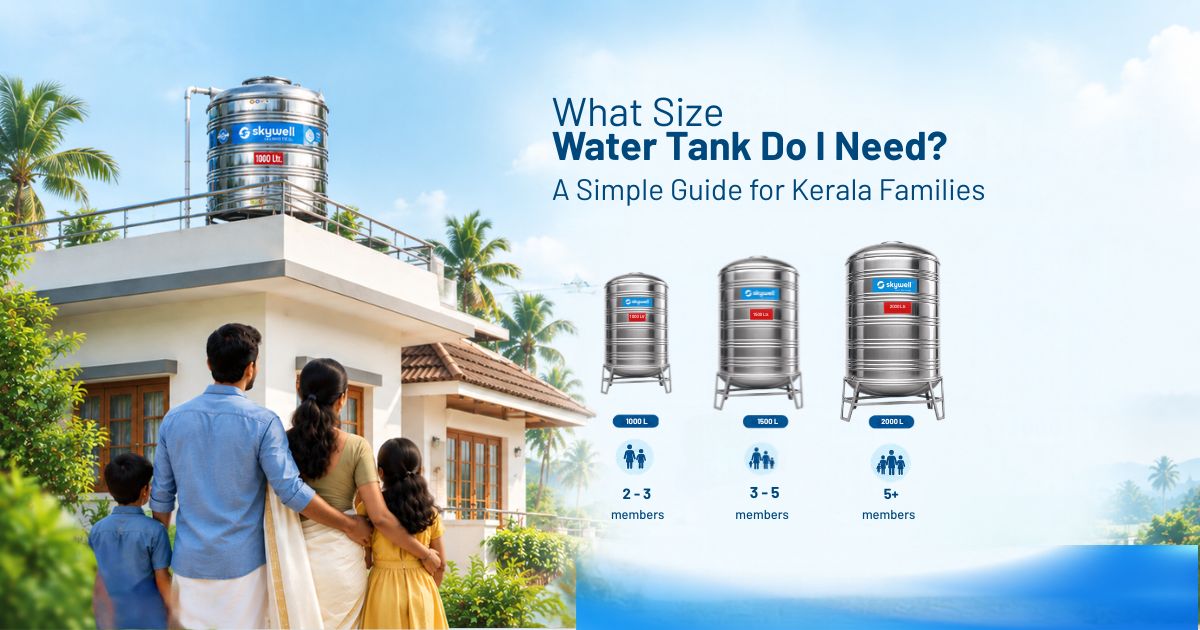
What Size Water Tank Do I Need? A Simple Guide for Kerala Families
Your overhead tank is one part of your home’s water-storage system. The right capacity depends on how many people use the house, how much water you are planning for, how often water reaches the property and how much storage you already have.
The Government of Kerala’s Guidelines for Water Budgeting, September 2023 uses 135 litres per person per day for residences with full flushing systems. The same document also presents other demand ranges and makes clear that water budgeting depends on the situation, so 135 litres should be treated as a planning benchmark rather than a measurement of what every family consumes.
How do I calculate water tank size for my family?
Water tank capacity starts with an estimate of household demand, calculated from the number of regular users and an appropriate planning benchmark. For a simple Kerala household calculation, multiply the number of users by 135 litres per person per day.
Number of people × 135 litres = indicative daily demand
The following table shows calculated examples using that planning benchmark.
| People using the house | Indicative daily demand at 135 L/person/day |
|---|---|
| 2 | 270 L |
| 3 | 405 L |
| 4 | 540 L |
| 5 | 675 L |
| 6 | 810 L |
| 8 | 1,080 L |
These are calculated examples based on the Kerala government planning benchmark. They are not observations of actual consumption by Kerala families. The Government of Kerala, Guidelines for Water Budgeting also presents different domestic-demand ranges for different contexts, so one figure should not be treated as universal.
For example, four people produce an indicative figure of 540 litres per day under this benchmark. That does not mean a 540-litre tank is automatically the right purchase.
Capacity comes after you understand the storage cycle.
How often does water reach your house?
The required storage depends heavily on the time between reliable refills. A home receiving dependable water every day has a different storage requirement from one that faces irregular well, borewell or piped-water availability.
Government of Kerala, Guidelines for Water Budgeting, September 2023 guidance treats water availability as a time-dependent issue because rainfall varies across both space and time. The document also recognises Kerala’s two monsoon seasons when discussing water availability.
Ask yourself one practical question:
How much water does the household need before the next reliable refill?
That question is more useful than choosing a tank from a family-size chart alone.
If your house has a sump that already stores water, the overhead tank does not necessarily need to contain the entire household reserve. The sump and overhead tank can be considered together as parts of the overall storage arrangement.
A four-person house in one Kerala locality can therefore require a different tank arrangement from another four-person house nearby.
If you want to compare your calculation with Skywell’s broader guidance, see what size tank you need.
Is 1,000 litres enough for a family of four?
A 1,000-litre tank can be appropriate for some families of four, but household size alone cannot establish that it is the correct capacity.
At 135 litres per person per day, four people represent an indicative planning demand of 540 litres per day.
| Household situation | What to consider |
|---|---|
| Four people, reliable daily supply | Daily demand and existing storage |
| Four people, irregular supply | Longer refill interval and reserve requirement |
| Four people with substantial sump storage | Total sump plus overhead storage |
| Four people with limited installation space | Safe physical capacity at the proposed location |
| Four people with seasonal source problems | The least reliable part of the year |
The table is a planning framework, not a prescription for a specific household.
A 1,000-litre tank is therefore not automatically too large or too small. The relevant question is whether the complete storage system matches the household’s demand and refill pattern.
If you are comparing materials after establishing capacity, Skywell’s stainless steel range includes 500 L, 1,000 L, 1,500 L, 2,000 L, 3,000 L and 5,000 L options.
If you already know your family size and water-supply pattern, you can message Skywell on WhatsApp with those details and ask which capacity range is relevant. No purchase decision is required to ask the question.
Does your water source change the calculation?
Yes. Your water source matters because storage is partly a response to how reliably that source can supply the house.
A Kerala home may depend on a well, borewell, piped supply, rainwater collection or a combination of sources. The Central Ground Water Board publishes Kerala-specific groundwater information, including the Ground Water Quality Yearbook 2024-25 Kerala, issued in 2025.
That does not mean a district name is enough to calculate your tank size.
A house in Palakkad and a house in coastal Kannur can have different sources, storage arrangements and refill patterns. Even neighbouring properties can have different well performance or pumping arrangements.
What should you record?
Before ordering, note:
- Your main water source.
- How often the source normally provides water.
- Whether supply becomes less reliable during particular months.
- Existing sump or other storage capacity.
- Where the proposed overhead tank will be installed.
The useful figure is your actual household storage requirement between dependable refills, not a district-wide assumption.
What about Kerala’s monsoon and dry months?
Seasonal rainfall should be considered when planning storage, but there is no universal percentage by which every Kerala household should increase or reduce tank capacity.
The Government of Kerala, Guidelines for Water Budgeting, September 2023 methodology treats water availability over shorter periods because rainfall varies spatially and temporally.
That means a tank decision made during a heavy monsoon should still consider the less dependable period of the year.
For example, if your household depends on a source that refills reliably during the monsoon but becomes less dependable later, the later period deserves attention when planning storage.
Do not resize the tank simply because the house is being completed during a wet month.
Plan around the conditions that matter when your water source is least dependable.
Does the tank location affect the size?
Yes. Tank capacity must be considered together with the proposed installation location and support arrangement.
A full 1,000-litre tank contains 1,000 litres of water. The supporting structure therefore needs to be appropriate for the filled installation, including the tank, stored water and associated fittings.
Do not assume that a terrace or loft that supported an older, smaller tank can automatically support a larger one.
Before ordering, ask your engineer or responsible contractor to confirm the proposed location and support arrangement. Skywell’s stainless steel water tank guidance also recommends professional installation and regular cleaning and inspection.
BIS identifies building and plumbing services, including water supply, within the National Building Code framework and provides standardized development and building regulations for states including Kerala.
Should you choose stainless steel for your water tank?
Capacity should be established before material. Stainless steel is a material choice after you know the required capacity and have confirmed that the installation arrangement is suitable.
Skywell lists its stainless steel tanks as food-grade AISI 304 stainless steel, with capacities of 500 L, 1,000 L, 1,500 L, 2,000 L, 3,000 L and 5,000 L.
Skywell states that its manufacturing unit is in Kanjikode, Palakkad, and that the company is ISO 9001:2015 certified. It also states a 10-year warranty for its water tanks.
These are Skywell product and company facts. They do not establish that stainless steel is the appropriate material for every household.
Who should not buy a stainless steel tank?
If your main priority is keeping the initial purchase within a tight household budget and a suitable alternative material meets your requirements, stainless steel may not be the decision you need to make.
If your installation location cannot safely accommodate the required tank, changing the tank material does not solve the structural problem.
If you have not calculated your capacity requirement yet, do that first. Choosing stainless steel before deciding how much water you actually need reverses the order of the decision.
The material should suit your use case. The capacity should suit your water requirement.
What should you ask your plumber before ordering?
Take four practical questions to the plumber, engineer or supplier handling your water-storage system.
- How often does water normally reach this house?
- How much storage is already available in the sump or other tanks?
- What capacity do you recommend, and what calculation supports it?
- Is the proposed terrace or loft location suitable for the filled tank?
A recommendation should be explainable in terms of household demand, refill frequency, existing storage and installation conditions.
If those four questions have clear answers, you have a much stronger basis for selecting capacity.
What size should you finally choose?
The right water tank size for family use is the capacity that matches household demand, refill frequency, existing storage and a suitable installation location.
Use this order:
- Calculate indicative household demand.
- Understand the normal water-supply cycle.
- Account for sump and other existing storage.
- Confirm the physical installation location.
- Select the tank capacity and material.
Skywell’s current stainless steel water tanks range covers 500 L to 5,000 L, giving homeowners several capacity points to consider after the household requirement has been worked out.
For plastic alternatives, Skywell also lists food-grade polyethylene water tanks in multiple capacities.
For a Kerala home, water tank size for family use is a storage-planning decision, not simply a family-size chart.
If you are unsure which capacity fits your household, message Skywell on WhatsApp with your family size, water source, supply frequency, existing sump capacity and proposed tank location. Skywell’s current contact page lists +91 6238801881 for support.
Skywell Aqua Solutions makes food-grade stainless steel and plastic water tanks in Palakkad, Kerala.
Not sure which tank suits your home? Message us on WhatsApp for free, honest advice.
Still have a question?
Send your family size, water source, supply frequency, existing sump capacity and proposed installation location on WhatsApp, and Skywell can help you understand the relevant capacity range.
FAQ
What is the right water tank size for a family of four?
A family of four has an indicative domestic demand of 540 litres per day when calculated using the Government of Kerala’s 135 litres per person per day planning benchmark for residences with full flushing systems. The final tank capacity depends on supply frequency, existing sump storage and the proposed installation location.
Is a 1,000 litre water tank enough for a family?
A 1,000-litre tank may suit some families, but family size alone cannot establish the correct capacity. Four people represent 540 litres of indicative daily demand at the Kerala government planning benchmark, but the actual storage requirement also depends on how often water reaches the home and how much storage exists elsewhere.
How do I calculate water tank capacity for my home?
Begin by multiplying the number of regular household users by the applicable planning demand. Kerala government water-budgeting guidance uses 135 litres per person per day for residences with full flushing systems. Then consider water-supply frequency, sump capacity and the proposed tank location before selecting the final capacity.
Does a sump reduce the size needed for an overhead tank?
A sump can form part of the home’s overall water-storage system, so the overhead tank does not necessarily have to hold the entire household reserve. The correct arrangement depends on water source, pumping system, supply frequency, household demand and available installation space. A plumber or engineer should assess the complete system before capacity is finalized.
Does Kerala’s monsoon affect water tank sizing?
Kerala’s seasonal rainfall pattern should be considered when planning household water storage, but there is no universal percentage by which every Kerala home should increase or reduce tank capacity. Government of Kerala guidance treats water availability and demand over shorter periods because rainfall varies spatially and temporally across the state.
What stainless steel tank sizes does Skywell offer?
Skywell’s stainless steel water tank page lists capacities of 500 litres, 1,000 litres, 1,500 litres, 2,000 litres, 3,000 litres and 5,000 litres. The tanks are listed as food-grade AISI 304 stainless steel. Capacity should be selected after considering household demand, water-supply frequency, existing storage and the installation location.
Does the installation location matter when choosing a water tank?
Yes. The proposed terrace, loft or other support location needs to be suitable for the filled tank and its associated fittings. A larger tank should not be installed simply because the capacity appears appropriate on paper. Skywell recommends professional installation for its stainless steel tanks, while building and plumbing requirements should be considered for the complete installation.