Short answer:
In this guide
- Where should I place a water tank in my house?
- Is an overhead tank the right choice for a Kerala house?
- Can I keep the water tank at ground level or underground?
- Is a loft tank suitable for a compact Kerala house?
- How does Kerala’s weather affect tank placement?
- Does well water or KWA water change the tank position?
- What about coastal Kerala and corrosion?
- Should I choose the tank material before choosing the location?
- Who should not choose an overhead or loft position?
- What should I ask my plumber or building professional?
- Frequently asked questions
- Still have a question?
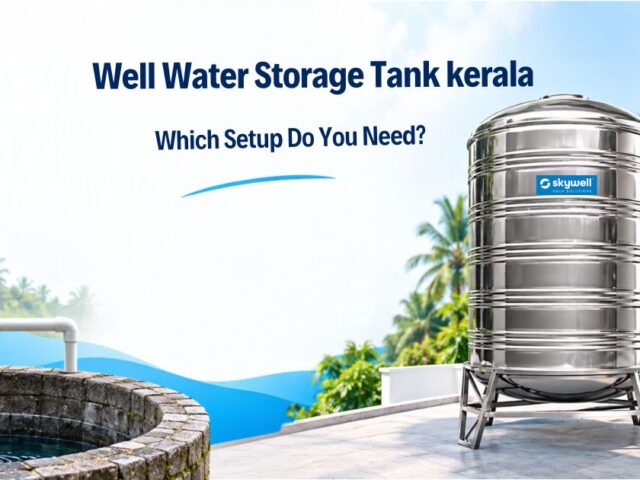
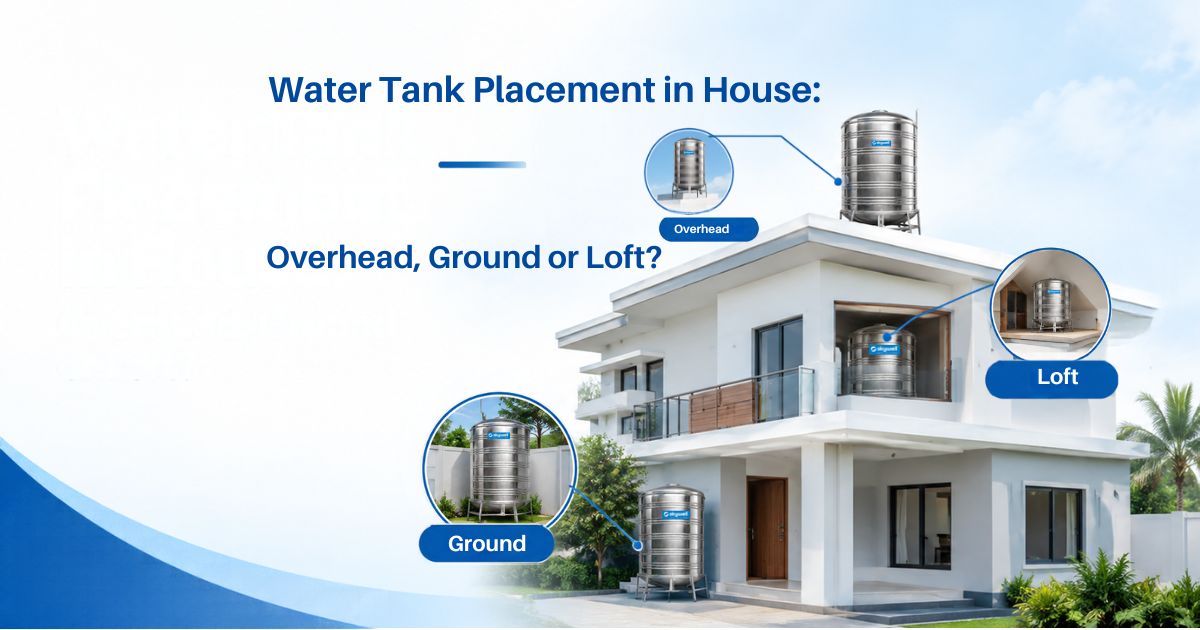
Water tank placement house decisions should start with the water source, storage sequence, structural support, plumbing route and maintenance access. An overhead tank can suit gravity-fed distribution, while ground or underground storage can work as an intermediate stage. A loft tank can suit compact layouts when the structure and access are appropriate.
Key takeaways
- Choose the tank position as part of the building and plumbing plan.
- An overhead tank is not automatically the right choice for every Kerala house.
- Ground storage can be useful when water needs pumping before distribution.
- Loft placement saves space only when support and maintenance access are adequate.
- The tank location must be confirmed before selecting the final configuration.
If you already have a house plan, you can message Skywell on WhatsApp with your proposed tank location and capacity. The aim is to help you check the practical fit before you buy.
Where should I place a water tank in my house?
Start with the water source, storage sequence, structural support, pipe routes and future maintenance access. Those five points usually narrow the possible positions before you even compare tank materials.
Your overhead tank is one of the last storage points before water reaches many household outlets. That makes its position part of the plumbing system, not simply an unused corner of the terrace.
Indian Standard IS 2065 covers water supply in buildings, including conveyance, distribution, storage, fittings, inspection and maintenance. BIS, IS 2065:1983, Code of Practice for Water Supply in Buildings.
Read the BIS standard information
A separate BIS-published building regulation document states that storage tanks should be accessible and positioned so inspection and cleaning can be carried out. It also specifies access arrangements for overhead tanks. BIS, Standardized Development and Building Regulations, 2024.
Read the BIS building regulations document
So the highest possible point is not automatically the right point.
Is an overhead tank the right choice for a Kerala house?
An overhead tank can suit a house designed around elevated storage and gravity-fed distribution. Its usefulness depends on the complete plumbing arrangement, including the height difference between storage and outlets, pipe routing and fittings.
The important word is designed.
If you are building a new house, tell the structural designer and plumber where the tank is expected to sit before the relevant construction work is finalised. If you are renovating an older house, do not assume that an existing terrace is suitable simply because it appears solid.
The full tank load matters. A 1,000-litre tank contains 1,000 litres of water when filled to nominal capacity, before considering the tank itself and associated fittings.
The National Building Code of India covers structural design and plumbing services as separate but connected areas of building planning. BIS, National Building Code of India 2016.
See the BIS guide to NBC 2016
What should I check before putting a tank on the terrace?
Check the supporting structure, tank base, access route, inlet, outlet, overflow, drain arrangement and working space around the tank.
A tank should remain accessible after installation. That matters during cleaning, inspection and valve maintenance, particularly when the terrace also contains a staircase room, solar equipment or other services.
BIS guidance states that storage tanks should be positioned for inspection and cleaning, while overhead tanks require suitable access and covers. BIS, Standardized Development and Building Regulations, 2024.
A convenient installation today should not create an inaccessible maintenance problem later.
Can I keep the water tank at ground level or underground?
Yes. Ground-level or underground storage can suit a house where incoming water is collected first and then pumped to another storage point or into the distribution system.
The sequence may look like this:
Water source → ground-level storage → pump → overhead tank → household outlets
But that is only one arrangement. Another house may use direct pumping, a different storage sequence or more than one water source.
Kerala Water Authority publishes state-level performance reports covering water-supply infrastructure and services. Kerala Water Authority, Performance Report 2024–2025.
See Kerala Water Authority performance reports
Your plumber therefore needs to look at the actual source, levels and pipe routes rather than copy the arrangement used in another house.
When does ground storage make practical sense?
Ground storage can be useful when the water source and pumping arrangement make it easier to collect water at a lower level before transferring it.
This can be relevant for homes using wells, borewells or public supply, but the correct sequence depends on the individual property.
For example, a borewell house may have a pumping stage that a house with a different supply arrangement does not need. The tank position should follow that system rather than determine it.
If you are comparing storage options, first identify what size tank you need and then discuss where that capacity can be installed safely.
Is a loft tank suitable for a compact Kerala house?
A loft tank can suit a compact house when a suitable structural location, plumbing connection and maintenance route are available.
The main advantage is space. A loft or utility-space position may avoid using valuable terrace area, but the tank should not be hidden so completely that inspection becomes difficult.
For a new house, include the loft position while the room and plumbing layout are being designed. For an existing house, have the proposed support arrangement checked before adding storage.
A tank above a false ceiling may look tidy after installation. It becomes less convenient if a valve, connection or tank surface cannot be reached without dismantling part of the room.
That is why access should be treated as a design requirement, not an afterthought.
How does Kerala’s weather affect tank placement?
Kerala’s rainfall varies by season and district, so tank placement should account for access, overflow routing, drainage and safe inspection during wet weather.
The India Meteorological Department recorded 1,748.1 mm of southwest monsoon rainfall across Kerala during June to September 2024, compared with a long-period average of 2,018.6 mm. IMD classified the seasonal rainfall as normal, with district-level variation. India Meteorological Department, Monsoon Report 2024, 2025.
Read the IMD Monsoon Report 2024
For your house, the practical question is not simply whether Kerala receives heavy rain. Ask whether you can still reach the tank, inspect the overflow and manage drainage when the terrace is wet.
This matters around staircases, parapets, solar installations and other terrace equipment. A tank that is technically reachable but awkward to approach during monsoon maintenance is not ideally placed.
Does well water or KWA water change the tank position?
Yes, the water source can change the plumbing sequence and therefore the most practical tank position.
A house using a private well may have a pump and intermediate storage stage. A public-supply connection may follow a different arrangement. Some homes use multiple sources and need the plumbing designed around how those sources are selected and stored.
Groundwater conditions also vary by location. The Central Ground Water Board’s Kerala assessment reports groundwater-resource and quality conditions by assessment unit rather than treating the entire state as having identical conditions. CGWB, Dynamic Ground Water Resources of Kerala, 2024, issued 2025.
Read the CGWB Kerala groundwater assessment
For example, the 2024 Kerala assessment identifies specific assessment units affected by water-quality issues. That does not mean every home in a district has the same groundwater condition.
Your actual water source matters more than a generic district-wide assumption.
What about coastal Kerala and corrosion?
Coastal location should be considered as part of the actual site conditions, but it should not be treated as a blanket corrosion warning for every coastal home.
CGWB’s Kerala groundwater assessment records conditions by specific assessment units, including locations affected by salinity. CGWB, Dynamic Ground Water Resources of Kerala, 2024, issued 2025.
If your property is near the coast, discuss the actual water source and site conditions with the relevant building and plumbing professionals. Material selection should follow those conditions alongside the installation position, capacity and maintenance requirements.
The same principle applies inland. Test and assess the situation you actually have rather than relying on a broad location label.
Should I choose the tank material before choosing the location?
Choose the practical installation position first, then select the tank configuration and material that fit that position and your storage requirements.
Skywell’s stainless steel range includes 500 L, 1,000 L, 1,500 L, 2,000 L, 3,000 L and 5,000 L capacities, with food-grade AISI 304 stainless steel construction. Skywell, current product specification.
Skywell also manufactures food-grade plastic water tanks using a 100% virgin polyethylene inner layer in a three-layer, UV-stabilised construction, with capacities from 500 L to 10,000 L.
If stainless steel fits the planned installation, you can review our stainless steel range. If a plastic configuration suits the space and requirements better, see our plastic water tanks.
Capacity comes first. Material comes after.
What does the installation position tell you about the tank?
The position tells you which dimensions, configuration and access arrangements are practical.
For example, a narrow utility location may favour one configuration while a large accessible terrace may provide more options. A loft installation may impose different access requirements from an open terrace.
Skywell’s published product range includes vertical and horizontal stainless steel tanks, while its plastic range includes classic black and white, marble-finish insulated, capsule and loft or bed-type configurations.
The right choice therefore depends on the available space and installation plan rather than the material name alone.
If you want to compare related maintenance considerations after choosing a location, see our tank maintenance guide for Kerala.
If you have already shortlisted a location but are unsure whether the tank configuration fits it, you can message Skywell on WhatsApp with the proposed position and capacity. The useful question is whether the complete installation works, not simply whether a tank can physically fit there.
Who should not choose an overhead or loft position?
Do not choose an overhead or loft position if the proposed support, access or plumbing arrangement has not been properly checked.
An elevated location may be the wrong option when the existing structure has not been assessed for the proposed installation, when maintenance access is severely restricted, or when the plumbing route creates an impractical arrangement.
A ground-level storage arrangement may also be unsuitable if the property has no appropriate space or if the required pumping arrangement has not been designed.
There is no single tank position that works for every Kerala house. The uncertainty is usually not about the tank alone; it is about how the tank interacts with the building, water source and plumbing system.
That is why I would not choose a tank simply by asking which position is generally considered better.
Choose the position your house can safely support and maintain.
What should I ask my plumber or building professional?
Take the proposed tank location to your plumber and, where structural support is involved, the appropriate building professional. Ask these questions before ordering the tank.
- Where does my water come from, and what should the storage sequence be?
- Can the proposed location safely support the full operating load of the selected tank?
- Where will the inlet, outlet, overflow and drain lines run?
- Can the tank be reached for inspection, cleaning and valve maintenance after installation?
- Which tank capacity and configuration fit the available space without compromising access?
If those questions have clear answers, the choice between overhead, ground and loft storage becomes much easier.
Frequently asked questions
Where should I place my water tank in my house?
Place the tank where the building can safely support the proposed installation and where the plumbing can connect efficiently to the water source and household distribution system. The position should also allow inspection, cleaning, valve maintenance and overflow management. For a Kerala home, decide the tank position as part of the building and plumbing plan rather than after construction.
Is an overhead water tank necessary for every Kerala house?
No. An overhead tank is one possible storage arrangement. Ground-level or underground storage can also form part of a home’s water system, depending on the water source, pumping arrangement, building layout and distribution method. The appropriate arrangement depends on the individual property rather than a universal rule. BIS, IS 2065:1983, Code of Practice for Water Supply in Buildings.
Can I install a water tank on an existing terrace?
An existing terrace should not automatically be assumed suitable for a newly installed tank. The selected capacity, full operating load, support arrangement and existing structure need to be considered by an appropriate building professional. The installation should also provide access for inspection and cleaning. BIS, Standardized Development and Building Regulations, 2024.
Is a loft water tank suitable for a small house?
A loft tank can suit a compact house where a suitable structural location, plumbing connection and maintenance route are available. The tank should remain accessible after installation, rather than being hidden where valves or connections cannot be reached. Planning the loft position during construction usually makes the plumbing and access requirements easier to accommodate.
Does Vastu decide where I should place my water tank?
Vastu provides traditional guidance about water-tank direction, but it is separate from structural and plumbing requirements. The practical installation position still needs adequate support, safe access, suitable pipe routing and proper drainage. If Vastu matters to your household, discuss it alongside the engineering and plumbing requirements rather than using it as the only placement criterion.
Does Kerala’s monsoon affect water tank placement?
Yes, Kerala’s seasonal rainfall makes practical access, overflow routing and terrace drainage important considerations when planning a tank location. IMD recorded 1,748.1 mm of southwest monsoon rainfall in Kerala during June to September 2024, compared with a long-period average of 2,018.6 mm. India Meteorological Department, Monsoon Report 2024, 2025. The figure describes seasonal rainfall, not conditions at every property.
Does well water or KWA water change tank placement?
Yes. The water source can change the pumping and storage sequence, which can change the practical tank location. A private well, borewell and public-supply connection may require different arrangements depending on the property. Kerala Water Authority publishes state water-supply performance information, while CGWB reports groundwater conditions by assessment unit. Kerala Water Authority, Performance Report 2024–2025; CGWB, Dynamic Ground Water Resources of Kerala, 2024.
How do I choose between different Skywell tank configurations?
Start with the available installation space, required storage capacity, water source, plumbing arrangement and access requirements. Skywell’s stainless steel range currently lists 500 L, 1,000 L, 1,500 L, 2,000 L, 3,000 L and 5,000 L capacities, while its plastic range covers 500 L to 10,000 L. The final configuration should fit the house plan and installation conditions.
Skywell Aqua Solutions makes food-grade stainless steel and plastic water tanks in Palakkad, Kerala.
Not sure which tank suits your home? Message us on WhatsApp for free, honest advice.
Still have a question?
Send Skywell your proposed location, water source and required capacity on WhatsApp, and ask which configuration fits the installation.
Cite as: skywell.in/water-tank-placement-house/