In this guide
- What does water tank monsoon preparation Kerala actually mean?
- What should you check before the Kerala monsoon?
- Do you need to clean your water tank before the rains?
- What changes if you use well water?
- What if you receive Kerala Water Authority supply?
- Does coastal Kerala need extra attention?
- Is stainless steel always the right choice?
- What does a Skywell stainless steel tank provide?
- Who should not buy a stainless steel tank?
- What should you do before the monsoon?
- A simple monsoon inspection order
- Still have a question?
- Frequently asked questions
Short answer:
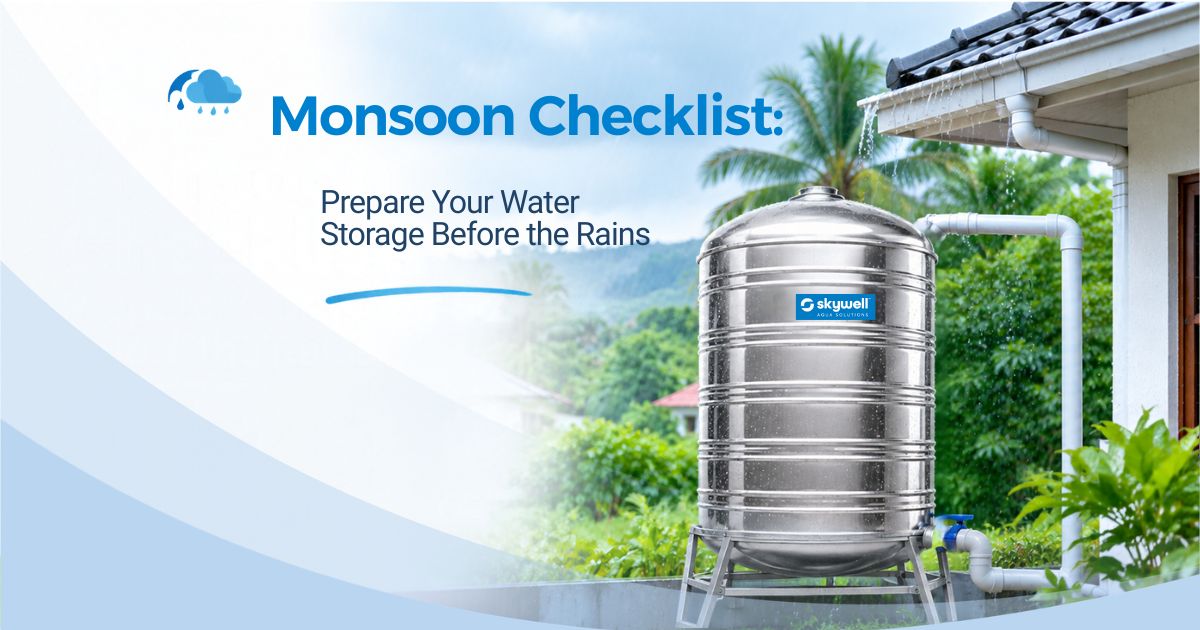
Water tank monsoon preparation Kerala means inspecting the tank, lid, inlet, outlet, overflow, sump, pump and drainage before heavy rain. If you use well water or rainwater harvesting, inspect the source and collection system too. The goal is to identify leaks, blockages, poor drainage and other problems before the monsoon puts the system under greater strain.
Key takeaways
- Inspect the tank, lid, pipes, overflow, sump, pump and drainage before heavy rain.
- Clean the tank when inspection finds sediment, deposits or accumulated dirt.
- Well-water homes need extra attention to drainage and nearby wastewater arrangements.
- A stainless steel tank cannot correct a contaminated source or faulty plumbing.
- Do not enter an overhead tank or confined space without qualified assistance.
If you want to check a tank option before the monsoon, you can browse Skywell’s stainless steel water tanks and then discuss the installation with your plumber.
What does water tank monsoon preparation Kerala actually mean?
Water tank monsoon preparation Kerala is a pre-rain inspection of the complete water-storage system, including the source, pipes, tank, pump and drainage connections. Checking only the tank body can miss problems elsewhere in the system.
The World Health Organization’s 2026 sanitary inspection package for piped distribution storage tanks uses a checklist to identify risk factors and corrective actions. WHO also provides a separate 2026 package for rainwater collection and storage; these are international technical guidance documents, not Kerala-specific regulations. WHO, Sanitary inspection package for piped distribution – storage tank, 2026. WHO, Sanitary inspection package for rainwater collection and storage, 2026.
In a Kerala home, the system may include a well, underground sump, pump, terrace tank and several metres of pipe before water reaches a tap. Monsoon preparation therefore needs to follow the water’s route, not just the container.
The practical sequence is simple: source, sump, pump, pipes, tank, overflow and drainage.
What should you check before the Kerala monsoon?
Before the Kerala monsoon, inspect the tank, lid, inlet, outlet, overflow, sump, pump and surrounding drainage for visible damage, leakage, blockage or poor connections.
Start with the tank itself. Look at the lid, visible exterior, inlet, outlet and overflow connection. Check for cracks, leaks, loose fittings or damage around connection points.
The lid deserves particular attention. A lid that does not sit properly can leave the opening exposed to leaves, dust and other material carried onto the terrace during windy weather.
The overflow also needs a clear discharge path. If it releases water against a wall, close to electrical equipment or onto an area where water can collect, ask your plumber whether the arrangement needs correction.
Use this as a practical inspection checklist:
| Check | What to look for | When to call a professional |
|---|---|---|
| Tank and lid | Cracks, leakage, poor fit or visible damage | Structural damage or persistent leakage |
| Inlet | Blockage, debris or damaged connection | Pipe or fitting repair |
| Outlet | Leakage, loose fitting or poor flow | Plumbing work |
| Overflow | Clear discharge path | Blockage or re-routing |
| Sump | Sediment, access and visible condition | Deep cleaning or repair |
| Pump | Leakage or unusual operation | Pump or electrical issue |
| Roof or gutter | Leaves, silt and debris | Unsafe access or major cleaning |
If you use rainwater harvesting, inspect the collection area and connected storage arrangements as well. WHO’s 2026 rainwater-collection guidance specifically addresses inspection and corrective action for collection and storage systems. WHO, Sanitary inspection package for rainwater collection and storage, 2026.
The useful rule is straightforward: inspect the whole water path, not only the tank.
Do you need to clean your water tank before the rains?
Clean your tank when inspection shows sediment, deposits or accumulated dirt; there is no single cleaning interval that should be treated as a universal Kerala rule for every home.
The right cleaning decision depends on the tank, water source, household use and visible condition. Instead of relying only on a calendar reminder, inspect the inside through the access opening and check what has accumulated.
Do not climb into an overhead tank yourself. Inspecting an accessible opening is different from entering a confined storage space.
If cleaning involves working at height, chemical handling or confined-space entry, arrange qualified assistance. The objective is to clean the storage system without creating a separate safety problem.
For routine maintenance guidance that goes beyond monsoon preparation, see Skywell’s tank maintenance guide for Kerala.
What changes if you use well water?
If your home uses well water, inspect the well surroundings, drainage and nearby wastewater arrangements as part of your monsoon preparation.
Heavy rain can change conditions around a household well, so the tank should not be treated as the only point of inspection. Look for standing water, damaged drainage, nearby wastewater pathways and other visible changes around the source.
A 2018 peer-reviewed study examined 449 households in a 1.05 km² urban area of Thiruvananthapuram. Among the wells assessed in that study area, 73% had coliform contamination, and more than 77% had a septic tank within 7.5 metres. These findings describe that specific study population and should not be presented as statistics for all Kerala wells. Ananth et al., Contamination of Household Open Wells in an Urban Area of Trivandrum, Kerala State, India, 2018.
The study also assessed physical features around wells, including drainage, covers, floors, walls and nearby pollution sources. Those observations reinforce the practical value of inspecting the source area rather than looking at the storage tank alone.
If your well water changes noticeably in appearance, odour or taste after heavy rain, do not diagnose the cause from the tank alone. Arrange appropriate water testing.
Kerala Water Authority states that its laboratories test parameters including total hardness, chloride, iron, total coliforms and E. coli. KWA also reports that samples from about 20,000 locations in various water-supply schemes are analysed each year and that about 40,000 private samples were tested in 2021-22. These are KWA testing figures, not measurements of your household water. Kerala Water Authority, Quality Control.
What if you receive Kerala Water Authority supply?
KWA supply and your home’s storage tank are separate parts of the water system, so public supply does not remove the need to inspect household storage and plumbing.
KWA reports ongoing water-quality monitoring within its supply system. Your own tank, sump, pump, overflow and internal pipes remain part of your household installation.
That distinction is particularly useful before heavy rain. Check the tank. Check the pipes. Check the overflow. Check the sump if you have one.
You do not need to assume there is a problem. You simply need to know the condition of the part of the system you control.
If your home has a separate underground sump or pump arrangement, include those components in the inspection rather than treating the terrace tank as the entire system.
Does coastal Kerala need extra attention?
Coastal homes should pay attention to the installation environment and visible condition of metal components, but corrosion performance cannot be reduced to a simple Kerala district rule.
Stainless steel behaviour depends on the material grade, fabrication, environment and water chemistry. A general statement about coastal exposure is therefore not enough to predict what will happen to a particular tank.
For a stainless steel tank, inspect welds, fittings and exposed connections rather than treating the word “stainless” as a guarantee of zero corrosion.
The same principle applies to any material: installation conditions matter.
Is stainless steel always the right choice?
No. Stainless steel is not automatically the right choice for every Kerala home, particularly when a suitable quality plastic tank already meets the household’s capacity, installation and maintenance requirements.
BIS lists IS 12701:1996 as the Indian Standard for rotational moulded polyethylene water storage tanks. The standard covers technical requirements and tests for areas including deformation, impact, top-load resistance and overall migration. Bureau of Indian Standards, IS 12701:1996.
That means plastic water storage is not simply an unregulated alternative. The specification provides a defined technical framework for the product category.
Material should therefore follow the actual installation. Consider the required capacity, available space, water source, installation conditions, maintenance expectations and household budget before choosing the tank material.
Capacity comes first. Material comes after.
What does a Skywell stainless steel tank provide?
Skywell states that its stainless steel tanks use food-grade AISI 304 stainless steel and are available in 500 L, 1,000 L, 1,500 L, 2,000 L, 3,000 L and 5,000 L capacities, in vertical and horizontal designs. Skywell also states that the tanks carry a 10-year warranty and are manufactured in Kanjikode, Palakkad.
Skywell states that its manufacturing facility is ISO 9001:2015 certified. The product information also recommends professional installation and regular cleaning and inspection. Skywell stainless steel water tanks.
For a homeowner, these are product and manufacturer facts rather than a promise that the tank will solve every water-system problem.
A stainless steel tank cannot correct contaminated source water. It cannot repair a badly routed overflow pipe. It cannot compensate for a leaking pump connection.
Those jobs belong to the complete water system.
Want to check whether stainless steel fits your home?
If you already know your required capacity but are unsure about material or installation, message Skywell on WhatsApp with your requirement and ask the question first. You can confirm the available option before deciding whether to buy.
Who should not buy a stainless steel tank?
A homeowner should not choose stainless steel simply because the material sounds more suitable if a suitable quality plastic tank already meets the home’s capacity, installation and maintenance requirements.
It is also the wrong purchase if the immediate problem is elsewhere. A dirty well, blocked pipe, faulty pump or badly designed overflow will not be fixed merely by replacing the storage tank.
If the terrace cannot safely accommodate the required tank and installation arrangement, resolve the structural and placement issue first.
This is why material should be treated as one part of the decision, not the entire decision.
The right tank is the one that fits the actual system.
What should you do before the monsoon?
Do the inspection before the first major downpour rather than waiting until rain exposes a weakness in the system.
Kerala’s monsoon onset can vary from year to year. The India Meteorological Department recorded the southwest monsoon setting in over Kerala on 24 May 2025, eight days ahead of the normal 1 June date. IMD’s 2025 monsoon report describes 24 May as the earliest onset since 2009. These dates describe the 2025 season and are not a fixed annual arrival date. India Meteorological Department, Press Release, 24 May 2025.
You do not need to predict the weather yourself. The practical response is to inspect the system before heavy rain makes access, cleaning or repairs more difficult.
Four questions to take to your plumber
- Is the tank, lid and supporting installation in suitable condition for the required capacity?
- Is the inlet, outlet and overflow routed correctly, with no visible leakage or blockage?
- Does the sump, pump and surrounding drainage need cleaning, repair or re-routing?
- If the home uses well water or rainwater harvesting, does the source and collection system need inspection or testing?
A short conversation with your plumber can identify issues that are difficult to judge from the tank exterior alone.
A simple monsoon inspection order
Follow the water from its source to the point of use.
- Check the well, municipal connection or rainwater collection point.
- Inspect the sump and pump.
- Check visible pipes, joints and valves.
- Inspect the tank, lid, inlet, outlet and overflow.
- Check where overflow and other discharged water are going.
- Arrange cleaning, repairs or water testing where inspection shows a need.
The order matters because a clean tank cannot compensate for a problem upstream.
Skywell Aqua Solutions makes food-grade stainless steel and plastic water tanks in Palakkad, Kerala.
Not sure which tank suits your home? Message us on WhatsApp for free, honest advice.
Still have a question?
Tell us your tank capacity, water source and installation situation, and we can help you identify what to check before the monsoon.
Message Skywell on WhatsApp.
Cite as: skywell.in/water-tank-monsoon-preparation-kerala/
Frequently asked questions
How do I prepare my water tank for the monsoon in Kerala?
For water tank monsoon preparation Kerala homes should inspect the tank, lid, inlet, outlet and overflow, then check the sump, pump and surrounding drainage. Homes using wells or rainwater harvesting should inspect those source and collection arrangements too. The inspection is intended to identify visible problems before heavy rain makes access and repairs more difficult.
Should I clean my overhead water tank before the Kerala monsoon?
Clean an overhead tank when inspection shows sediment, deposits or accumulated dirt. There is no single cleaning interval that should be treated as a universal Kerala rule because tank condition, water source and household use differ. Avoid entering the tank yourself, and use qualified help when cleaning involves height, chemicals or confined-space entry.
Is well water safe during the Kerala monsoon?
Well-water quality varies by location and source conditions, so it should not be labelled universally safe or unsafe. A 2018 study of 449 households in an urban area of Thiruvananthapuram found coliform contamination in 73% of assessed wells. The result applies to that specific study area and cannot be treated as a statistic for all Kerala wells.
Do I need to inspect my water tank if I receive Kerala Water Authority water?
Yes. Kerala Water Authority monitors water quality within its supply system, but your household tank, sump, pump, overflow and internal plumbing remain separate parts of the installation. KWA reports analysing samples from about 20,000 locations in various supply schemes each year. Household storage still needs physical inspection and maintenance.
Can a stainless steel water tank prevent water-quality problems?
No. A stainless steel tank is a storage component, not a water-treatment system. It cannot correct problems with a well, pump, inlet, plumbing or source water. Skywell states that its stainless steel tanks use food-grade AISI 304 stainless steel and are available in capacities from 500 L to 5,000 L.
Is stainless steel always necessary for a Kerala home?
No. Stainless steel is not necessary when a suitable quality plastic tank already meets the home’s capacity, installation and maintenance requirements. BIS lists IS 12701:1996 for rotational moulded polyethylene water storage tanks. Material selection should consider capacity, available space, water source, installation conditions, maintenance and household budget.
Who should consider a Skywell stainless steel water tank?
A Skywell stainless steel tank may suit a homeowner specifically looking for food-grade AISI 304 stainless steel storage and a locally manufactured product. Skywell states that its tanks range from 500 L to 5,000 L, carry a 10-year warranty and are manufactured in Kanjikode, Palakkad, Kerala.
What should I ask my plumber before the monsoon?
Ask whether the tank and supporting installation suit the required capacity, whether the inlet, outlet and overflow are properly routed, and whether the sump, pump and drainage need attention. If you use well water or rainwater harvesting, also ask whether the source and collection system should be inspected or the water tested.