In this guide
- What is the difference between a vertical and horizontal water tank?
- How do you know which water tank orientation fits your home?
- When does a vertical water tank make sense?
- When does a horizontal water tank make sense?
- Does tank orientation affect water pressure?
- What changes for a Kerala home?
- What should you check before putting a tank on your terrace?
- What if your plumber recommends a different orientation?
- Who should not buy a stainless steel water tank?
- What is the simplest way to choose?
- Action checklist: what should you ask your plumber or supplier?
- Still have a question?
- Frequently asked questions
Short answer:
A vertical vs horizontal water tank decision depends mainly on your available height, floor footprint, support, plumbing, access route and maintenance space. Vertical tanks generally suit sites with limited floor area and sufficient height, while horizontal tanks can suit lower-clearance locations with more floor space. The actual tank dimensions must be checked before ordering.
Key takeaways:
- Vertical tanks generally need less floor footprint but more clear height.
- Horizontal tanks can suit sites where overhead clearance is limited.
- Tank orientation alone does not determine household water pressure.
- Terrace support, plumbing and delivery access matter as much as tank shape.
- Neither orientation is automatically right for every Kerala home.
If you have the site measurements but are unsure which configuration fits, you can message Skywell on WhatsApp for a configuration check before ordering:
What is the difference between a vertical and horizontal water tank?
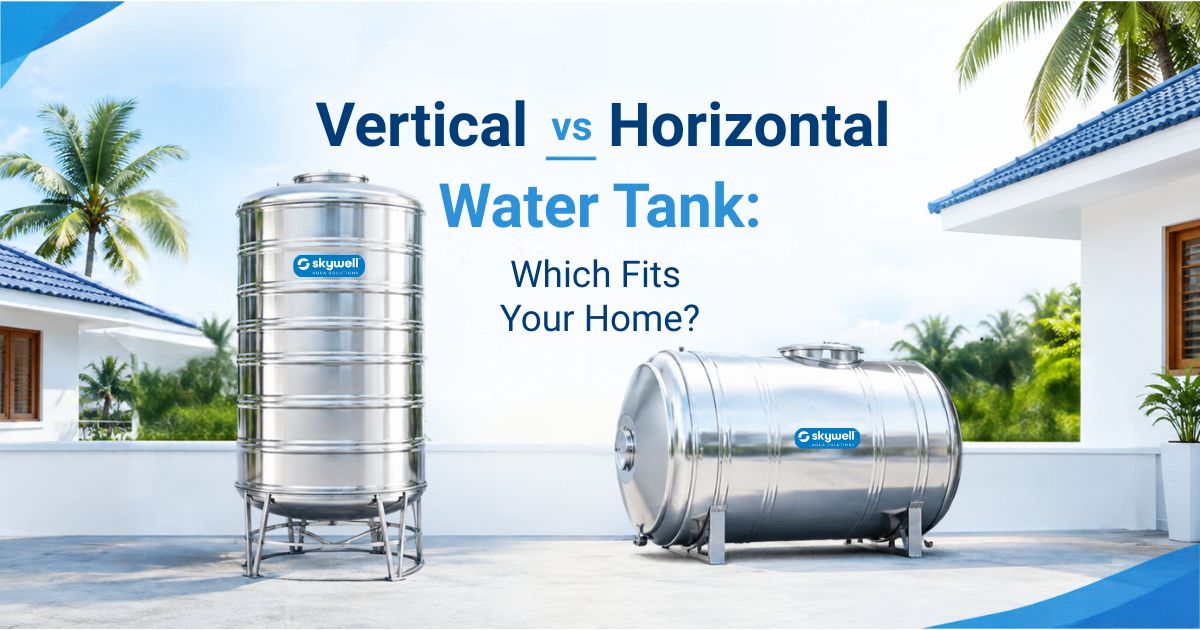
A vertical water tank uses a taller form to store water while keeping its floor footprint relatively compact. A horizontal tank uses a lower, wider form and therefore generally needs more floor area but less clear height.
That sounds simple until you reach the terrace with a measuring tape.
A tank can match your required capacity and still be the wrong shape for the space available. The staircase may be narrow, the roof may have limited clear height, or an existing outlet pipe may interfere with the proposed tank position.
For a Kerala home, the practical comparison looks like this:
| Factor | Vertical tank | Horizontal tank |
|---|---|---|
| General form | Taller | Lower and wider |
| Floor footprint | Generally smaller | Generally larger |
| Clear-height requirement | Generally higher | Generally lower |
| Useful where | Floor space is restricted | Height is restricted |
| Main site check | Height and footprint | Footprint and height |
| Other checks | Base, access and plumbing | Base, access and plumbing |
The exact dimensions vary by manufacturer, capacity and model. Orientation should therefore be chosen from the actual product dimensions, not from the shape shown in a photograph.
How do you know which water tank orientation fits your home?
Start with five measurements: available length, available width, clear height, access route and space around the proposed installation point.
Do not measure only the empty terrace. Measure the route from the delivery point to the final position, including stairs, doors, turns and narrow passages.
Then check the plumbing. Where is the inlet? Where does the outlet pipe run? Where will overflow water discharge? Can the tank still be inspected and cleaned after installation?
BIS guidance on water storage tanks explains the importance of suitable support and discusses hydrostatic pressure in relation to the height of the water column. Bureau of Indian Standards, Water Storage Tank, IS 12701, 2023.
A separate BIS building-standard publication states that storage tanks should be accessible for inspection and cleaning and that overhead tanks should have suitable access arrangements. Bureau of Indian Standards, SP 73:2023, Chapter 6, General Building Requirements.
That makes the tank part of a larger installation decision. Shape is only one part of it.
For a broader comparison of tank materials and configurations, see our stainless steel vs plastic water tank guide.
When does a vertical water tank make sense?
A vertical tank can make practical sense when your installation area has limited floor space but enough clear height.
Imagine a compact terrace corner. There is enough room for the tank’s required footprint, but spreading the storage area farther across the roof would interfere with access or other equipment.
A vertical configuration can use available height while keeping the occupied floor area relatively compact. That can be useful during new construction, where the tank position can be considered while planning the terrace and plumbing.
Skywell’s published stainless steel range lists capacities from 500 L to 5,000 L and includes vertical and horizontal configurations. Skywell Aqua Solutions, current product information.
| Skywell stainless steel range | Published information |
|---|---|
| Material | Food-grade AISI 304 stainless steel |
| Capacities | 500 L, 1,000 L, 1,500 L, 2,000 L, 3,000 L, 5,000 L |
| Configurations | Vertical and horizontal |
| Manufacturing location | Kanjikode, Palakkad, Kerala |
| Warranty | 10 years |
The capacity may fit your household requirement, but the specific model dimensions still need to fit your site.
Capacity comes first. Orientation comes after the site measurements.
When does a horizontal water tank make sense?
A horizontal tank can make practical sense when height is the main restriction and enough floor length and width are available.
This can apply to a low-clearance service area, a restricted utility space or some renovation projects where changing the surrounding structure is difficult.
The same principle applies here: do not choose the shape first and try to make the building accommodate it later.
Check the actual length, width, height and support requirements of the proposed model. Then check whether the tank can reach the site through the available delivery route.
A lower tank can solve a height problem, but it may create a footprint problem. That trade-off needs to be measured rather than assumed.
If you want to compare available stainless steel models, see our stainless steel water tank range.
Does tank orientation affect water pressure?
Tank orientation alone does not determine household water pressure.
BIS explains hydrostatic pressure using the relationship between water density, gravity and the height of the water column. Bureau of Indian Standards, Water Storage Tank, IS 12701, 2023.
The practical question is where the tank is positioned relative to the points where water is used, together with the pipe arrangement and outlet elevation.
That is why statements such as “vertical always gives more pressure” are too broad. The plumbing system has several variables beyond the tank’s orientation.
If pressure is your concern, ask your plumber to assess the tank elevation, pipe route, outlet position and any pump arrangement together.
Do not choose vertical or horizontal orientation based on pressure claims alone.
What changes for a Kerala home?
Kerala homes need the same basic site checks as homes elsewhere, but local rainfall, water sources and installation conditions can affect how the storage system is planned.
Kerala’s Ground Water Department notes that groundwater availability varies according to climatic, geomorphological and hydrogeological conditions. Government of Kerala Ground Water Department, Groundwater Resources.
If your home depends on a well or borewell, consider how the source is used and how the tank will be refilled. If you depend on piped water, consider supply timing and how your existing storage arrangement operates.
Rainfall also varies substantially across Kerala. The Kerala State Disaster Management Authority publishes monsoon preparedness guidance through its annual Orange Book, including the 2025 edition. Kerala State Disaster Management Authority, Orange Book of Disaster Management 2025.
For a tank installation, the practical takeaway is straightforward: overflow should have a suitable discharge route, and water should not be allowed to repeatedly collect around the tank base.
Coastal and humid locations also deserve careful consideration of material, fabrication and installation conditions. Do not treat SS-304 as an absolute guarantee against every form of corrosion in every environment.
The installation environment matters.
If you are comparing storage options more broadly, see the different water tank types explained by Skywell.
What should you check before putting a tank on your terrace?
The tank base and structural support deserve attention before the tank is ordered.
A full tank places a much greater load on its support than an empty tank. Whether an existing terrace can safely accommodate a proposed installation cannot be determined from litre capacity alone.
BIS building guidance states that overhead storage tanks need appropriate access and positioning for inspection and cleaning. Bureau of Indian Standards, SP 73:2023, Chapter 6.
For an existing house, especially during renovation, ask the appropriate professional to assess the proposed support arrangement if there is any uncertainty about the structure.
Then check maintenance access.
A tank squeezed tightly against a parapet may technically fit but become difficult to inspect later. The installation should leave practical access consistent with the manufacturer’s requirements.
Your final site check should cover:
| Check | What to confirm |
|---|---|
| Base | Suitable, level and properly supported |
| Height | Enough clear height for the selected model |
| Footprint | Enough length and width around the tank |
| Plumbing | Inlet, outlet and overflow positions |
| Access | Delivery route and future inspection access |
A tank that fits on paper is not necessarily a tank that fits the building.
What if your plumber recommends a different orientation?
Listen to the plumber, but ask why the proposed orientation suits your particular site.
A plumber familiar with your existing pipework can identify practical problems that a product catalogue cannot. The manufacturer can confirm the tank’s actual dimensions and configuration.
Ask these questions before ordering:
- Where will the inlet, outlet and overflow connect?
- Is the base suitable and level?
- Can the tank reach the installation point?
- Is there enough room for inspection and maintenance?
Your plumber understands the pipe route. The manufacturer understands the tank dimensions and installation requirements.
You need both pieces of information before ordering.
If you want help checking the configuration, message Skywell on WhatsApp with your location, required capacity and available measurements.
Who should not buy a stainless steel water tank?
Stainless steel should not be treated as the automatic answer for every household.
If your main requirement is straightforward water storage and another suitable material already meets your site’s requirements, budget and intended use, there is no reason to choose stainless steel simply because it sounds more premium.
Stainless steel may be worth considering when you specifically want food-grade AISI 304 construction and the characteristics of Skywell’s stainless steel product line. Skywell’s current product information lists food-grade AISI 304 stainless steel and a 10-year warranty for its water tank products.
Skywell states that its manufacturing facility is in Kanjikode, Palakkad, Kerala, and that it operates an ISO 9001:2015-certified facility.
But stainless steel cannot correct an unsuitable structural base, badly routed plumbing, poor overflow arrangement or an inaccessible installation location.
The orientation cannot fix those problems either.
For households considering plastic instead, Skywell’s plastic water tank range includes food-grade polyethylene options and different tank configurations.
What is the simplest way to choose?
Before ordering, write down the actual site information rather than choosing from appearance alone.
| Step | Information to record |
|---|---|
| 1 | Required capacity and available length, width and clear height |
| 2 | Base condition and proposed support arrangement |
| 3 | Delivery route from the access point to the installation site |
| 4 | Inlet, outlet and overflow pipe positions |
| 5 | Water source and future inspection or cleaning access |
Then compare the actual dimensions of the vertical and horizontal models that meet your capacity requirement.
The decision I would make on a Kerala building site is simple: measure first, choose the orientation second, then select the material and model after the installation conditions are clear.
Skywell’s stainless steel range currently lists 500 L to 5,000 L capacities in vertical and horizontal configurations.
If you already have the measurements but are unsure which configuration fits, send them to Skywell on WhatsApp. There is no need to guess from a product photograph.
Action checklist: what should you ask your plumber or supplier?
Take these questions to the plumber, engineer or tank supplier before you place the order:
- What tank capacity is appropriate for my household and water-supply pattern?
- Does the proposed vertical or horizontal model fit the available length, width and clear height?
- Is the proposed base and support arrangement suitable for the full tank load?
- Can the inlet, outlet and overflow connect without awkward pipe routing?
- Will there still be enough access for inspection and cleaning?
The material should suit your use case. The capacity should suit your water requirement. The orientation should suit the building.
Skywell Aqua Solutions makes food-grade stainless steel and plastic water tanks in Palakkad, Kerala.
Not sure which tank suits your home? Message us on WhatsApp for free, honest advice.
Still have a question?
Send your capacity, available site measurements and installation location to Skywell on WhatsApp, and ask which configuration fits your site: WhatsApp Skywell.
Cite as: skywell.in/vertical-vs-horizontal-water-tank/
Frequently asked questions
Is a vertical or horizontal water tank better for a Kerala home?
Neither orientation is universally better for every Kerala home. A vertical water tank can suit a site with limited floor footprint and adequate height, while a horizontal tank can suit a site with restricted height and more available floor space. The final choice should also account for the base, plumbing, access route and maintenance space.
Does a vertical water tank save space?
A vertical water tank generally uses less floor footprint for a comparable storage arrangement because more of its form extends upward. Whether that actually saves useful space depends on your available height. Measure both floor dimensions and clear height before choosing a vertical configuration for your home.
When should I choose a horizontal water tank?
A horizontal water tank can be suitable when available height is limited but sufficient floor length and width exist. This can apply to low-clearance service areas, certain utility spaces and some renovation projects. The tank’s exact dimensions, support requirements, plumbing connections and delivery route should be checked before ordering.
Does tank orientation affect household water pressure?
Tank orientation by itself does not determine household water pressure. BIS explains hydrostatic pressure in relation to the height of the water column, while actual household pressure also depends on plumbing arrangement and outlet elevation. A vertical tank should therefore not be described as automatically providing stronger pressure than a horizontal tank.
Can I install a water tank on my existing Kerala terrace?
An existing Kerala terrace should be assessed for the proposed tank installation rather than assumed suitable from its appearance or empty floor area. A full tank creates a significant structural load, and the base, support arrangement, tank dimensions and location all matter. Structural verification is appropriate where the existing construction or proposed load is uncertain.
Is SS-304 suitable for a coastal Kerala home?
Food-grade AISI SS-304 can be considered for coastal Kerala homes, but stainless steel should not be described as completely immune to corrosion in every environment. Coastal exposure, fabrication quality, material condition and installation circumstances can affect performance. The appropriate material and configuration should therefore be considered for the actual site.
What should I measure before ordering a vertical or horizontal tank?
Measure the available length, width and clear height at the installation point, then check the route from the delivery point to that location. Also record the base arrangement, inlet and outlet positions, overflow route and available maintenance access. These measurements allow the manufacturer or installer to check whether the selected tank configuration suits your site.
How do I choose between a vertical and horizontal stainless steel tank?
Choose between a vertical and horizontal stainless steel tank after confirming the required capacity and the physical restrictions of your installation site. Vertical models generally favour limited floor footprint with adequate height, while horizontal models can suit lower-clearance locations with more floor area. Always verify the specific model dimensions before ordering.