Short answer:
In this guide
- What does ISO 9001 certification mean for a water tank manufacturer?
- Does ISO certification mean the water tank itself is certified?
- How can you verify an ISO certificate before buying?
- What other quality checks matter when choosing a water tank?
- What should Kerala homeowners consider before selecting a manufacturer?
- What does Skywell’s ISO 9001:2015 certification mean for buyers?
- Who should not choose a tank based on ISO certification alone?
- What should you ask before purchasing a water tank?
- A practical way to judge an ISO certified water tank manufacturer
- Still have a question?
- Frequently asked questions
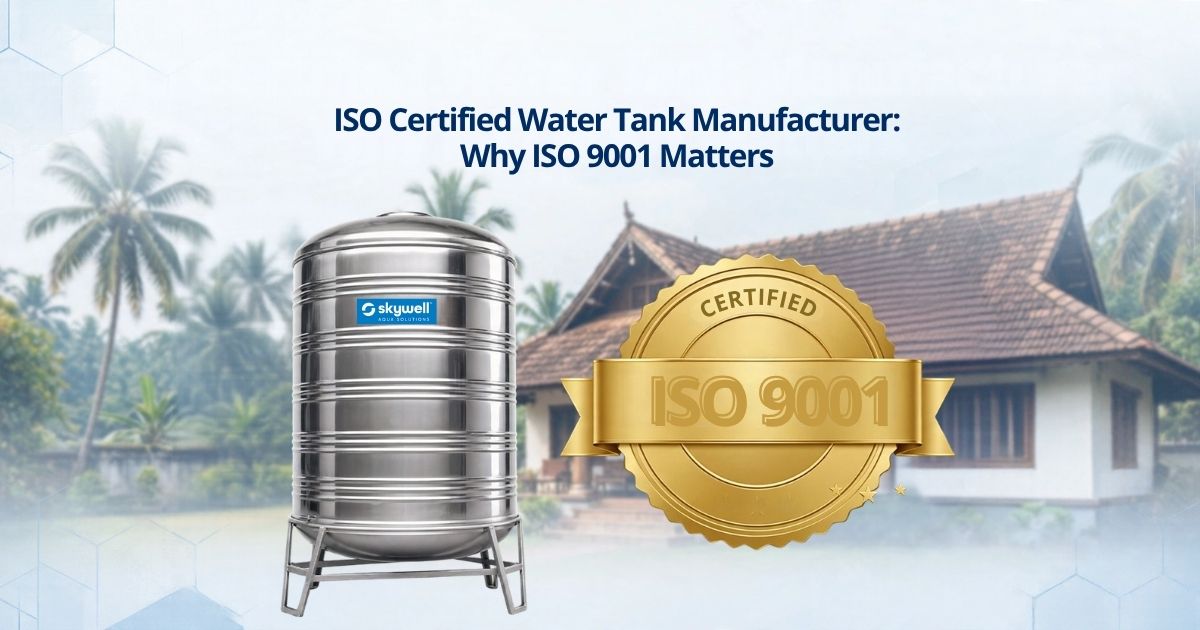
An ISO certified water tank manufacturer has had its quality management system assessed against ISO 9001 requirements by an independent certification body. This can provide useful evidence of organised quality management, but it does not automatically certify every tank. Before buying, check the certificate, its scope, the tank’s material and specifications, warranty terms, and installation support.
Key takeaways
- ISO 9001 evaluates an organisation’s quality management system, not automatically each water tank.
- Verify the certificate, certification body, manufacturing site, scope and validity.
- Check material specifications, capacity, applicable product standards and warranty separately.
- Compare installation support and after-sales service alongside manufacturing credentials.
- Certification alone cannot guarantee correct installation, suitability or trouble-free performance.
Want to compare your options? Message Skywell Aqua Solutions on WhatsApp for guidance on choosing a suitable tank for your home.
What does ISO 9001 certification mean for a water tank manufacturer?
ISO 9001 specifies requirements for an organisation’s quality management system. It provides a framework for managing processes, meeting requirements, addressing problems and pursuing continual improvement.
For a homeowner, the important question is how the manufacturer applies that framework to its work. A certificate is useful evidence, but it is not a substitute for checking the actual product.
The standard is used across different industries. It does not prescribe one particular water tank material, capacity or design.
According to the International Organization for Standardization (ISO), ISO 9001:2026 was published on 16 September 2026. Organisations holding ISO 9001:2015 certification will need to follow the applicable transition arrangements, with the published transition period extending to 30 September 2029.
When evaluating a manufacturer, check which edition its certificate references and whether the certification remains valid. Do not assume that a certificate is invalid simply because a newer edition has been published.
Does ISO certification mean the water tank itself is certified?
No. ISO 9001 certification applies to an organisation’s quality management system, not automatically to an individual water tank.
This distinction matters when you compare manufacturers in Kerala. A company may hold a quality management certificate, but you still need to establish what material, design and product requirements apply to the tank you intend to buy.
ISO also does not itself certify companies. Independent certification bodies carry out certification activities.
For polyethylene water storage tanks, the Bureau of Indian Standards provides product-specific information under IS 12701. Its product manual for rotationally moulded polyethylene water storage tanks describes product certification, inspection and testing considerations.
ISO 9001 and product-specific requirements therefore answer different questions. One concerns the management system; the other concerns requirements applicable to the product.
| What you check | What it helps establish |
|---|---|
| ISO 9001 certificate | The stated certification of the manufacturer’s quality management system |
| Certificate scope | The activities and locations covered by the certificate |
| Product specification | The tank’s stated material, construction and intended application |
| Applicable product standard | The requirements relevant to the particular product |
| Warranty document | The manufacturer’s stated coverage and conditions |
| Installation arrangements | Who is responsible for delivery, placement and connections |
A certificate is one part of the evidence. The product specification tells you what you are actually buying.
How can you verify an ISO certificate before buying?
Ask the manufacturer or authorised dealer for a copy of the certificate. Check the details instead of relying only on an ISO logo in an advertisement.
Your verification should cover the organisation’s name, the applicable ISO 9001 edition, the certification body’s name, the scope, the relevant manufacturing location and the certificate’s validity information.
Where possible, check the certificate with the issuing certification body. Accreditation can provide additional confidence in the certification body’s competence, but you should still verify the specific certificate and its scope.
The ISO guidance on the publication of ISO 9001:2026 and transition arrangements is useful when checking certificates that reference the 2015 edition.
Be particularly careful if the certificate covers an office or business activity that does not clearly relate to the manufacturing operation you are evaluating. Ask the manufacturer to explain any uncertainty before you make a decision.
A genuine certificate is worth checking. A certificate with an unclear scope deserves further questions.
What other quality checks matter when choosing a water tank?
A water tank should match your water-storage needs, installation conditions and budget. Certification does not remove the need to assess those practical requirements.
Start with the material. Skywell Aqua Solutions offers stainless steel water tanks made using food-grade AISI 304 (SS-304), while its product information also references a premium SS-316 line. Its plastic tanks use a food-grade 100% virgin polyethylene inner layer and three-layer, UV-stabilised construction.
These are different product specifications, not interchangeable quality claims. Ask which material and construction apply to the exact model being quoted.
Next, confirm the capacity and configuration. A tank intended for an overhead terrace may need a different arrangement from one intended for a loft. Check available space, access for installation, pipe connections and the support surface before ordering.
The warranty deserves the same attention. Skywell states a 10-year warranty on its stainless steel and plastic tank ranges. Ask for the applicable warranty terms for your selected model rather than assuming every type of damage or installation issue is covered.
Finally, check the support available after purchase. A manufacturer or dealer who can explain the specifications, coordinate installation and clarify warranty procedures can make the buying process easier to manage.
You can compare Skywell’s stainless steel water tank range and plastic water tank range before deciding which material suits your home.
What should Kerala homeowners consider before selecting a manufacturer?
Your water source and installation location should influence your choice. A home using a public water supply may have different storage arrangements from one relying on a private well or borewell.
The Kerala Water Authority’s quality-control information explains that its laboratories monitor water supplied through its schemes and also test samples from rivers, wells and private sources.
This is relevant because a manufacturer’s ISO certificate does not establish the quality of the water entering your tank. Water quality and tank selection are separate considerations.
Your installation environment matters too. An exposed terrace, a compact loft and a coastal property can present different practical requirements.
For homes in coastal areas, discuss the suitability of the proposed material and installation arrangement with the supplier. Do not assume that a particular material grade is appropriate for every location without considering the actual conditions.
Capacity should also be decided before material. Estimate your household’s storage needs, consider the reliability of your supply and check the available installation space. Then compare suitable tank materials and configurations.
Skywell Aqua Solutions operates its manufacturing facility in Kanjikode, Palakkad, Kerala, and has a dealer network across the state according to its business information.
For more help with capacity, read our guide to choosing the right water tank size for a Kerala home.
What does Skywell’s ISO 9001:2015 certification mean for buyers?
Skywell Aqua Solutions identifies its manufacturing operation at Kanjikode, Palakkad, Kerala, with ISO 9001:2015 certification according to its current business information.
For a buyer, this certification is one consideration in evaluating the manufacturer’s quality management system. It should be assessed alongside the actual tank specification, warranty and available support.
Skywell’s stainless steel product information specifies food-grade AISI 304 (SS-304), and the company states that its stainless steel and plastic tank ranges carry a 10-year warranty. These product and warranty claims are separate from the ISO certification.
The company also describes quality checks during manufacturing and an in-house laboratory for its stainless steel tank operations. Ask the manufacturer for the relevant details if you want to understand which checks apply to the particular model you are considering.
No certificate alone can establish that a tank is suitable for every property. The right choice still depends on your storage requirements, installation conditions and budget.
If you know your approximate capacity requirement and installation location, you can message Skywell on WhatsApp to ask about suitable models and current quotations.
Who should not choose a tank based on ISO certification alone?
Homeowners who are comparing products on price, capacity or a particular installation requirement should not treat ISO certification as the deciding factor. A certificate cannot tell you whether a specific tank is the right fit for your property.
If your budget is limited and a suitable quality plastic tank meets your capacity, installation and service requirements, a more expensive stainless steel tank may not be necessary for your situation.
Likewise, stainless steel should not be selected simply because you believe ISO certification guarantees that the tank will never develop a problem. It does not.
Incorrect sizing, unsuitable support, poor plumbing work and conditions outside the manufacturer’s specified use can affect the performance of a tank, regardless of the manufacturer’s certification.
There is also a limit to what can be concluded from a certificate alone. Without checking its scope, validity and the specific product documentation, you cannot establish every detail of the manufacturing or testing process.
The sensible approach is to compare the evidence available for each option. Material, capacity, applicable product requirements, warranty and installation support should all fit your needs.
What should you ask before purchasing a water tank?
Use this checklist when speaking with your plumber, dealer or manufacturer.
- Can you provide the ISO certificate and explain its scope, issuing body and validity?
- What material, capacity, configuration and applicable product specifications apply to the tank I am buying?
- What does the written warranty cover, and what conditions or exclusions apply?
- Who will coordinate installation and answer questions if an issue arises after purchase?
Keep the answers with your quotation and warranty documents. If any claim is unclear, ask for written clarification before paying.
You can also review the manufacturer’s product range to compare the available tank options.
A practical way to judge an ISO certified water tank manufacturer
An ISO certified water tank manufacturer should be evaluated using more than a logo or certificate. Verify the management-system certification, understand the tank specification and check the support offered after purchase.
For a Kerala home, those checks help you compare options based on evidence rather than advertising claims. The certificate starts the conversation; it should not end it.
Skywell Aqua Solutions makes food-grade stainless steel and plastic water tanks in Palakkad, Kerala.
Not sure which tank suits your home? Message us on WhatsApp for free, honest advice.
Still have a question?
If you are unsure about the certificate, material, capacity or warranty, ask the manufacturer to clarify the details for your selected model.
Message Skywell Aqua Solutions on WhatsApp for information about available tanks and a current quotation.
Cite as: skywell.in/iso-certified-water-tank-manufacturer/
Frequently asked questions
What does an ISO certified water tank manufacturer mean?
An ISO certified water tank manufacturer is a manufacturer whose quality management system has been assessed against ISO 9001 requirements by an independent certification body. The certification relates to the organisation’s management system, not automatically to each tank it produces. Buyers should also check the certificate’s scope, the tank’s material specifications and the applicable product requirements.
Does ISO 9001 certify the water tank itself?
No. ISO 9001 certification applies to an organisation’s quality management system rather than automatically certifying an individual water tank. Product-specific certification and standards are separate considerations. Before buying, check the tank’s material, capacity, construction, applicable product requirements, warranty and installation arrangements.
How do I verify an ISO certificate from a water tank manufacturer?
Ask for a copy of the certificate and check the organisation name, ISO 9001 edition, certification body, scope, manufacturing location and validity information. Where possible, verify the certificate with the issuing body and check its accreditation status. These checks help you understand what the certification covers rather than relying solely on a manufacturer’s advertising claim.
Is ISO certification enough when buying a water tank?
No. ISO certification is one part of a purchasing decision because it concerns the manufacturer’s quality management system. It does not automatically establish the suitability or performance of a particular tank. You should also check material specifications, capacity, applicable product requirements, written warranty terms and installation support before choosing a tank for your home.
Why does the manufacturing location matter for a Kerala homeowner?
A manufacturing location in Kerala may make it easier to discuss product information, dealer availability, delivery and after-sales support within the state. However, location alone does not prove product quality or guarantee service in every area. Confirm the delivery arrangements, installation responsibilities and warranty contact for your particular property before placing an order.
Should everyone choose a stainless steel water tank?
No. The appropriate material depends on your home’s storage needs, installation conditions, product requirements and budget. A suitable quality plastic tank may be a sensible option when it meets the project’s requirements. Stainless steel may suit other applications, but the choice should be based on the intended use and verified specifications, not simply on ISO certification.
What is the difference between ISO 9001 and BIS product certification?
ISO 9001 concerns an organisation’s quality management system. BIS product certification relates to a product’s conformity with the relevant Indian Standard and applicable certification requirements. For example, BIS provides product-specific documentation for rotationally moulded polyethylene water storage tanks under IS 12701. Check which requirements apply to the exact product you intend to purchase.
Does ISO 9001:2015 certification remain relevant after ISO 9001:2026 was published?
Yes. ISO 9001:2026 was published on 16 September 2026, and the published transition arrangements allow organisations holding ISO 9001:2015 certification until 30 September 2029 to complete the transition. Buyers should check the certificate’s current validity and confirm the transition requirements with the relevant certification body rather than assuming that every 2015 certificate is immediately invalid.