Short answer:
In this guide
- What happens before a stainless steel sheet becomes a water tank?
- How is the stainless steel cut and formed?
- How are stainless steel tank sections welded?
- What happens to the welded surface?
- How is a stainless steel water tank inspected and tested?
- Does stainless steel suit every water-storage situation?
- What does Skywell’s Palakkad manufacturing location mean for you?
- Who should not buy a stainless steel water tank?
- What should you check before your tank is ordered?
- Still have a question?
- Frequently asked questions
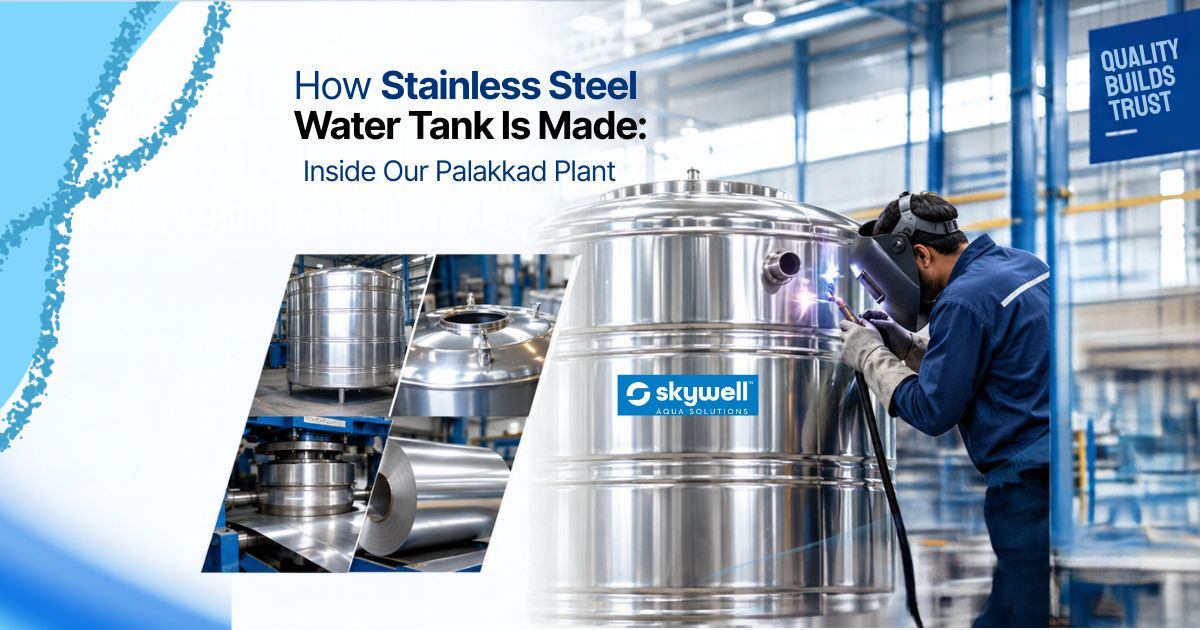
A stainless steel water tank is made by specifying the steel grade, cutting and forming sheets, welding the sections and fittings, finishing fabricated surfaces, inspecting the workmanship and carrying out appropriate testing before installation. At Skywell, stainless steel tanks are manufactured at the Kanjikode, Palakkad plant using food-grade AISI SS-304.
Key takeaways
- A stainless steel water tank starts with a specified material grade, not appearance alone.
- Skywell specifies food-grade AISI SS-304 for its stainless steel tanks.
- Welding and post-weld surface condition are important to stainless steel performance.
- Skywell lists capacities from 500 L to 5,000 L in vertical and horizontal configurations.
- SS-304 is not automatically suitable for every water chemistry or coastal environment.
If you are standing on a Kerala terrace looking at a finished tank, most of the manufacturing work is already hidden from view. The details that matter are underneath the shine: material specification, dimensions, forming, weld quality, surface condition, inspection and testing.
For Skywell Aqua Solutions, that manufacturing work takes place in Kanjikode, Palakkad, Kerala. Skywell identifies its facility as an ISO 9001:2015-certified manufacturing facility and lists stainless steel water tanks among its products.
Message Skywell on WhatsApp if you want the current specification or quotation for a particular tank capacity. The useful starting point is your required capacity and installation space, not simply the material name.
What happens before a stainless steel sheet becomes a water tank?
A stainless steel water tank begins with a defined material specification and a tank design suited to the required capacity and configuration. Skywell specifies food-grade AISI SS-304 and lists 500 L, 1,000 L, 1,500 L, 2,000 L, 3,000 L and 5,000 L capacities in vertical and horizontal options.
The current Skywell product specification lists sheet thicknesses from 0.6 mm to 0.8 mm, with the applicable thickness depending on capacity. It also lists dimensions according to the selected capacity. These are product specifications, so the exact model should be confirmed before ordering.
| Skywell stainless steel tank specification | Current listed range |
|---|---|
| Material | Food-grade AISI SS-304 |
| Capacity | 500 L to 5,000 L |
| Configuration | Vertical and horizontal |
| Sheet thickness | 0.6 mm to 0.8 mm, according to capacity |
| Warranty | 10 years |
The table above summarises Skywell’s current published product information. It should be treated as a manufacturer specification rather than a general specification for every stainless steel tank.
That distinction matters when you compare products. Asking whether a tank is “stainless steel” is only the first question. You also need to know the specified grade, capacity, dimensions, fabrication details and quality checks.
How is the stainless steel cut and formed?
The stainless steel material is prepared and cut according to the dimensions required for the selected tank design. The components are then formed into the sections needed to create the tank body and connection areas.
A 500 L tank and a 5,000 L tank do not simply use the same components at different scales. Capacity changes the dimensions and component requirements, which is why the fabrication process has to follow the selected tank specification.
The finished tank also has to work in the real installation location. On a Kerala terrace, available platform space, access through the building, tank orientation and plumbing connections can all affect installation planning.
Capacity comes first. Material comes after.
If you are comparing options, Skywell’s stainless steel water tank range provides the published capacities and configurations to check against your requirement.
How are stainless steel tank sections welded?
Welding joins the formed stainless steel sections into the tank structure, making weld quality an important part of fabrication rather than a cosmetic detail.
Stainless steel relies on a thin passive surface film for corrosion resistance. The Australian Stainless Steel Development Association explains that welding can produce heat tint and a chromium-depleted layer around the weld, which can reduce corrosion resistance if it is not appropriately addressed.
That is why “the tank is welded” does not tell you enough about the fabrication.
The relevant questions are how the welding is controlled, how the weld area is finished, how contamination is avoided and what inspection takes place afterward. ASSDA guidance also highlights the importance of controlling heat input and interpass temperature during stainless steel welding.
For a homeowner, you do not need to become a welding specialist. You need to know that the manufacturer treats welding as a quality-critical stage.
What happens to the welded surface?
Welded stainless steel surfaces may require cleaning or other post-weld treatment because welding changes the surface condition around the heated area.
ASSDA explains that mechanical treatments such as brushing or polishing can be used in stainless steel fabrication, while pickling and passivation are established treatments for addressing heat tint, contamination and restoration of the passive surface. The appropriate treatment depends on the fabrication and application.
That does not mean every stainless steel water tank receives the same treatment.
Skywell’s public product information does not establish a particular pickling or passivation procedure for every tank. It would therefore be misleading to claim one without confirmation from the manufacturing team.
If you are buying a tank, ask what happens after welding. The answer should relate to the manufacturer’s actual production process, not a generic stainless steel brochure.
How is a stainless steel water tank inspected and tested?
Inspection is the stage where the finished tank is checked against its intended manufacturing requirements, including relevant dimensions, workmanship, fittings and surface condition.
The exact inspection sequence and testing frequency are manufacturer-specific. Skywell states that its tanks undergo quality checks at its manufacturing facility and describes its plant as having laboratory and quality-analysis facilities.
Skywell also publishes a 10-year warranty for its water tanks. That is a Skywell product term, not a general property of stainless steel tanks.
Before you order, ask for the specification of the exact capacity and configuration you are considering.
What should you ask a manufacturer?
If you are comparing tanks at a dealer or discussing installation with your plumber, ask:
- What stainless steel grade is specified?
- What capacity and dimensions will I receive?
- How are the welded areas finished?
- What quality checks are carried out?
- What warranty applies?
- Who handles delivery and installation?
You do not need to become a stainless steel fabricator to make a sensible purchase. You need enough information to understand what you are actually buying.
Does stainless steel suit every water-storage situation?
No. Stainless steel should be selected according to the material grade, water conditions, environment and intended application.
Type 304 stainless steel can perform well in many water applications, but chloride concentration is one factor that affects corrosion risk. World Stainless notes that practical experience indicates Type 304 is satisfactory for waters with chloride contents below about 200 mg/L, while conditions above that level require more careful material selection and consideration of other factors. This is an international technical guideline, not a Kerala household-water limit.
Coastal exposure also deserves attention. ASSDA notes that more aggressive marine environments can require higher-alloy stainless steel grades, with 304 being more susceptible to staining or corrosion in demanding marine conditions.
| Condition | What it means for your decision |
|---|---|
| Ordinary household water | Check the specified grade and product application |
| Higher chloride water | Assess the actual water chemistry before choosing the grade |
| Coastal or marine exposure | Consider environmental exposure, surface condition and grade selection |
| Unknown water chemistry | Test the actual water rather than assuming conditions from location |
| Specific engineering application | Obtain application-specific technical advice |
The figures and conditions above are technical guidance, not observations about individual Kerala households.
Kerala Water Authority’s water-quality programme measures parameters including chloride, hardness, iron, TDS, residual chlorine, total coliforms and E. coli. This illustrates why actual water characteristics can be more useful than assuming that every property in a district has identical water.
Water chemistry is measurable. If your source is unusual, assess the actual water before making a material decision.
What does Skywell’s Palakkad manufacturing location mean for you?
Skywell manufactures its water tanks at its plant in Kanjikode, Palakkad, Kerala, and states that it serves Kerala through its dealer and distribution network.
For a homeowner, the practical question is what happens between manufacturing and installation.
The tank has to reach your property, fit through the available access, sit correctly on its prepared support and connect with the plumbing arrangement. These details matter whether the tank is being installed on a new building or replacing an older tank.
Before ordering, check the available platform, access route, tank orientation, inlet, outlet and overflow arrangement with your plumber or installer.
If you want to compare the published product specifications before speaking to a dealer, review Skywell’s stainless steel water tank range.
Who should not buy a stainless steel water tank?
A stainless steel water tank is not automatically the right choice for every homeowner. If a suitable alternative already meets your storage requirements and your budget is the main constraint, there is no need to choose stainless steel simply because it sounds more premium.
You should also pause before ordering if your property has unusual water chemistry, severe chloride exposure or a specific engineering requirement that has not been assessed. The appropriate material grade depends on the actual application.
And if your only requirement is the lowest purchase price, compare the total specification and suitability rather than assuming stainless steel is necessary.
That is why I would not choose a tank simply by asking which material sounds superior. The useful question is whether the specified tank fits your water requirement, installation conditions and expectations.
If you need a current quotation, message Skywell on WhatsApp with your required capacity and installation details.
The right tank is the one that fits the application.
What should you check before your tank is ordered?
Use this checklist with your plumber, engineer or supplier:
- What capacity does my household actually require?
- What tank dimensions and orientation fit the prepared platform?
- What stainless steel grade and specification are being supplied?
- What installation connections and access requirements should be prepared?
- What warranty and after-sales support apply to the selected model?
These questions are more useful than judging a tank only by its polished appearance.
The manufacturing journey is a chain of decisions: material specification, cutting, forming, welding, surface treatment, inspection and testing. Each stage contributes to the finished product.
Skywell Aqua Solutions makes food-grade stainless steel and plastic water tanks in Palakkad, Kerala.
Not sure which tank suits your home? Message us on WhatsApp for free, honest advice.
Still have a question?
If you are unsure about capacity, configuration, material specification or installation, send Skywell the details of your home and water-storage requirement on WhatsApp.
Cite as: skywell.in/how-stainless-steel-water-tank-made/
Frequently asked questions
How is a stainless steel water tank made?
A stainless steel water tank is made by specifying the stainless steel grade, preparing and cutting the sheets, forming the tank components, welding the sections and fittings, finishing the fabricated surfaces, inspecting the workmanship and carrying out appropriate testing before installation. The exact sequence varies according to the tank design and manufacturer’s production process.
What stainless steel does Skywell use for its water tanks?
Skywell specifies food-grade AISI SS-304 for its stainless steel water tanks. Its current published range includes 500 L, 1,000 L, 1,500 L, 2,000 L, 3,000 L and 5,000 L capacities, with vertical and horizontal configurations. Skywell also lists sheet thicknesses from 0.6 mm to 0.8 mm according to capacity.
Can stainless steel water tanks rust?
Stainless steel is corrosion-resistant, but it should not be described as completely immune to corrosion. Grade, chloride exposure, contamination, fabrication quality, surface condition and the surrounding environment all affect performance. ASSDA explains that heat tint and chromium-depleted areas created during welding can reduce corrosion resistance if they are not appropriately addressed.
Is SS-304 suitable for every water-storage application?
SS-304 should not automatically be assumed suitable for every water-storage environment. World Stainless identifies chloride as an important factor in Type 304 performance and gives about 200 mg/L as a useful guideline for certain water applications. This is international technical guidance rather than a Kerala household-water limit. More demanding conditions should be assessed individually.
What should I check before buying a stainless steel water tank?
Check the specified stainless steel grade, capacity, dimensions, fabrication details, welded-surface treatment, quality-control process, warranty and installation support. Also check the available platform and plumbing connections. If your water has unusual characteristics, testing the actual water is more useful than assuming conditions from your location alone. Kerala Water Authority’s testing programme includes parameters such as chloride, hardness, iron and TDS.
Is stainless steel the right choice for every homeowner?
No. Material choice should follow the household’s storage requirement, installation conditions, water environment and budget. A homeowner who already has a suitable alternative that meets the required storage needs does not need to choose stainless steel simply because of its premium positioning. Stainless steel should be selected when its specified material and fabrication characteristics suit the intended application.
Where are Skywell stainless steel water tanks manufactured?
Skywell Aqua Solutions manufactures its stainless steel water tanks at its plant in Kanjikode, Palakkad, Kerala. Skywell identifies its facility as ISO 9001:2015 certified and states that its manufacturing operation includes laboratory and quality-analysis facilities. Current certification details should be checked against the valid certificate when formal product or certification claims are published.